FOR CLOSE TO 30 YEARS IN THE
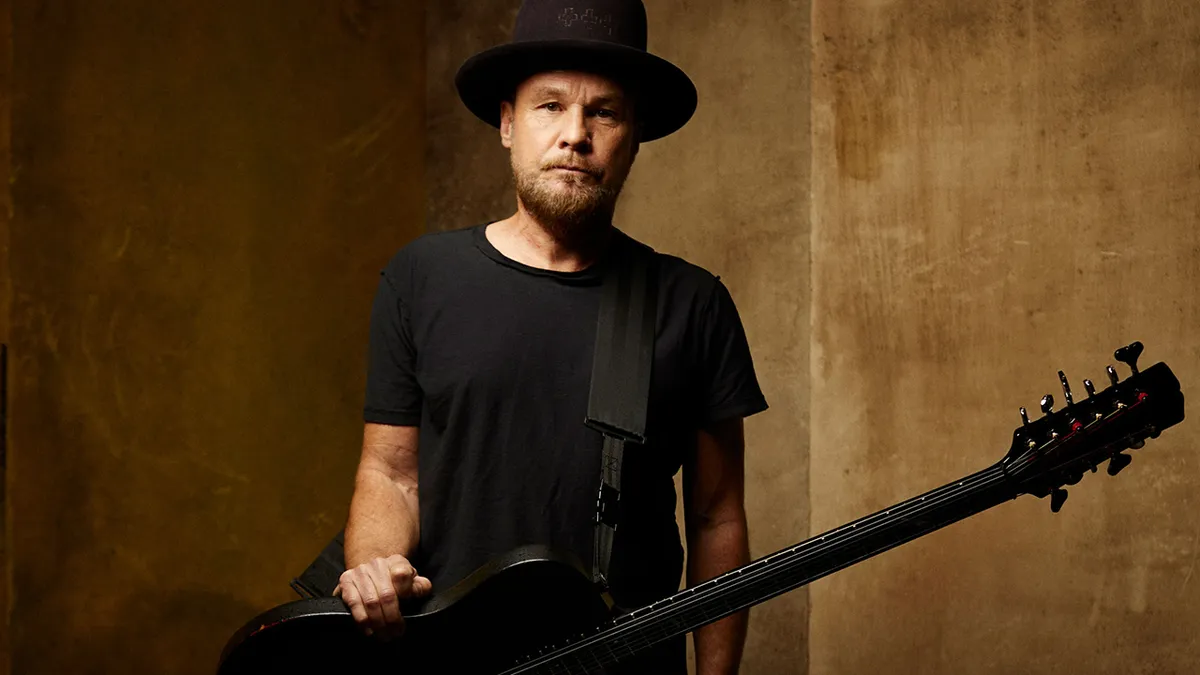
musical limelight, Artie Reynolds has kept
his profile low and his grooves deep. Falling
somewhere between James Brown and Will
Lee in Hardest-Working-Man-in-Show-Biz
ranking, Reynolds has always shunned selfpromotion;
he’s too busy gigging to attend
NAMM shows and bass events, or to pose
for ads. So it’s true to form that Artie now
stands in the shadows on TV’s No. 1 show,
American Idol, hatted, with hips swaying
behind the contestants, still purveying precision
pocket, and still relatively unknown.
Except to insiders like Idol musical director
Ray Chew and judge Randy Jackson: “Artie
is an amazing player,” says Chew. “He not
only has the incredible range we need from
the bass chair, he knows when to bring the
fire and when to bring the sensitivity. He’s
low key and a true professional. It’s a joy to
have him on the team.” Randy Jackson adds,
“Artie is just an unbelievable bass player; dude,
he’s the real deal. I always have an ear on
him. Idol is the greatest show and he’s one
of the unsung reasons why it stays great.”
Born and raised in the musically rich
Jamaica section of Queens, New York, where
his dad was a noted singer and bandleader,
Reynolds recalls his folks’ Motown and
Philly Soul records (as well as classical
cartoon music) as the genesis for trying his
dad’s guitar. In junior high he began playing
trumpet and realized his fondness for bass, leading him to buy a semi-hollow Baldwin
from his dad’s bassist. Inspired by Verdine
White and Louis Johnson—“I would go to
their concerts with binoculars and watch
their hands”—and with formal lessons from
Mel Bay author Ronny Lee, Reynolds was
soon working with his dad and other local
groups. Landing his first major tour in 1984
with Freddie Jackson, Reynolds began a road
and recording run with such artists as Alex
Bugnon, New Edition, Najee, Mariah Carey,
Alicia Keys, and Patti Austin. In 1999 he
joined Ray Chew & the Crew, after Chew
heard him with guitarist Jonathan Butler.
The band anchored NBC’s Showtime at the
Apollo to its conclusion in 2008, and played
the 2008 Democratic National Convention
and President Obama’s 2009 inauguration
before Rickey Minor recommended the unit
to Idol upon his departure in 2010. We
attended American Idol in mid March to see the Crew in action and to get Reynolds’
rap about his unique live television role.
What do you find to be the greatest challenge
of the Idol gig?
Focus and retention, because it’s live TV and
there’s no room for mistakes. We’re constantly
learning songs and then playing them with
shortened, altered forms, so you have to be on
your toes. Aside from the vocals, bass is often
the loudest signal in the mix; if you make a
mistake it goes out to millions of homes—that
big, long, wrong note is forever! People know
the iTunes versions of the songs and hear how
good the Emmy-winning sound is on the show
and they assume we’re lip-syncing, but we’re
playing live up there at all times. In the heat
of battle, tunes change on the fl y, and there’s
not always time for the arrangers to come up
with complete charts until later. It may just be
a road map with chords, so I’ve got to know the original bass line. Our strong point as a band is having a large repertoire and being
able to retain quickly—hear it once and go.
What’s the band concept when it comes
to covering the songs?
Basically, we try to be accurate to the
original and the elements that made it work,
yet at the same time add the new flavor the
producers or the contestants want to present.
It depends on the song too; “I Will Always
Love You” needed to be a straight-up homage.
On the other hand, we’ve done “Time After
Time” as a rocker, “September” as a ballad,
and “Born This Way” as a country song. Also,
the iTunes full versions done in the studio tend
to be more laid back and safe, but onstage
Ray will remind us to loosen up and play. The
other day I played a fill on “I’m So Excited”
and I looked at our drummer Rex [Hardy] and
laughed, “That lick had no place in this song!”
But when I heard it back on TV, it worked.
What’s the key to copping an authentic
phrasing and feel on covers?
For me it was coming up in my dad’s wedding
and party band playing all kinds of music
with veteran musicians who each specialized
in a different style. I was determined to play
a rock tune or a jazz tune like that was the only music I played. And it quickly dawned
on me that the more genres you know, the
more you’ll work. You have to start with
an appreciation and respect for all forms of
music; most cats aren’t into enough idioms
to want to know the nuts and bolts of each
process. It comes down to having a passion
and curiosity for how a bass line works and
why it sounds different from anything else.
Beyond the notes, what is the bassist’s thought
process, their attitude, where is it played on
the neck? When you dig that deep musically,
you open up whole worlds. You start to hear similarities and learn what to listen for; you
get to the essence. Ultimately, it’s about finding
the love in the performance. That’s what
has always worked for me.
Generally, you use one bass for everything.
There really isn’t the time or space to
switch out basses, but my career has always
been about having one good workhorse
instrument. People tend to hear bass the same
way from genre to genre, and the nuances
of different basses tend to get lost in mixes
anyway. As long as you approach the music and the feel authentically—plus, there’s obviously
a lot you can do with your hands. What
has surprised me is I didn’t think I’d use my
Fodera Emperor for everything, but I do. I
go single-coil mode for R&B, vintage, and
slapping stuff, and when we do country and rock, using dual-coil mode and bringing up
the mid-boost on the preamp gives me a fat
sound that really cuts through all the guitars
and sits nicely in the TV mix. It also adds a
singing presence on ballads. What you hear
on TV is the bass direct. I’ve used the Emperor
on every iTunes studio track this year, too. All
I did was add foam for one rockabilly song.
What have been some of your favorite
playing moments over your two seasons?
Last season I really enjoyed all the songs for
the Michael Jackson and the Motown-themed
shows. Obviously, getting to meet Bob Babbitt
was a huge honor. We hung out and took
photos, and he was very complimentary of my
approach to those tunes. This season it was a blast playing Mary J. Blige’s single “Why”
with her; that’s a bass-heavy track played by
Jerry “Wonda” Duplessis [see Transcription,
page XX]. I had fun with DeBarge’s “I Like
it”; that’s right up my alley. I’m proud of the
country performances; I really try to get into
a Nashville head. Recently, Billy Joel’s “Only
the Good Die Young” was a challenge—to make the song happen, the walking bass line
needs to feel just right and not be too jazzy.
What’s your interaction with Randy
Jackson?
Randy has shown me love from day one,
which is a thrill considering what an amazing
bassist, musician, and producer he is.
When I see him backstage he’ll give me a
hug, and he has tried out my basses. During
the show, he’ll look up and point to me and
smile, and give me the peace sign across his
chest. Steven Tyler gave me a shoutout last
year before he even knew my name: “I hear
you, bass player!” Nigel Lythgoe, the show
producer, has a long musical background,
too; he caught me in the hallway once and
said he loves when I slap, that it reminds
him of Mark King. Everyone here is very
supportive and they all know their music.
What are your musical goals beyond
bass ace?
I’m somewhat of a computer nerd; I
recently got my Pro Tools certification.
I’d like to eventually do more songwriting
and production work so I can cut back on
live gigs and play bass more for fun. To be
somebody’s in-house Pro Tools operator/
producer/bassist would be ideal. We’ll see;
I’ve always believed you take the
path before you. The Lord has
his plan for you.
IDOL TIMELINE
It’s a hectic seven-day work week for Ray
Chew & the Crew at American Idol, during
a season that lasts from early February
to late May. Here’s Artie Reynolds’ daily
breakdown, for a week that begins each
Friday.
Friday Contestants pick songs and
present them to show mentor Jimmy
Iovine, backed by a second band (due to
the full schedule of Chew & the Crew). At
6 PM, Reynolds and Crew arrive at Interscope
Studios in Santa Monica to record
the basic rhythm tracks for the selected
contestant songs that will be performed
as a group or duo. They record both long
versions (for iTunes) and the short versions
to be performed on the show (for
the contestants to practice to).
Saturday Record long- and short-version
rhythm tracks for each of the contestents’
solo songs, all day at Interscope.
Sunday Record vocal, string, and horn
overdubs on all rhythm tracks at Interscope,
as well as any fi xes or overdubs for
the Crew.
Monday All-day rehearsal at CBS Television
City, Stage 36, in the Fairfax District
of L.A. This is to get audio sounds,
for contestants to practice their songs,
and for show producers to get presentation
ideas.
Tuesday All-day technical run-through
at CBS Stage 36 for set changes and fi -
nal scripting. Tuesday night is usually a
rehearsal at Interscope for guest artist
performances.
Wednesday Early afternoon dress rehearsal/
camera blocking run-through at
CBS Stage 36. Following a meal break, at
5 PM Pacifi c time the two-hour show goes
live (broadcast on tape delay to the West
Coast).
Thursday CBS Stage 36 in morning
lockdown for elimination vote tally. Chew
and Crew arrive at noon to prepare and
rehearse a number of possible “swan
songs” for the contestant who is eliminated
that night. At 5 PM the one-hour
“elimination” show goes live. On Thursday
night the band gets a breather, often
partaking in a group bowling outing.
AMERICAN EARFUL
Through 13 weeks of American Idol, Season 11, Artie Reynolds has been his chameleonic self, authentically issuing rock, R&B, country, singer/songwriter,
and dance/hip-hop grooves on bass guitar, with a dash of keyboard bass and upright. It’s when a song gets “fl ipped”—that is, given an entire
new feel and arrangement—that Reynolds is able to step out with more of his creative stride. The examples below echo what Artie typically played
on contestant Reed Grimm’s late-February version of Maroon 5’s “Moves Like Jagger.” Says Reynolds, “The half-time, jazz/funk shuffl e was Reed’s
idea, and even before Ray approved and arranged it, I knew how I was going to play it.”
Example 1a shows the opening unison riff and the fi rst four bars of groove. “I would describe the feel as Bootsy’s ‘What’s a Telephone Bill?’
or ‘Munchies for Your Love,’ but with the swing of Marcus Miller’s ‘Tutu,’” smiles Reynolds. Example 1b begins at the percussion solo, which ends
with the unison fi gure in bar 4 and sets up the modulation. The vocals return in bar 6, as Artie ups the energy by playing more of the subdivisions
in-between the established bass line pattern (bar 7 and the end of bar 8), and by adding an ear-rousing fi nger-plucked fi ll at the end of bar 9. He
advises, “It’s laid back but with a hard pocket, so be sure to breathe and keep it fl owing.”
GEAR
Basses Fodera Emperor
5-string, fretted and fretless
Fodera NYC 5-strings
Keyboard bass Roland Gaia SH-
01, Moog Little Phatty Stage II
Strings Fodera stainless steel
roundwounds (.045, .065, .085, .105, .125)
Rig Aguilar DB 751 head with two GS 212
cabinets
Direct Box Radial Bassbone
Headphones Beats by Dr. Dre, PRO and
MIXR over-the-ear and in-ear monitors
Other Freehand Systems MusicPad Pro
Plus Electronic Music Display
SELECTED DISCOGRAPHY
American Idol: Season 11 [iTunes]; American
Idol: Season 10 [iTunes]; Alicia Keys,
Diary of Alicia Keys [J Records, 2003];
Mariah Carey, Butterfly [Columbia, 1997];
Bobby Womack, Raw [Truth, 2010]; Ray
Chew, Feelin’ It [Charu, 2002]; Najee,
Share My World [EMI, 2004]; Alex Bugnon, Head Over Heels [Alliance, 1990].