Basso Cantante,Continuo Chris Squire's Singing Bass Rings Again With Yes

 
Brian Fox


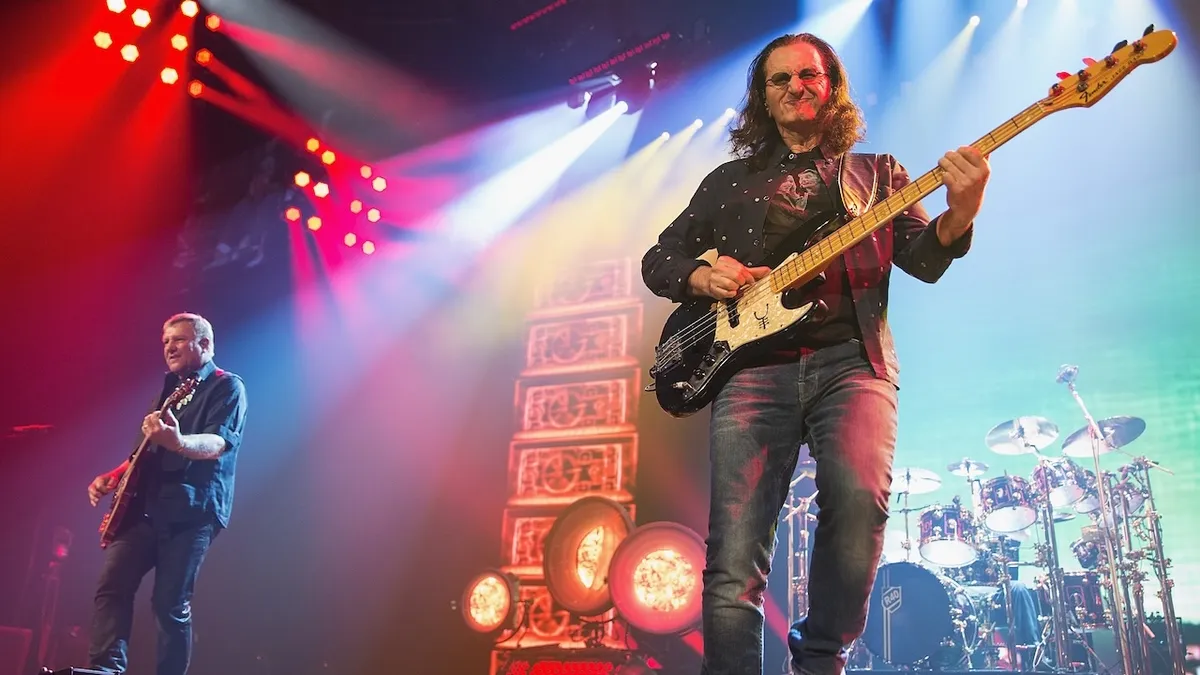
Both a serious student of harmony and a hardened disciple of rock, Chris Squire has made the most of his dual persona with Yes, the progressive rock titans who’ve personified the genre for 40 years: complex, ethereal, dynamic. From the band’s early-’70s heyday through its New Wave reinvention and modern-day revival, Yes has always had a sound solidly tied to Squire’s crisp, clarion bass tone.

Squire’s strong stand on Yes’s sonic foreground has made him a hero to some, a curiosity to others. His playing embodies a certain rakish recklessness—a bright tone just shy of abrasive and a chugging rhythmic disposition prone to speed. Yet it’s tempered by Squire’s choir-like composure, gleaned from years of choral singing. His solos are dazzling, but Squire seems strongest when his sizzling riffs offer support under his bandmates’ improvisatory flights. When his contrapuntal inventions play against the band’s dreamy melodies, Squire’s on fire. So when Chris and company invited BASS PLAYER to check out rehearsals for Yes’s current In The Present tour, we came like moths to flame.

CHOIRMASTER SQUIRE

Waving his Rickenbacker like a baton, Chris runs drummer Alan White through tricky numbers from the Yes’s back catalog. “How does that one go,” asks White as Squire calls a tune. “I think it’s in A,” muses Squire, as the two quickly bring each other up to speed. This particular rehearsal is a strange one—guitarist Steve Howe and new keyboardist Oliver Wakeman (son of longtime keys player Rick Wakeman) are off gigging abroad, leaving Chris and Alan to enlist local guitarist Johnny Bruhns to fill in. There’s also a new face at center stage; After medical problems forced Yes frontman Jon Anderson to cancel the band’s last tour, Squire, White, and Howe decided to move forward this year with a replacement vocalist. Introduced to Squire via YouTube and lifted from a Yes tribute band out of Montreal, singer Benoît David has stepped in as a sort of understudy as Anderson recovers.

The tour is less than two months out, and there’s limited time to get it all together; the group will gather just once more before taking to the road. But Squire, in the midst of a move from London to Arizona, seems unfazed. Sliding up to his mic, Chris coaches David through some vocal parts. “No, that’s my note—find another one!” he teases Benoît, whose command of the material is impressive. David’s selection as vocal substitute suddenly appears a no-brainer; his voice bears an uncanny aural likeness to Anderson’s. Putting down their instruments, Chris and the guys gather to check out a new song demo of Squire’s. Singing in Benoît’s ear, Squire unleashes a sprawling, soaring medley that would befit any of the band’s early records. I look down at my notes and scrawl the only thing that rings through my addled brain: This is awesome!

How are you building the set list for this tour?
We’re going to be doing the popular songs that people have liked through the decades, and we’ll also do tracks from the Drama album, which we recorded with Trevor Horn on vocals and Jeff Downes on keyboard. That version of the band only lasted for one album and did about a year’s worth touring. That was the only time we ever played those songs, because when Jon Anderson rejoined the band in the early ’80s, we didn’t do the songs he hadn’t been involved in creating.

What was the song you were just rehearsing?
That’s something completely new, because fans haven’t had any fresh Yes music in a long time. While I’ve been living in London for the last three or four years, I’ve been working on music—that’s one of the songs.

Might you play any material from your 1975 solo album Fish Out of Water?
That’s a very good question. I’m not ruling that out, because I’ve actually started to play that stuff again. In 2006, I was asked to play at Rickenbacker’s 75th Anniversary, and the guys from Spock’s Beard—who are fans of Yes and fans of mine—were made available to me as a band. We played the first few songs from Fish Out of Water, and they turned out really well.

Back in London, I’ve been working quite a lot with Steve Hackett, who played guitar with Genesis in the ’70s. We’ve been working on new material together and we’re planning to go out and do a tour together, probably in the spring. On that tour we might do some Fish Out of Water songs.

How did you first meet up with Hackett?
Last year, I decided to make Chris Squire’s Swiss Choir, an album of Christmas carols I’d sung as a kid in choir. I did it with my friend Jeremy Stacey on drums and Gerald Johnson on keyboards, and we combined a classical choir with a prog-rock rhythm section. Jeremy is the one who first suggested working with Steve. The whole thing turned out great, and it’s started a relationship that’s now become a writing partnership.

You’ve played the same Rickenbacker for over 40 years. What is the story of that particular bass?
I bought it in 1964 when I was 15 or 16. I left school and I went to work as a sales assistant in a music store that was an English importer for Rickenbacker. When the first few instruments came over, Pete Quaife from the Kinks bought one, John Entwistle bought one, and there was one bass left. I asked the manager if I could get an employee discount, and he said, “Sure.” I’ve had it ever since.

During its history it’s been through various stages of decoration. It had “flower power” wallpaper stuck on it, and then in the process of removing all that sticky stuff, it got shaved down by an old Chinese guy in London who used to work on guitars. After that, it had some reflective silver paper stuck on it and then later removed. From the wood being stripped so many times, the bass actually lost a lot of weight. That has a lot to do with why that particular bass sounds the way it does.

When I became famous with tunes like “Roundabout” [Fragile, 1972], lots of guys ran out to buy Rickenbackers to sound like me, but they didn’t always get rewarded with the same kind of sound. Since I used Rotosound strings, the story goes that the guys at Rickenbacker got rather upset at me. Because people were putting Rotosound roundwounds on their Rickenbackers, they were wearing down the softer fretwire on those earlier basses. When I first visited the Rickenbacker factory, I thought I was going to get a hero’s welcome. But they were like, “Come take a look at our repair room,” where they had a hundred basses that had been returned. [Laughs.] We have a good relationship now, but originally we had a rocky start!

How did you get turned onto Rotosound strings?
The first person I knew to use them was John Entwistle. As far as I remember, he was very responsible for developing them with James Howe, who originally started the company. John said to James Howe that he wanted the bass to sound more like the low end of a grand piano, and that was that. I’m a died-in-the-wool Who fan since I was a teen, and I always loved John’s sound, so I tried the strings, too.

You’ve become famous for your pick technique, but you seem to vary your right-hand playing position quite a bit when you play.
I’ve developed a technique over the years where I hold the pick very close to my thumb. I hit the string with the pick, but then a millisecond later, I hit it with my thumb as well. That way I get the attack from the pick, but sustain from my thumb. Sometimes I just play with my fingers, but I’ve never been as proficient as someone like John Entwistle.

How do you write your bass lines?
When I’ve written with Jon Anderson, I’ve listened to his ideas and let them suggest bass lines to me. When I write my own songs, I tend to do it more on keyboard than bass or guitar, and I tend to figure out the bass line after I’ve written the song. But sometimes I write a bass line first and then invent a vocal melody—it happens all different ways.

Who are your biggest harmonic influences?
I got a big education from my years in church choir, which had a really good choirmaster. He taught us a lot about the relationship between vocal lines and bass lines in a choir setting, and I think I adapted a lot of that knowledge into playing bass and singing. I’ve always been very aware of the relationship between the bass and the top melody line. The Beatles were a fantastic band, harmonically, and so was Simon & Garfunkel.

What kind of music do you tend to listen to when you’re not playing?
One of my favorite bands is the Red Hot Chili Peppers. They’re a great band live. No Doubt is one of my favorites, and I hear they’re getting back together to do a new album.

Do you listen to much jazz?
When I was a kid, there was a lot of blues and jazz around me, so I guess I have a pretty broad spectrum of jazz knowledge. But I was never as big a fan of crazy avant-garde jazz as Bill Bruford [Yes drummer, 1969–1972].

You recently sat in with the Foo Fighters. How did that happen?
I’ve known [Foo Fighters drummer] Taylor Hawkins from around town when I lived in Los Angeles. We would run into each other at the Rainbow Room or the Key Club on Sunset. When the Foo Fighters were in London recently, they jammed with Jimmy Page and John Paul Jones. Taylor invited me to stop by, but I couldn’t make it. When he heard we were back in town, Taylor stopped by and said, “Hey, we’re playing a show in Vegas—why don’t you come jam with us?” So I did. We played “Cold Day in the Sun,” which is one that Taylor sings. It was a great night, they’re a fun bunch of guys, and I like a lot of their tunes.

You and Benoît David will be singing vocal harmonies together. Will that require a lot of work beforehand?
I don’t think there’s much we’ll need to do, because Benoît has been used to playing the Jon Anderson role in his own band. We’ll just go through a few things beforehand.

How is the Yes of today different from the band 30 years ago?
I don’t really know how to answer that. I’m surprised, first of all, that Yes is even 40 years old. It’s an incredible length of a career. I’d never have thought there would be a demand for all these years. But there is, and it’s great.

I’m sure we play with a little more maturity as we get older, but I love the whole feeling of playing to an audience and getting them excited, and when the audience feeds that back to you, it’s what makes a great show. But as for how we’re different, I don’t know. You’ll just have to come and see.

LEARN TO PLAY “LONG DISTANCE RUNAROUND” BY YES

“‘LONG DISTANCE RUNAROUND’ WAS A QUITE simple, funny song,” says Chris Squire of one of Yes’s most enduring radio hits. “I’ve always found it surprising that it ended up one of our better-known pieces.” Anchoring the side two of Yes’s seminal Fragile album [1972], “Long Distance Runaround” sees Squire juxtaposing steady eighths with herky-jerky rhythmic stabs on bass. Along with the band’s other Fragile smash, “Roundabout” [see lesson in November ’07 and video at bassplayer.tv], the tune showcases Squire’s aggressive pickstyle tone.

After the introduction’s nine bars of contrapuntal interplay between guitarist Steve Howe and keyboardist Rick Wakeman, Squire kicks the song’s groove into gear with a tightly woven chromatic pattern (Ex. 1, bars 1–2). While these notes may ring longer and sound more open when played in 1st position, try playing them midway up the neck as shown here—the notes will fall more easily under your fingers, and you’ll get much more low-end punch. The challenge in this part of the line lies in keeping those eighth-notes steady, so get your picking-hand motor running and bust out that metronome! In bar 20, Squire sets up the verse with a cool upper-register trill. To nail it, finger the high F# on the 11th fret with your index finger and follow it up by middle-finger hammer-ons and pulloffs at the 12th fret.

Ex. 2 shows Squire’s spacious verse line. “Jon wrote the song on guitar,” says Chris, “and when we started to work it out, we settled on the keyboard part holding down those chord changes [Ex. 2, bars 1 and 9]. Between Steve and myself, we figured out how to interject that stabby little bass guitar part [Ex. 2, bar 2]. As the keyboard part became consistent, we found ways to play in and around it. I’m sure [drummer] Bill Bruford had something to do with that; he was always keen on not playing anything in a linear fashion.” Once you’ve found your rhythmic footing in bars 1–4, check the recording to dig Bruford’s snare cracks, which land on every fifth quarter-note. Wild! When the tight rhythmic feel opens up at bar 19, Squire’s ratty tone pops out for those staccato quarter-notes. At bar 26, Chris spits out a “simple” Bb scalar run before repeating the verse figure. Music theory in practice never sounded so cool!

GEAR

Basses 1964 Rickenbacker 4001, ’70s Fender Jazz Bass, Lakland Bob Glaub, Mouradian CS-74 Rig Marshall Super Bass, SWR Bass 350, and Ampeg SVT-2 PRO heads; Samson UR-4 and UR-5D wireless systems

Effects ART SGX Nightbass, Sound Sculpture router, MXR 1500 digital delay, Korg Digital Reverb, E-mu ESI-2000 sampler, X-15 Ultrafoot controller, Furman PL1 Power Conditioner

“My pedalboard almost qualifies as vintage,” chuckles Chris Squire as he eyes his gear for the current Yes outing. “It was made in 1983 by a guy who went on to build SSL recording decks. It was a custom board that I worked on with him as he made it from scratch. But it’s now 25 years old and it’s not without its problems.

“I originally had a set of Dutron bass pedals that were made in Italy in the ’60s and ’70s,” Squire continues. “Later on, when Bob Moog made his Taurus pedals, I had those as well. As time progressed and sampling came into fashion, I took those Dutron and Taurus pedal sounds and blended them into one sampled sound for each note. Now when I play that keyboard with my feet, I’m actually triggering the samples.”

Even before Rickenbacker introduced its Rick-O-Sound output jacks (which allow players to send individual signals from each of a Rickenbacker’s two pickups), Squire had his bass wired so he could have individual outputs for each pickup. “I didn’t do it because I wanted to play in stereo,” says Squire. “It’s because I loved the fuzz tone I could get from the bass [neck] pickup, but with the bridge pickup, the fuzz was horribly nasal sounding. All of my guitars have stereo outputs for that reason. With new innovations through the years, these little nuances have come into play and been part of my development.”


Leave a Comment
Name:
Location:
Average Rating :
 

Earl Greyhound Kamara Thomas: On Going All In

Deftones Sergio Vega On Working As A String Section

Expanded Horizons: Sean Hurley On John Mayer And The L.A. Session Scene

Aguilar AG 5J-60 Pickups

Anthony Jackson Gets Down


What does your typical practice routine involve?
 
Subscribe Live Bookmarks Advertise Contact Us Privacy Policy Terms & Conditions


Bass Player is a trademark of New Bay Media, LLC. All material published on www.bassplayer.com is copyrighted @2009 by New Bay Media, LLC. All rights reserved