Main Site Navigation

Your current location
BassPlayer.com >> This Month >> Darryl Jones Stone Unturned

Jazz cat or rock star?

Darryl Jones Stone Unturned

| July, 2005

Some pigeonhole the 43-year-old as a “jazz cat,” most likely because his first big professional gig was with Miles Davis in 1983. Others say “rock star,” because for the past ten years, he’s held down the bottom with the Rolling Stones, including this year’s new album and farewell tour. Darryl doesn’t even know the


Some pigeonhole the 43-year-old as a “jazz cat,” most likely because his first big professional gig was with Miles Davis in 1983. Others say “rock star,” because for the past ten years, he’s held down the bottom with the Rolling Stones, including this year’s new album and farewell tour.

Darryl doesn’t even know the answer himself. “I straddle the fence. Once I was playing with Miles at a festival with the Modern Jazz Quartet, and one of those guys came up to me and said, ‘I really don’t like rock music, but I like the way you play rock.’ Another time, I was recording with [guitarist] Carlos Alomar, who had played with David Bowie for a long time, and the guys at the session were all rock guys. At the end of the session, one of them came up to me and said, ‘Listen, man, I don’t dig jazz, but I like the way you play jazz.’ In a way, I’ve been this wandering musician, moving from one idiom to the other, and I’ve been influenced by all the people I’ve worked with.”

And Darryl has worked with a lot of people. Over the last 20-plus years, the Chicago-born bassist has graced the stage and/or the studio with Sting, Madonna, Peter Gabriel, and Eric Clapton, among others. But the whole rock-star thing truly took root a decade ago, when he replaced Bill Wyman as the Stones’ bottom-dweller.

Born in Chicago on December 11, 1961, Darryl took up bass at age nine, after seeing a neighbor thumping away at a local talent show. Already sporting a huge sound and glue-like lines, Jones quickly established himself on the local scene, gigging with such Windy City heavies as soul-bop guitar hero Phil Upchurch. Drummer Vince Wilburn, a Chi-town compadre, had Darryl audition for his uncle’s band—that uncle, of course, being Uncle Miles. After acing what was easily the most memorable audition of his life, Jones played with the “Prince of Darkness” for two years, garnering notice for his work on Davis’s two finest late-career records, Decoy and You’re Under Arrest.

Near the end of Jones’s tenure with Davis, Sting asked saxophonist and former Davis sideman Branford Marsalis to put together what was, in effect, an all-star jazz-cat backing band. Marsalis told his new employer that Darryl would make an excellent addition to his adventurous post-Police band; Sting agreed, and Darryl’s rhythmically and harmonically bold playing on Dream of the Blue Turtles justified everybody’s faith.

As Darryl eventually learned, you can take the cat out of jazz, but you can’t take the jazz out of the cat. During the late ’80s, itchy to get back to his instrumental and improvisational roots, Jones worked alongside guitarists Mike Stern, John Scofield, and Hiram Bullock, plus he anchored the rhythm sections of Herbie Hancock’s Headhunters, Steps Ahead, and the Gil Evans Big Band. After tightening up his pop chops with Madonna and Peter Gabriel, he hooked up with the Stones in 1995, and he’s been painting it black ever since.

In the midst of preparations for the Stones’ four-month cross-country trek—his fourth tour with Mick, Keef, and the boys, and supposedly their last—the dreadlocked, baritone-voiced bassman took time out to reflect on his career.

You’ve played in venues of all shapes and sizes, and now you’re headed out on another arena tour. What do you do differently at a small place like the Jazz Bakery in Los Angeles, versus a stadium like Chicago’s Soldier Field?
It all depends on the song, basically. If it’s a mellower tune, I’ll use the same touch at the Jazz Bakery as I would at Soldier Field. If I’m playing something that’s really hard-rocking in the large stadium, I’m going to touch the bass a different way. Rock & roll doesn’t require the same sort of left-hand dexterity, so I tend to use more of a “monkey grip” when I’m playing rock, because I don’t have to get to as many notes as I would if I were playing [Charlie Parker’s] “Donna Lee,” or some kind of bebop lick. Grabbing the bass around the neck facilitates a different kind of feeling. I’m not trying to do anything real intricate. I’m only using the amount of technique necessary for me to play a particular song. So the song dictates my approach.

When you first started playing, did you ever envision yourself onstage at Soldier Field?
Actually, I did. In the early ’70s, before I started playing bass, my mom took me, my brother, and a couple of kids from around the neighborhood to see James Brown at Soldier Field, and it got to be a real dream of mine to play there. When I started to dream about what I wanted to do musically, I never dreamt of being James Brown, I wanted to play with James Brown, Michael Jackson, and all those different people. I always wanted to play with the best bands. In a way, the Rolling Stones gig is the culmination of those childhood dreams; I figure now that I’ve played with Miles, Sting, Herbie Hancock, Peter Gabriel, and Madonna, I’ve pretty much covered it. And because of that, at this point in my life, I’m thinking now it would really be cool to start performing my own music.

Tell us about your music.
It guess it would be best characterized as “aggressive music.” Like, there’ll be an R&B tune on the record, but it’ll be aggressive R&B. There’ll be a reggae tune that’s also a little more aggressive. Working with the Stones has affected not only the energy of my compositions, but also the makeup. Many of the songs I’m working on now don’t have as sophisticated harmonies as the stuff I wrote before I started working with them ten years ago. That isn’t to say there aren’t elements of jazz in the music, too, but I had been composing at the piano, and now I’ve been composing on guitar—specifically on a Telecaster that’s strung up with only five strings, like Keith’s, in a G major tuning. I did the basic demos by myself in my home studio, but for the final product, I’ll have a little help from some friends, like [percussionist] Mino Cineula, and [drummers] Charlie Drayton and Vince Wilburn.

Speaking of Vince, tell us about your audition for Miles.
I got a call from Vince late in May 1983. He said, “Listen, man, Miles wants to hear you play over the phone.” I put the phone down and ran around the house looking for my great 1966 white Jazz Bass, before I realized I had left it in the trunk of my car. At that point, I went back to the phone and said, “Vince, hold on a second, I’ve gotta go get the bass.” He said, “No, you hold on,” and Miles gets on the phone. He said, and this is all verbatim, “Darryl, when can you be in New York?” This was on a Monday, and I didn’t want to appear too eager, so I told him Wednesday. Then he said, “What’s gonna take you so long? You gonna walk?” I told him I’d be there first thing Tuesday morning, and then I asked if he still wanted me to play for him over the phone. He said, “No. You can play, can’t you?” At that point in my life, when anybody asked me if I could play, I would be very self-effacing and say, “Well, I can play a little; I’m okay,” trying to be modest. But when Miles Davis asked me that, for the first time ever, I said, “Yes. I can play.” He said, “Good. And if you can’t, I’m kicking Vince’s ass.”

So I flew to New York the next day, and Vince had me meet him at an apartment on 71st Street—315 West 71st Street, to be exact. You remember those kinds of things. I was waiting for them out front, and this gray limo pulls up, and Vince gets out, and Miles gets out. Then we walk into the lobby of the building, and Vince says, “Miles, Darryl. Darryl, Miles.” Miles looks at me, then says to Vince, “This is a weird-looking dude.” We went upstairs, and Miles asked me to play a really slow Bb blues. I started to play, and he grabbed the neck of the bass and said, “No, real slow.” I started again, and he grabbed the neck again and said, “No. I mean reeeeeeal slow.” So I sat in there for three or four minutes, just walking this slow B blues. Then he played me a tape of one of their recent gigs and said, “Play along with this. You don’t necessarily have to play what the other bass player is playing. Just play something that you think will fit.” After a few minutes, he shut off the tape and walked into the bedroom with Vince. Vince came back out after a few minutes and said, “Yo, man, you got it.” I said, “No, Vince, I want him to tell me.” Miles came out, and he play-hit me on the shoulder—he used to box—and confirmed, “You got it.”

Miles always made it a point to impart his wisdom on his young sidemen. What are the most important musical lessons he taught you?

Miles taught me to listen. It’s real simple, and everybody knows you have to do it to play music, but so few people do it in an active way. That doesn’t mean when somebody plays an accent, you jump all over it. Sometimes when a guy plays an accent, you should ignore it, but you ignore it from a place of consciousness. That was the first lesson. One of the last lessons came when he brought in some new sidemen and reordered the music. Instead of becoming more comfortable about what I was going to play, he made me less comfortable, because he would throw out so many different things at the end of rehearsal, and I wouldn’t be sure what he wanted. But that opened the door to create all these new and different things. Like, I would come up with a bass line that I thought was slick, but he would take it away from me, and I’d be forced to come up with something else. Once before a show around that time, he called me into the dressing room and said, “Darryl, why are you always answering yourself?” That’s a weird turn of the phrase, but that was his way of telling me I was overplaying, that I wasn’t leaving enough space. I said, “Miles, we’ve got all these new guys [in the band], and I’m afraid we’re gonna have a train wreck, because they’re unsure about what to play.” I figured that since I’d been around a bit longer, I’d play a little more just to make sure it all stayed together. Then he said, “Darryl, you can’t fix that by playing more. In fact, the only way you can fix it is by playing less.” That was the final lesson.

What is it about your bass playing that’s attracted such a disparate batch of musicians?
A few years ago, a friend from my neighborhood said to me, “You realize that part of the reason you play music the way you do is that you came from a two-radio home.” When I asked him what he meant, he said, “I know your mom was listening to James Brown and the Temptations and all that stuff on [Chicago soul station] WVON.” Ironically, every once in a while you’d hear a Stones song like “Angie” or “Satisfaction” on WVON, but it was basically all black music. My friend also noted that my dad always listened to jazz on WBEE and public radio, and he played his Miles, Count Basie, and Oscar Peterson records. Because I grew up with those two different sensibilities, I have elements of the Motown thing in my playing, but there are also things I got from Stanley Clarke and Anthony Jackson. I also dug Ray Brown. I didn’t necessarily get stylistic stuff from him; it was more in terms of the groove. I didn’t study any of these players—they just found their way into my blood. I could solidify a groove in these different areas, so that’s probably why I was able to move from one to the other. Like with Sting: That music wasn’t run-of-the-mill rock & roll, nor was it run-of-the-mill jazz, and I was able to provide a solidifying force.

What is the Rolling Stones groove, and how do you make it happen?
It’s a rhythm & blues pocket, but it’s a little looser. That’s not to say it’s less in-the-pocket, but the pocket is wider and not as tight as it might be for some other kinds of music. That took a little getting used to for me. I remember in the beginning, sometimes when [drummer] Charlie Watts would go from section A to section B of a tune, it would feel like the pocket was starting to stretch during some of his fills, and I would make an adjustment. But I noticed when I made that adjustment, I would end up in a place where I didn’t want to end up, because the pocket hadn’t moved as much as I thought it had. Now I solidify it, but I don’t lock it up so tight that it can’t breathe. I always have a great time playing with those guys. It’s lots of fun, and I wouldn’t be doing it if it weren’t. And when it stops being fun, I won’t be doing it.

Can you talk about the Rolling Stones’ compositional process, and your part in it?
The first thing that happens is Mick and Keith get together and throw around different riffs and ideas. Keith once told me that sometimes he’ll play an old tune on piano, like something by Hoagy Carmichael, or a blues tune, and as his hands fall to different places, things will occur to him, and that’s how he’ll come up with a song. Then Charlie comes in and they start doing a little recording, and they start adding people. Recently, I’ve discussed bass lines with Mick more than I ever have, because he’s evolving, and he has a better idea of what he’s looking for in a bass line. Then we’ll try a bunch of different stuff—we’ll try straight eighths, we’ll try partial straight eighths, we’ll try a full-blown line, we’ll try doubling the guitar—until we come up with something he’s satisfied with. Keith is much more hands-off. He just puts the idea out there and lets you develop it in a way that’s more organic to you. The interesting thing about Keith’s writing now is that I can recognize a certain thread that goes through it, and I know a bit about the way he plays bass, so now I have a repertoire of things Keith will do to make the bass line his, to give it those “Keith” characteristics. Like, instead of playing the root note, he’ll play a 3rd lower. I try to add those things to their writing to try and make it a little more Stones-ish.

Do you have any tips on how a young musician could go about landing a job with a higher-profile artist?
When I talk to a young bass player about this kind of thing, it usually starts with them telling me how they’re frustrated with their musical situation, whether it be a high school band, a college band, or a bar band. They’ll tell me they want to do something more, to play with musicians of a higher caliber. I tell them—and this goes back to my lessons with Miles—that if you’re playing with a drummer who has time problems, it’s part of your job as a bassist to figure out how to play with him without fighting him. If a drummer is dragging, you can’t just play faster and think that’ll fix it. It’s about active listening, and making the best choices under the circumstances, and you have to hone that skill. Before you get on a great gig with a bunch of great musicians, the person who’s going to give you that gig is going to see you at a bar playing with that drummer you don’t dig playing with. So you’ve got to figure out a way to make that work, because that’s part of your entrée into the new gig.

Second, be specific about what kind of music you’re interested in playing, and whom you’d like to play with. Pick three or four bands that you really, really want to play with, familiarize yourself with their music, and try to familiarize yourself with their management. You want to do everything in your power to make it easy for the person who’s in charge of hiring the musicians—be it the drummer, the manager, or whoever—to think of you when they think, We need a bass player. There are a number of ways of doing it. First, you go to the band’s concerts and if possible, you meet some of the band. But if that’s not possible, you still have to do as much as you can for yourself, like going and learning the music. You make your own luck by being prepared.

Jonesing For Gear

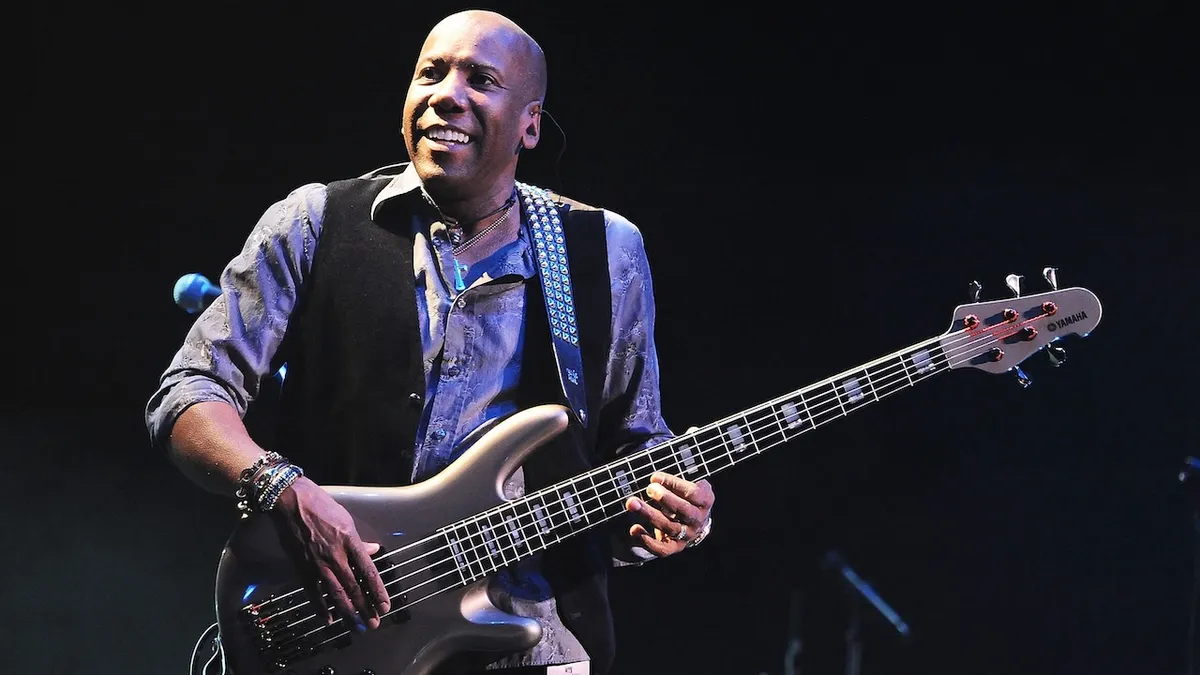
Axe-wise, Darryl’s fave is, logically enough, his black Lakland Darryl Jones Signature J-style bass. He also carries—get out your scorecard—a ’66 Fender Jazz, a ’64 Fender Jazz with a P-Bass neck, a pair of ’60s Fender Precisions, a Lakland Hollowbody, and two Fender Custom Shop Jazz Basses built by Jay Black. Lately, all the plucking is done on R. Cocco strings, except for the Hollowbody and the ’66 Jazz, which sport DR flatwounds.

On the Stones tour, the band plays two sets on two different stages. The “A” stage setup goes like this: Rocktron loop switcher to two-channel Shure wireless, to an Ashly preamp, to a Meyer crossover, to two Crown power amps, to Meyer Sound tri-amped speaker cabs. Phew. On the “B” stage, which is considerably smaller and more intimate, it’s the same deal, except for the fact that it all ends up pumping out of an Ampeg B-15.

For smaller, non-Stones club gigs, Darryl uses a pair of custom Epifanis: one with two 12s, and one with two 14s.

Selected Discography

With the Rolling Stones (all on Virgin) Live Licks;Bridges to Babylon; No Security; Stripped; Voodoo Lounge.
With Miles Davis (both on Sony) You’re Under Arrest; Decoy.
With Sting (all on A&M) Giving Thanks; Bring on the Night; The Dream of the Blue Turtles.
With Eric Clapton Journeyman, Warner Bros.
With B.B. King Deuces Wild, MCA.
With Joe Cocker Organic, Sony.
With Steps Ahead Live in Tokyo 1986, NYC.
With John Scofield Still Warm, Gramavision.
With the Temptations Legacy, Motown/PGD.
With Lou Marini Lou’s Blues, Chase Music.
With Ivan Neville Scrape, Compendia.
With Tania Maria Outrageously Wild, Concord.
With Nickelbag Mas Feedback, Lizard Group; 12 Hits and a Bump, Iguana.
With Michael White Side by Side, Noteworthy.
With Lenny White Renderers of Spirit, Hip Bop Essence.
With Mark Ledford Miles 2 Go, Verve.
With Joan Armatrading What’s Inside, RCA.
With David Murray (both on DIW) Jug-A-Lug, The Tip.
With the Chieftains Long Black Veil, RCA.
With Buckshot LeFonque Buckshot LeFonque, Sony.
With Charles Earland I Ain’t Jivin’, I’m Jammin, Muse.
With Barry Finnerty 2 B Named Later, Cheetah.
With Bemshi Womanchild, Capitol.
With Pee Wee Ellis Blues Mission, Gramavision.
With Carmen Bradford Finally Yours, Evidence.
With Adam Holtzman In a Loud Way, Capitol.
With Robert Irving III Midnight Dream, Polygram.
With Philip Bailey Inside Out, Columbia.
With Andy Summers Charming Snakes, Private Music.
With Randy Brecker Toe to Toe, MCA.


Bass Player is part of the Music Player Network.


This is the end of the page [ Back to start of the page ]