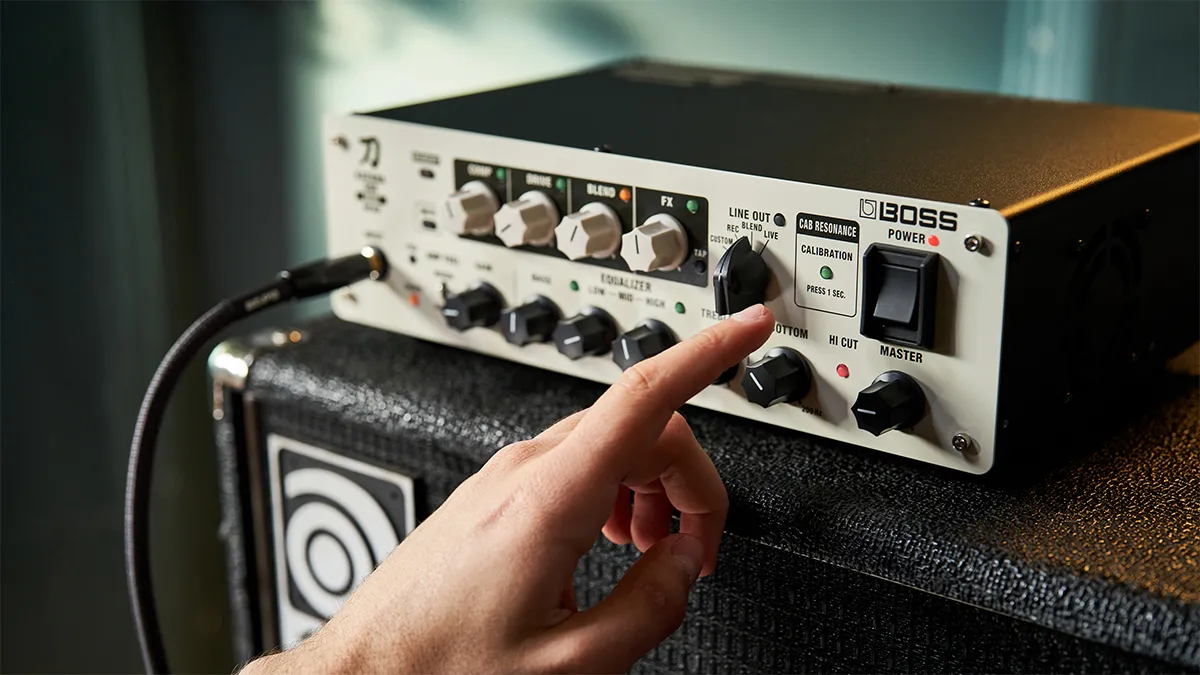
The big deal: Two technologies, switching power amps (Class D or, rarely, Class T) and switch-mode power supplies (SMPS), are revolutionizing bass amps, with blatantly obvious results. Take, for example, the Euphonic Audio iAmp Micro-300, Markbass F1, and Eden WTX-260. Combined, they weigh less than most conventional bass heads, and on their own each is laughably light—under five pounds. The weight savings are due mostly to their lack of a clunky iron-filled linear power transformer, a consequence of the high operating frequency of an SMPS. Class D power amps also help peel off pounds: Their exceptional efficiency means the necessary components are smaller and need less heat-sinking than the (for now) more conventional Class AB power amps. When a SMPS and a Class D amp are combined in a bass head, you end up with ridiculous lightness, as Eden’s David Nordschow attests: “We ended up using a steel chassis for the WTX just to get enough weight so that the speaker cables wouldn’t pull it off a cabinet.”
The weight benefits are inarguable—but you’re saying, “it’s the sound, stupid,” so we snagged three of the hippest, lightest, um, high-techiest heads, slipped them into our man-purses, and hit some gigs.
Euphonic Audio iAmp Micro-300
The Micro-300 is—dare I say—cute, but that doesn’t detract from its high-end look and feel. The components look like the good stuff, especially the pleasingly textured, smooth-turning knobs and rugged metal jacks. EA will have to dream up a better foot design, though, as the little glued-on rubber nubs fell off almost immediately upon arrival. Also, there was a disconcerting rattle when I shook the head that I couldn’t quite pinpoint. I didn’t hear it live, but it can’t be a good thing. The louvered top panel made it easy to peer into the EA’s densely packed guts; doing so reinforced my suspicion that this is not an amp to go poking around in with a searing-hot soldering iron. But should you need repair, you’ll definitely save on shipping.
The iAmp’s SMPS is a proprietary design built for power-factor correction (meaning you can use it all over the world) and quick response. The Micro-300’s power amp is inherited from the Class D unit found in the iAmp 200. Between the SMPS and Class D power amp, that’s some seriously clever engineering, but EA didn’t stop there. The two-channel head features what EA calls IIS, or Intelligent Input Switching. It allows a player to either use one input and switch between the two (perhaps differently dialed) channels or use two inputs with two instruments, or the two outputs of piezo/mic-system acoustic bass. It’s also programmable, via internal jumpers, to change the operational mode of various features. The EQ is a simple shelving/notch/shelving design, and it’s well voiced and musical. The all-important mute switch and all of the iAmp’s connectivity are front-panel located (except for speaker and power jacks). I liked that the iAmp has a tuner send (it doubles as a parallel effects send), but I wish EA had been able to somehow squeeze in an xlr jack for balanced-output duties. The jack is balanced trs, but who knows a sound guy that wants to take a q" send from the bass player? Not me.
The Micro-300 worked proficiently in a variety of settings—even bigger, louder ones where my laziness got the better of me and I didn’t feel like schlepping something more powerful. Its tone-home is dry and arid, with a gritty haze when pushed real hard. It isn’t overwhelmingly bassy or particularly ballsy, but it offers enough clean, clear, and quick bass tone to satisfy almost any small- to medium-size gig. The EQ works predictably; I rarely had a problem honing in on a solid tone. It doesn’t mind being hit hard (I played a few loud keyboard-bass gigs through it), although when left on for a while, it gets mighty toasty and made a nearly inaudible buzzing sound. (Euphonic Audio responds: “The review unit was one of the first models shipped. The excessive heat, slight buzz, and rattle were all related to the power transformer core. We have since redesigned the transformer and resolved these three issues.”)
Power Rating: 325 watts rms into 4Ω; 350 watts rms into 4Ω minimum load
Input Impedance: 1MΩ
Tone Controls: low: ±12dB @ 60Hz; mid: ±12dB @ 600Hz; high: ±12dB @ 8kHz
¼" di output: Differential op-amp driven
Power Amp Topology: Class D
Weight: 2 lbs
Options: Padded Back Pack for Micro-300 and WZ-110, $119
List: $795
Street: $599
Pros: Crisp and clear tone; two-channel design greatly improves flexibility; crazy light
Cons: No xlr output
Bottom Line: An excellent choice for a weight-conscious gigger, especially one who doubles.
Contact: 888-894-3790 www.eaamps.com
Markbass F1
The F1 takes a slightly different design approach than the other two heads here, stuffing itself into a relatively wide single-rackspace chassis. It feels rugged and dense; Markbass didn’t skimp on components. The front panel is a touch cluttered, but it’s nothing that one couldn’t adapt to quickly. The rear panel offers two Speakon outputs, an xlr balanced output with ground lift, and a parallel effect loop. Even though the head is a bit wide, it’s exceptionally portable—I was able to stuff it into a gig bag (the ultimate measure of these tiny amps).
The preamp is straightforward, with the exception of Markbass’s proprietary vle and vlf circuits. Vle (Vintage Loudspeaker Emulator) is a variable lowpass filter and EQ contour—as it’s turned up, highs are reduced and low mids boosted to emulate the huskier sound of vintage gear. I thought of it as the amp equivalent of a passive bass’s tone knob. The vlf is a midrange cut, best for achieving that scoopy slap sound. Otherwise, the Markbass’s no-frills tone shaping is predictable and controlled. One notable absence is a mute switch—this should be standard on every head by now.
Two qualities seemed to define the Markbass’s sound on gigs and in rehearsals. First, it has a buttery-sounding preamp, with toothsome mids and a smooth, syrupy top. That’s not to say it’s a slow responder; rather it delivers sweet, colorful tone with booty-thwacking immediacy. Second, and perhaps more important, it’s loud. Delivering 500 watts into 4 ohms, it doesn’t seem like a lightweight, single-rackspace head at all. It was plenty loud for decent-size gigs. I found it to be particularly strong at quick techniques, like uptempo fingerstyle, that played to its midrange beauty and fast response.
Power Rating: 300 watts rms into 8Ω; 500 watts rms into 4Ω minimum load
Input Impedance: 500kΩ
Tone Controls: low: ±16dB @ 40Hz; low mid: ±16dB @ 360Hz; high mid: ±16dB @ 800Hz; high: ±16dB @ 10kHz
vpf filter: Variable pre-shape filter, cut @ 380Hz
vle filter: Vintage loudspeaker emulator, cut @ 250Hz–20kHz
xlr di output: Differential op-amp driven with ground lift switch
Power Amp Topology: Class D
Weight: 4 lbs, 8 oz
Options: Padded shoulder bag, price TBD; rack kit, price TBD
List: $1,419
Street: $849
Pros: Syrupy, juicy midrange and smooth top; louder than one might think; well-voiced EQ
Cons: No mute switch
Bottom Line: A light head that sounds big for its britches.
Contact: 416-763-1493 www.markbass.it
Eden WTX-260
All right, I’m sure there is no actual nano-technology in the Eden (in fact, I’m not sure I know exactly what that is)—but perhaps Eden used “ramo” technology, as in ramming a rack-load of features into a cigar-box-size container of golden goodness. The head is stuffed to the gills with features, and its density does nothing to compromise its light weight and rugged construction. Hefty knobs, a backlit rocker switch, and solid-feeling push-pull pots all combine for a generally high-end vibe. The WTX packs in a conventional 3-band EQ augmented with a dynamic bass boost designed to compensate for low-volume bass response, a midrange center frequency shift, and adjustable compression. It’s also gig-friendly, thanks to the front-panel mute switch and various accessory jacks. The rear panel is a feature-forest, too, with a robust di output, Speakon and q" jacks, and a footswitch jack for mute and compression control. Eden touts the WTX compatibility with a huge variety of wall-power standards, so consider this a friendly companion on your next international gig.
The Eden has a sweet, subtly edgy tone with a top-to-bottom balance and overall dryness. It sounded precise, clean, and clear, and offered enough volume for small- to medium-size club gigs. The compressor was an excellent addition to a small head like this, as taming the input signal can go a long way toward achieving maximum efficiency from a small rig in a boomy room. The DI output sounded superb, and the level control was a thoughtful addition.
Power Rating: 260–300 watts rms into 4Ω (depends on wall current)
Tone Controls: bass: ±15dB @ 35Hz; mid: ±15dB @ 500Hz–2.2kHz; high: ±15dB @ 2kHz;
xlr di output: Differential op-amp driven with ground lift switch and level control
Power Amp Topology: Class D
Weight: 4 lbs
Options: Rack kit, $32
List: $899
Street: $719
Pros: Extremely flexible preamp with thoughtful, rugged design; clean, clear tone
Cons: Could be a hair louder
Bottom Line: A baby-size head with a daddy-size tool-belt.
Contact: 800-877-6863 www.eden-electronics.com
Brave New World
Want a moment’s entertainment? Log on to an online bulletin board about amps (any kind, bass or otherwise) and start talking up (or dissing) switching amps and power supplies. Emoticons—not just smiley faces—will be recklessly tossed about, people will LOL you to death, flaming your naive ignorance or blind acceptance of the opposite constituency’s side of the issue. Whether or not switching stuff sounds as good as its linear counterpart is what keeps geeks up at night. The way I see it—and the way these three amps prove it—the benefits are too important and the engineers too smart for amps with SMPS and Class D output sections to continue as a design tangent. My guess? You’ll one day reminisce with your grandkid about the time amps used to weigh over ten pounds. He’ll snicker, and pull his 1000-watt head out of his pocket.
Soundroom Policy
We test products in real-world environments, evaluating them with regard to price and the manufacturer’s design intent. Advertising does not influence our product coverage. We invite manufacturers to fact-check product reviews prior to publication, and we print dissenting opinions when applicable. Street prices are approximate.