Mick Karn: Sonic Sculptor
"Words can''t really be trusted," says Mick Karn. "Music is a much truer way to express ourselves than words." Karn''s fretless bass language has a vocabulary of whoops, bends, smears, stuttering funk gestures, gurgling harmonics, and angular Eastern melodies. His dialect might well be called jazz or rock--but his dis
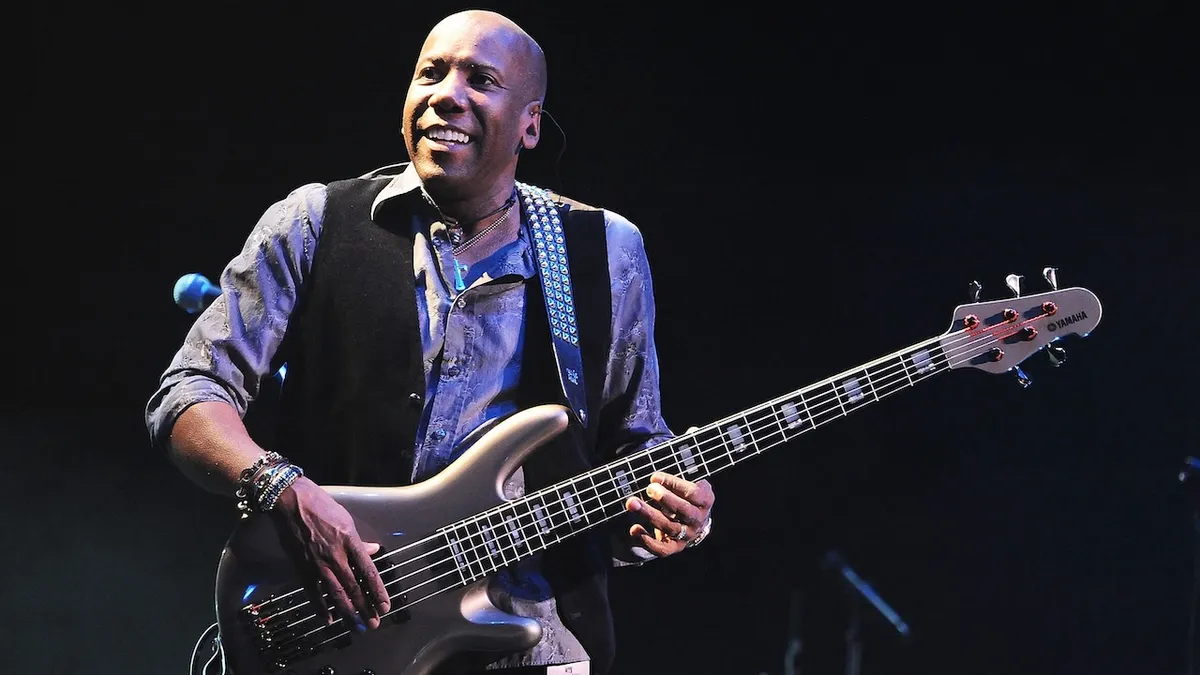
"Words can't really be trusted," says Mick Karn. "Music is a much truer way to express ourselves than words." Karn's fretless bass language has a vocabulary of whoops, bends, smears, stuttering funk gestures, gurgling harmonics, and angular Eastern melodies. His dialect might well be called jazz or rock--but his distinctive bass parlance is the result of his ethnicity, his varied musical background, and an almost militant individualism. An accomplished sculptor who casts weird humanoid figures in bronze, Mick has a musical vision no less intense and intriguing than his artistic one.
Karn, formerly the bassist of the British glam/art-rock outfit Japan, brings a sculptured complexity and wholeness to his funky, snaking bass lines and eerie, exotic soundscapes. This aesthetic has never been so pronounced as on his latest CMP solo album, The Tooth Mother. The record embraces Mick's early love of Motown, his art-rock pedigree, and especially his Near Eastern roots. With David Torn's Indian-flavored fuzz guitar lines, drummer Gavin Harrison's crisp funk snare and percussion, the evocative vocals of Arabian techno-siren Natacha Atlas, and contributions by multi-instrumentalist Jakko Jakszyk, the record shares common stylistic ground with the cutting-edge cross-pollinations of Bill Laswell, Shiela Chandra, Peter Gabriel, and Steve Tibbetts. Karn's low-end voice has also been immediately recognizable in past collaborations with Ultravox's Midge Ure and Bauhaus's Peter Murphy, and in sessions with Joan Armatrading, Kate Bush, Gary Numan, and Nusrat Fateh Ali Khan.
Admittedly limited in technical know-how and barely cognizant of pop and instrumental trends, Karn is nevertheless a monster bassist, though the depth of his talent may only now be coming to the surface. "For a long time I was almost frightened to show my true colors, because I thought it would be too much for people to take," he says in his refined London accent, explaining the mighty, leading bass presence on The Tooth Mother. "Although things were great with Japan, there was always a certain pressure to calm down my playing, because there were other musicians to think of. Having to do sessions to stay alive brought a similar feeling. It's taken me a long time to reach the point I'm at with The Tooth Mother; the bass is really in your face, but it doesn't seem to have offended too many people. I hope it's going to carry on getting louder and louder. Let's see how much bass the people can take!"
BASSOON TO BASS
Born Anthony Michaelides on the Mediterranean island of Cyprus on July 24, 1958, Karn relocated with his family to London three years later; they settled in the rough South London neighborhood of Lewisham, where his father found work as a butcher. Besides having to negotiate a difficult language barrier, Karn was overweight as a child and was sheltered by his overprotective mother. Turning inward to find creative resources to help him communicate where words and social standing had failed him, he toyed with various instruments, including mouth organ and violin, before finally settling on the ultimate cool-guy axe: the bassoon.
"Learning an instrument was a great way to get out of things like running around the football pitch," Karn recalls. "Every year there was an audition for the London Schools Symphony Orchestra, which was hand-picked from all the musicians in all the London schools. I'd been playing bassoon for only six months, but I went to the audition, which lasted a week. There were two other bassoon players, so my first move was to become the best friend of the good bassoon player. I would hand the music to him and ask him to play it to me; I would then memorize it before going in to play it. Somehow, they chose me for the orchestra.
"I was in a complete panic; I couldn't believe I had been chosen, because I knew I was there under false pretenses. We had our first performance on the radio, and after that my bassoon was stolen. But playing it had a big influence on my later bass playing; it was a bass instrument, but it had moments of real melody--sometimes carrying the main melody in the orchestra. So although the experience didn't last long, and I never learned to read or write music, the influence was fundamental."
Not long afterwards, Karn purchased a bass guitar for a few pounds and started a band with novice drummer Steve Jansen and singer David Sylvian. In the early days, the three pals each had their reigning heroes; for Karn the top pop was Berlin- era Lou Reed, Jansen was enamored of Alice Cooper, and Sylvian was stuck on the androgynous boogie and ersatz soul- funk of Marc Bolan's T-Rex. Adding guitarist Rob Dean and keyboardist/art-rock fan Richard Barbieri, the school chums followed their heroes' musical cues as well as their penchant for makeup and dyed hair, which served to alienate them even further from their parents and the working-class kids with whom they went to school. Meanwhile, Karn's new instrument wasn't sitting completely comfortably with him.
"I was pretty disappointed to be stuck with the bass, actually," he says. "I tried being the keyboardist and that didn't work; I even tried being the vocalist and that didn't work--I didn't have the balls for that. So I got demoted to bass." Karn remembers Stanley Clarke as the first bassist who made a big impression on him. "School Days [Epic] made me think, Why am I bothering? But it was really hard to find any bass heroes when I was young. I was never a Yes fan, but Richard Barbieri was; The Yes Album [Atlantic] was among the records constantly playing over at his house, so I guess I listened to Chris Squire quite a bit--there's definitely an influence there." Was Mick ever attracted to the Jack Bruce/John Paul Jones blues-rock bass axis? "I never came across them," he answers, "although I was recently listening to one of my favorite records of all time, Lou Reed's Berlin [RCA]--and to my amazement, I realized that the bass player is Jack Bruce. I was listening to this incredible-sounding, very slightly fuzzed bass, and I'd never asked myself who it was. Now that I use fuzz bass quite a bit, I guess it harkens back to those days."
JACO WHO?
Because they were self-taught and developed their skills in tandem, the young members of Japan were also ignorant of much that more-conventional musicians take for granted. "When we first went into the studio, the engineer told me and Steve we were very tight," Karn recalls. "We were absolutely horrified; we had no idea what he could possibly mean." Japan's first album--the provocatively titled Adolescent Sex--was released in 1977, but their Motown-meets-Mott mvàlange was at odds with the prevailing blood-and-guts approach of punk. During the recording of the second Japan album, Obscure Alternatives, Karn pulled out the frets on his first bass--and though he was playing a fretted Ibanez in rehearsals, he was practicing fretless at home. Eventually he picked up a fretless Travis Bean.
"The transition from fretted to fretless is not an easy one to make," Mick observes. "At first I definitely had problems with the tuning--especially since the aluminum-neck Travis Bean went out of tune all the time with temperature changes. Rather than hit the note dead-on, I'd move around the note so that at some point in the beat I would be in tune!" Perhaps this partly explains his glassy, portamento-inflected phrasing, although nowadays Karn says he's completely adjusted to fretless intonation. "It's amazing, but I don't even bother to tune up my bass anymore. One of the nicest compliments Joan Armatrading paid me was when she said Pino Palladino and I were the only two fretless bassists who could play in tune. I didn't tell her I wasn't actually tuning the bass at the time--I probably would've been off the session!
"The fret markings matter when I'm writing; I use them to drill y?into my head the shapes I'm working with. But when I'm playing live I tend not to look at the bass at all, which never ceases to amaze me. I keep telling myself, Just how long can I keep going with this track and not lose it without looking at the bass? It's an interesting test to put yourself through, because you tend to get away with the whole tune when you're live. You're feeding off some response from the audience--some kind of adrenaline that keeps you focused even though you're not looking."
Karn's shift to fretless brought a predictable flurry of Jaco comparisons in the British press, which Mick found difficult to handle--particularly since he'd never even heard Jaco. "They'd say I must go to sleep listening to him," says Karn. "That used to make me really mad, and I made a point of never listening to him, just in case he might influence me. It was only a couple of years ago that the owner of CMP bought me Jaco's first solo album [Jaco Pastorius, Epic]; it's amazing--out of this world--but I don't think I sound like him at all. There's the obvious fretless connection, and it seems that whenever somebody plays fretless, those comparisons are made. But he was much more in the jazz sphere than I could ever be."
GOING IT ALONE
After Marc Bolan's former manager, Simon Napier-Bell, adopted Japan, their sound grew into a synth-heavy new-wave style often reminiscent of Roxy Music; their look, meanwhile, changed from a Hanoi Rocks-like bad boy glam to a suave, close-cropped "New Romantic" effeteism a la Spandau Ballet and Duran Duran. Though they never cracked the U.S. charts, the group had numerous hit singles in the U.K. and Far East.
In 1982, just after the success of the LPs Gentlemen Take Polaroids and Tin Drum, Japan split up. The 1983 release of the live set Oil on Canvas was a bittersweet reminder of the group's deft interplay--particularly of the way Karn's bass lines dueled and darted around Sylvian's smooth baritone. "Most of the problems with Japan were between David and me," he says. "There were all kinds of things going on, largely to do with ego. We lost contact and didn't speak to each other for many years after the breakup."
Encouraged by Virgin Records to launch his own career, Karn released the quirky, experimental Titles--which, in addition to his performances on vocals, saxophone, clarinet, Mellotron, keyboards, ocarina, African flute, and something called the "movement drum computer," featured the return of Karn's mighty bassoon prowess. The Near-Eastern disco groove of "Saviour, Are You With Me" was an early indication that Karn's Greek roots were beginning to show. Though Titles is a far cry from such tougher, more focused solo efforts as the later Bestial Cluster, it's noteworthy for the clarity of the bass tone, the chromatic tonalities and frantic rhythmic push-pull of his bass lines ("Trust Me" suggests a bookish Jamaaladeen Tacuma), and the syncopated, almost African-style drum programs Mick used when composing.
"Drums are my favorite instruments," says Karn, who has consistently worked with such leading percussionists as Glen Velez and Ed Mann and such top-tier drummers as Terry Bozzio and Bill Bruford. "I've always wanted to play drums but never quite managed it. However, for composing, I need some rhythmic foundation, even if it's just a click. It doesn't have to be too developed, but I find that the more developed the drum part is the more the bass line flows, and the more instant the picture becomes in my mind. When I listen to a drum kit playing on its own, I can almost hear a tune coming out. Often my weird melodies will come directly from a drum part."
After Titles, Karn backed away from the spotlight, unwilling to position himself as a bass-wielding frontman. He studied art and worked in a foundry to acquire the skills for casting metal sculpture. In 1984, he joined Bauhaus singer Peter Murphy and released The Waking Hour under the name Dali's Car--also the title of the album's first track, which is an excellent introduction to Karn's extremely active phrasing and pulsating vibrato technique.
"Mick has incredibly strong hands," says David Torn. "He does a lot of his vibrato--especially the quicker type--as a guitar player would, pulling the string back and forth across the neck." Karn also achieves vibrato with a back-and-forth motion of the elbow. "With a violin or cello, you generally get vibrato with wrist movement--but I tend to use my whole arm," he explains. "In general, I play very, very hard; it's the tip of the finger that touches the string, almost like a claw, rather than the front of the finger. I often hammer with the left hand in a very hard manner up and down the 'board. If you can imagine my hand being like a claw with my thumb hanging over the neck, you realize it's not the normal way you play bass."
Karn's unorthodox technique doesn't stop there. "I usually use just the first two left-hand fingers, and sometimes I clasp my whole hand onto the string and slide up and down the neck, in which case I don't give priority to any one finger. When I'm playing live, I'm constantly aware that there are probably bass players in the audience who will go home thinking, 'I've been tricked--he uses only two fingers!' So I try to use more when I'm being watched." His right hand works as hard as his left, as Mick plucks furiously with his first two fingers (and occasionally his thumb). "I'm always surprised when I see bassists playing softly; I wish it were something I could do. I think I give myself a hard time, playing in such a very physical way."
In 1987 Karn released his second solo album, the gothic-robotic Dreams of Reason Produce Monsters, graced with sparse, moody settings that jibe easily with Karn's feeling that he maintains a "close, almost genetic, link through the ages to a time long past." That same year he toured with Torn, Bruford, and horn player Mark Isham, following the release of Torn's ECM project Cloud About Mercury, for which Tony Levin supplied bass and Chapman Stick parts. Meeting Torn for the first time in Dusseldorf, Germany, to commence rehearsals, Karn may well have had flashes of his nerve-wracking early bassoon episode.
"I was teaching Mick some of the basic concepts of the pieces," recalls Torn, "but he was playing the wrong root, so I told him so. Mick said, 'The wrong what?' Mark was looking really goggle-eyed, and Bill was losing his patience. I answered, 'Just move up one fret and you've got the right note.' So Mick moved his hand down towards the headstock instead of up the fretboard. Bill went into one of his 'I'm an educated musician and this guy's a fucking lout!' vibes, and Mark just put his face in his hands. I said, 'No, Mick--I mean up in pitch.'"
Torn--who hails Karn as "one of the few honest voices on his instrument"--was first attracted to Mick's style with Oil on Canvas, which displays an Eastern sensibility married to a strong funk reflex on such songs as "Canton" and "Sons of Pioneers." "Mick's a completely intuitive musician," says the guitarist. "What distinguishes his style is that his bass lines are melodic in a way you would consider nearly chromatic. He's always using scales with more than one 7th, or both the 9th and the b9th, or the 9th, the b9th, the major 7th, and the b7th. Besides the flatness of scale one associates with Greek and Middle Eastern music, there's a lot of intervallic movement between the root, b2nd, major 3rd, and minor 3rd. If he's playing in C#minor pentatonic on the G or D string, at some point he's bound to pull off and let the open string ring for a second--so suddenly you've got a b9th and a b13th, which changes the horizontal movement and the perceived harmonic structure."
Still ignorant of music theory, Karn accepts the notion that he gravitates toward shapes on the fretboard rather than conventional scales. "I never learned the scales," he says. "I used to think that would be a terrible thing to do, because it would change the way I play. I don't think that's true now, but I never got around to learning what the notes are on the bass. Okay--I know the open strings--but up the neck I'm completely lost. Sometimes Torn makes me go through some of my bass lines in slow motion; then he tells me what the scales are and where they come from. If he didn't, I wouldn't have a clue. Because he's told me a lot of them are from the East, I've admitted to myself there's a strong Middle Eastern influence."
Karn's whoops, hiccups, slides, and smears can also be seen as an inheritance from his Greek lineage. "I never really understood where [my ornamentation] came from," he says. "But with a lot of Near Eastern instruments, like the Greek bouzouki, quite often at the end of a line there's a 'whoop' off the string; I guess it must have influenced me without my realizing it. I do the smears because I like the ambiguity of the note. I like to leave a lot up to the listener's imagination; that ranges from concentrating on instrumental music--where the listener has to make up his own theory on what the piece is about--to smearing the notes all over the place so you can't really tell what the root is."
CROW & CLUSTER
In 1989, after years of little or no contact, Karn, Sylvian, Jansen, and Barbieri talked through their differences. The group decided not to resurrect the name Japan but to complement their new, improv-heavy approach with a new name: Rain Tree Crow. With a massive budget from Virgin (rumors abounded of a million-plus advance), the foursome began recording all their jam sessions in the studio, later picking through hours of tape to find the choice bits to develop. It was an approach that suited Karn just fine--but he was dismayed that it took two years to complete the project. "It was a very different way for all of us to work. In the past we'd spent a lot of time together polishing what we'd done, and perhaps it was more polished than it deserved to be. In the beginning, Rain Tree Crow was a very raw-sounding album, and it was a surprise to us all."
Originally, the band was intended to be a long-term project that would eventually overshadow Japan--but by the time the album was ready to be mixed, they had run out of money. "Virgin agreed to give us as much as we wanted to finish, as long as we called it a Japan album. David Sylvian became very angry and said he would put up the money--but from that day on, it would be a David Sylvian album, and the rest of us weren't allowed to be involved with the mixing. It was a very strange feeling for the rest of us--that we'd spent two years of our lives working on a record that we weren't allowed to actually finish. Although we like a lot of the work on the album and are pleased to hear people say nice things about it, it's hard to associate ourselves with it, because it was quite a trauma towards the end." Once again, the other band members have lost touch with Sylvian. "It's frustrating when you've grown up with somebody and you think you know him, but you're constantly being surprised. Once David and I are away from each other, though, we can go much further without that frustration."
Despite the problems, Karn is proud of his contributions to Rain Tree Crow and considers it a necessary step in his creative evolution. "We had to purge ourselves of the creativity amongst us before we could move away from our past," he says. After RTC, Karn started work with Torn on Bestial Cluster and collaborated with Jansen and Barbieri on the underrated project Beginning to Melt. With contributions from pianist Joachim Kuhn and saxophonist David Liebman, Bestial Cluster was closer to a jazz record than Karn's previous solo work, and it represented a breakthrough in his skills as a composer, arranger, and singer. The album's rich, midrangy bass tones also brought out the vocal quality in Karn's style, a trait he's quick to acknowledge.
"One of my favorite albums is Stevie Wonder's Songs in the Key of Life [Motown], which is very heavily vocal. I don't consider myself a singer, but I approach bass almost like a lead vocal. In a lot of black music, the vocal goes places you're not expecting it to--and the rhythms it can come up with are infinite, although it never seems to interfere with the rest of the music. That's not done with instruments very often, but I don't see why. If a voice can do it, why can't a bass?"
In mid '94 CMP Records released Polytown, which joined Karn, Torn, and ¬?ber-drummer Terry Bozzio. The three had worked together on a Mark Isham tour in 1987; according to Mick, "We noticed that when the rest of the band would stop playing and just the three of us were left, there was a really nice feeling--a kind of groove we would all slot into." When the trio finally came together five years later to record, their major concern was that the project not happen too easily. Each musician's part was improvised independently of the other players; most of the tracks began with a Bozzio drum improvisation, on which Karn and Torn overdubbed parts while Terry was coughing up a new groove in the other room.
That wasn't the only house rule. "We limited ourselves to having only three weeks to completely finish the record, which is not a particularly nice thing to do to yourself," Karn explains. "As soon as the drum kit was set up, there was already a drum track recorded, and I had to go in there and lay down the bass. By the time I'd done that, there were two more drum tracks finished--so there was this constant feeling of having to catch up and having to come up with things that were going to surprise the others. That was the nice thing about working on Polytown--you never quite knew what the next person was going to change the piece into!"
PULLING TEETH
The success of Polytown gave Karn the confidence he needed for the Tooth Mother sessions. Though Torn was originally set to produce, the record company was concerned that the duo's frequent collaborations were jeopardizing their status as autonomous artists. So Karn took the reins, travelling to various musician's homes with his ADAT and building up the tracks from ideas sketched out on his rudimentary home demos. "They're the most disgusting demos you've ever heard," he laughs. "I usually work on a 4-track at home, with the most basic equipment you could imagine: keyboards with preprogrammed rhythms on them and terrible things like that." With a SMPTE timecode on one track, Karn recorded the drums to sync with his original sequences but erased the timecode when he needed the extra track. "I didn't want to be tied down to the computer. Plus, everything was first or second take, so it generally feels as if there was a live band. I kept a lot of mistakes. This record keeps me much more interested than others I've worked on so far. It wasn't killed in the studio, which is always a danger."
From the ferocious opening track, "Thundergirl Mutation," Karn announces that this is a bass record, with a fat, up-front funk line courtesy of one track of his new Klein bass and one track of his Wal (see equipment sidebar, page 41), both blasting through an overdriven Trace Elliot head. On the appropriately named "Feta Funk," he plunks out skittering figures while smearing down the neck, interspersing crackling phrases with melodies that wouldn't sound odd on a Turkish oud or saz.
"It's been quite a weird road that brought me to making this album," says Karn. "I learned bass from scratch, trying to treat it as a unique instrument that could be discovered as I went along--so I have a lot of embarrassing things to live down. The surprising thing is that now I'm 37, I've made a few solo albums, and I still feel as if I'm growing up in public. When you make a record that really pleases you, it's irritating to know that in six months you'll think, That was just another part of the growing. Now I know what I'm going to do."
THE MOTHER LOAD
Mick Karn is quick to point out that his one-of-a-kind, late-'70s Wal bass (above, right) is a key element of his warm, woody sound. "I do have another Wal, but it doesn't sound anything like the one they built especially for me," he says. "I think it has a lot to do with the wood; apparently it's the only one that's ever been made of African tulipwood. It's quite a thin tree, and they've never found a piece big enough to make another one."
Pete "The Fish" Stevens of Electric Wood, the company that makes Wal basses, provides more information: "Mick had a Wal previously, but he wanted something different. We had a piece of tulipwood that had been kicking around for years, so we decided to go with that for the top, mostly because it was a one-off piece of wood more than anything else; normally we use American walnut for our fretless tops and backs. The tulipwood is only six millimeters thick, laminated on the front and back." Pete says he fields requests for tulipwood basses from players all over the world who hope to cop the Karn tone. "But when Mick comes down to the workshop for a set-up or for service, it doesn't matter which bass he picks up--it always sounds just like Mick Karn." The core wood of the body is Brazilian mahogany, a less dense stock appropriate for fretless instruments. The humbucking pickups and heavy cast hardware--except for the tuners--are made in-house at Electric Wood, as is the instrument's active preamp.
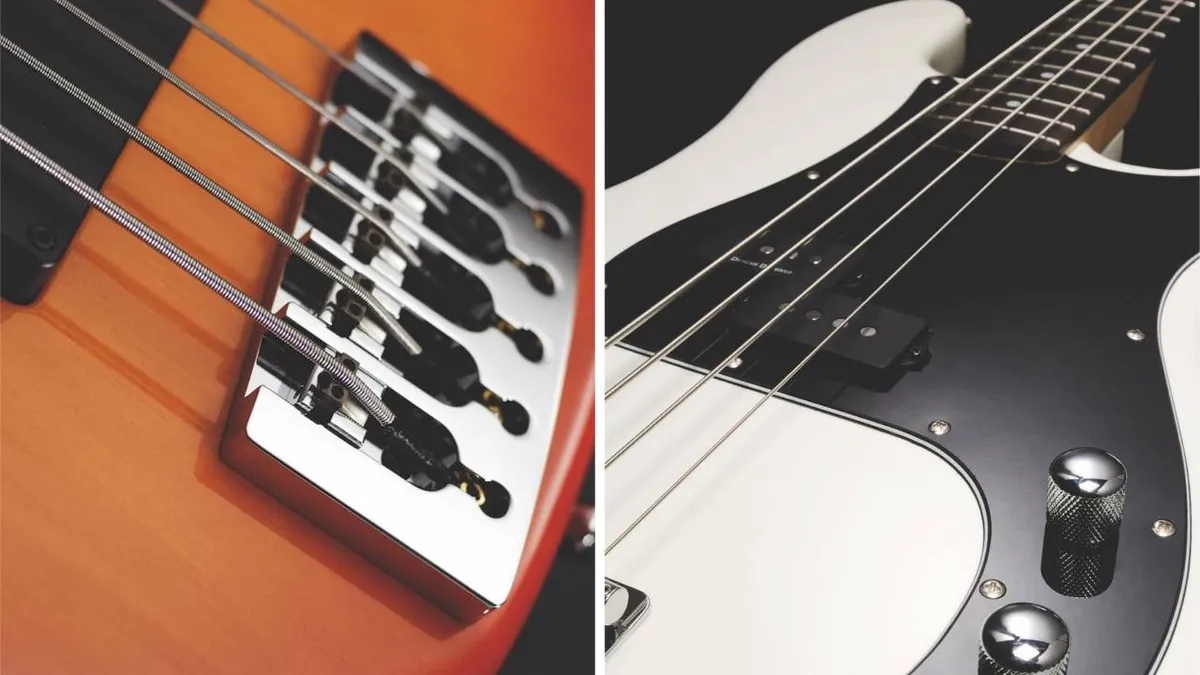
Karn recently acquired a new bass (above, left) from American builder Steve Klein, who has made guitars for David Torn and Bill Frisell. Klein's K-Bass line is quite new; in fact, Karn's is only the third one the luthier has built. "I like the feel of the [Moses] graphite neck," says Karn. "I'm normally not particularly fond of graphite basses, because they don't give the same kind of warmth in the harmonics; they're usually quite dead. But it's so easy to play a lightweight bass with a graphite neck. I also find it's really good to write with." Karn admits to finding the lack of a headstock somewhat disconcerting. "While you're playing, you think you're in a higher place than you are. I find that I'm starting to write a lot higher up the neck, and I'm sure it's because the head's missing." Karn's K-Bass has an alder body, Bartolini BB4C pickups, a Bartolini NTBT 18-volt active system, and a Steinberger DB bridge, which allows detuning of the E string. (The detuner came into play on theTooth Mother tracks "Thundergirl Mutation," "Plaster the Magic Tongue," and "Feta Funk.") "The Wal and the Klein make a nice blend of sounds--it has a lot of weight," comments Karn. "I usually doubletrack the Wal anyway, with the two channels split slightly left and right."
Mick uses DR strings--with a skinny .085 on the bottom--but his string preference has as much to do with age as brand. "I hardly ever change my strings. I like the sound when they're old and muffled, so I generally play them until one breaks. DR strings match up very well; when I have to change one, it doesn't really feel as if there's an odd string in the set."
Karn uses Trace Elliot amps: for large venues, an AH600SMX head with 1048H (4x10 + horn) and 1518 (1x15) cabinets; in smaller halls, a 122HSMX combo (2x10 + horn) with an 1153 (1x15) cabinet. Achieving a pronounced midrange has always been Karn's EQ objective. "I like to boost the middle and bottom and bring down the highs a bit. That's what cuts through best, and it gives an unusual tone. When the middle is boosted, it also brings out any harmonics that might be going on. Although I like a much bassier, heavier sound, you can lose clarity that way--and the harmonics just get killed. So I work towards a middle bass."
For the "pulse bass" credited on Rain Tree Crow's "Big Wheels in Shanty Town," Karn stuck pieces of sponge under the strings on the neck and bridge, resulting in a percussive thud. For The Tooth Mother, he reverted to more time-honored techniques. "The idea was to cut out the effects pedals and create distortion by overdriving the amplifier. Instead of going in direct and then playing around with the sound, I'd get a blend of direct bass plus an amped, overdriven bass. It gives a much warmer distortion than anything else; fuzz pedals tend to cut out the lows. So the next time I go on the road, I'll have to bring two amplifiers--one I can blow up, and one I can play through!"
A Selected Discography
Solo albums: The Tooth Mother, CMP; Bestial Cluster, CMP; Dreams of Reason Produce Monsters, Caroline; Titles, Caroline. With David Torn & Terry Bozzio: Polytown, CMP. With Lonely Universe: Lonely Universe, CMP. With Jansen, Barbieri, Karn: Beginning to Melt, Medium. With Rain Tree Crow: Rain Tree Crow, Virgin. With Japan: Oil on Canvas, Virgin; Tin Drum, Virgin; Gentlemen Take Polaroids, Virgin; Quiet Life, Caroline; Obscure Alternatives, Caroline; Adolescent Sex, Caroline. With Dali's Car: The Waking Hour, Beggars Banquet. With Mark Isham: Castalia, Virgin. With Joan Armatrading: Hearts and Flowers, A&M. With David Torn: Door X, Windham Hill. With Gary Numan: Dance, Beggars Banquet.