Three Decades As Stevie’s Left-Hand Man
Nathan Watts's Wonderful World
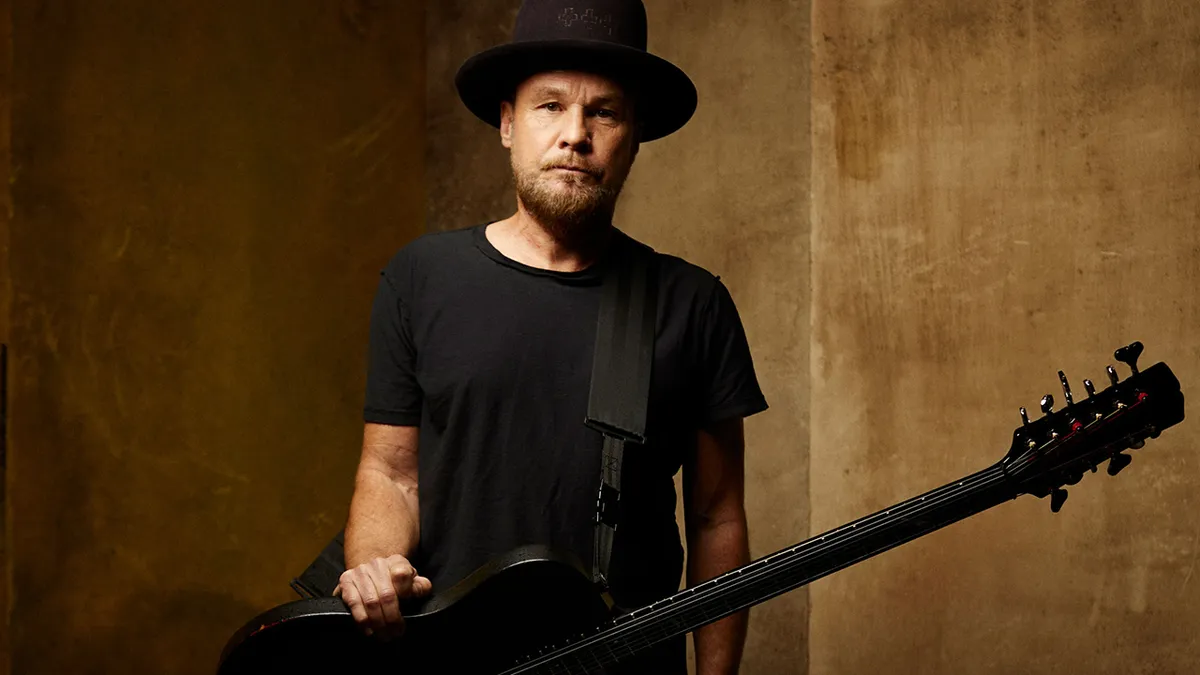
Holding it down for a force of nature like Steveland Morris Wonder seems an unenviable task. In addition to being one of most prolific songwriting geniuses of the last century, and possessing perhaps the most imitated vocal style since Louis Armstrong, Wonder—through his keyboard-born left-hand lines—have been as influential on thumpers as those of a short list of essential bass players. But none of that daunts Nathan Watts, now entering his 32nd year with the man he casually refers to as Steve, the last dozen as his musical director. In fact, Nathan’s muscular, rhythm-rife parts on such Wonder standards as “I Wish,” “Sir Duke,” “Master Blaster,” and “Do I Do” have firmly established him as a cornerstone figure in R&B bass. This, in turn, has led to his appearance on hit singles such as Paul McCartney and Michael Jackson’s “Say, Say, Say,” the Pointer Sisters’ “I’m So Excited” and “Slow Hand,” Diana Ross’s “Muscles,” the Jacksons’ “This Place Hotel” (originally titled “Heartbreak Hotel”), and Jermaine Jackson’s “Let’s Get Serious.”
Born in Detroit on March 25, 1954, Nathan Lamar Watts was raised an only child on the city’s gritty west side. Inspired by jazz great Lee Morgan, he took up trumpet in elementary school, forming a trio with friends and fellow future session stars Ollie Brown on drums and Ray Parker Jr. on clarinet. When he wasn’t in school, Nathan would stroll over to Motown’s Hitsville Studios to watch through the basement window as the Funk Brothers worked their magic. Another passion was the rock & roll of Jimi Hendrix, Deep Purple, Rare Earth, Mahogany Rush, and Steppenwolf, many of whom played at the nearby Grande Ballroom—“a rock club in the middle of the ghetto.” When Parker Jr. switched to guitar, he and Brown encouraged Watts to pick up bass so they could remain a trio. Nathan made the switch around the time he graduated from Northwestern High School, when he bought a National Bass from Montgomery Ward. Watts learned his first bass line, James Brown’s “Cold Sweat,” and began soaking up the influence of Motor City heavies like James Jamerson, Tony Newton, and Bob Babbitt. (“You had to know Babbitt’s bass solo from [Dennis Coffey’s] ‘Scorpio’ to work in Detroit.”) By then, Parker had moved on to join Marvin Gaye’s band, so Nathan joined a local group called the Final Decision. As a backup plan, he went to school to study accounting.
That would all change on a sunny August day in 1974, when his mom yelled down the street to tell him he had a call from Stevie Wonder’s office.
How did you come to join Stevie Wonder’s band?
Steve’s people told me he needed a bassist and someone had recommended me—I later found out it was Ray Parker Jr. Reggie McBride, who I knew from Detroit, was the previous bassist; he had replaced Michael Henderson, who left Steve for Miles Davis. Reggie was doing the road gigs, as well as some of Steve’s West Coast recordings, along with Scott Edwards. But he left to join Rare Earth, so the chair was open. I was told to learn as many of Steve’s songs as I could, because they were going to fly me down to Memphis on the weekend for a gig. Here I was as green as an apple—I had never been on a plane. I got there and walked into the hotel room to find Steve sitting with Jesse Jackson. The show was a Push For Equality concert, in front of 250,000 people! There was no rehearsal; we went over a few tunes backstage and we were on. The first two tunes were “Superstition” and “My Cherie Amour,” and I was fine. Then they called “Contusion,” which I’d never heard, and I froze up! I went over and started watching Steve’s left hand and somehow got through it. Afterwards, I was informed they were bringing me to L.A. to audition. At the audition there were two other bassists who were better, more advanced players than me. But I noticed when Steve played a line and asked us to play it back, I was getting it quicker; I’d always had big ears. A week later I got the greatest blessing of my life: They had selected me. From there, we went on a tour of Japan, returning in March ’75, and then we began recording Songs in the Key of Life, in L.A. and New York.
What are some of your favorite bass tracks?
With Steve, it’s “I Wish,” “As,” “Do I Do,” and “I Ain’t Gonna Stand for It”; I also like “Let’s Get Serious,” which Stevie wrote and produced for Jermaine Jackson, and “The Real Thing,” which Steve wrote and we all recorded for Sergio Mendes’s Brasil ’77 album. And Sergio’s version of “The Waters of March,” from Brasil ’88, is cool. My all-time favorite Steve song, although I didn’t play on it, is “Pastime Paradise” [from Songs in the Key of Life, later adapted for Coolio’s 1995 rap smash “Gangsta Paradise”].
How do you and Stevie arrive at a bass part in the studio?
Well, Steve plays keyboard bass on at least 60 percent of his albums, but if he asks me to play on a track he’ll usually have a demo or an idea, and he’ll have me embellish it and come up with my own part. Then he’ll say, “Yeah, that’s what I want,” or, “I don’t like that, try something else.” There are times when he has me cut a track first and then he goes with keyboard bass on the final version; that happened on “Isn’t She Lovely,” “Knocks Me Off My Feet,” and “Go Home.” Whoever I’m recording with, I listen to the song, look at the chord structure, and do what I think fits. My whole concept is what I call melodic rhythm. I try to play something basic and solid, but if you listen closely, you’ll hear a lot of subtle rhythmic movement—pickups and approaches. That all comes from my three main influences: Jamerson, Chuck Rainey, and Joseph “Lucky” Scott, who played with Curtis Mayfield.
Can you describe your basic technique?
I pluck with three right-hand fingers, and I have a heavy touch; I was using two fingers early on with Steve, but the day before we played at Human Kindness Day in Washington D.C., he accidentally closed a cab door on my middle finger, so I had to use the first and third fingers for the concert. Sly Stone was on the bill and Larry Graham came over to tell me I sounded great, so I’ve been using all three fingers ever since! My slapping is conventional: thumb across the strings down by the bottom of the neck, and pops with my index and second fingers. I also like to mute the strings with my palm and pluck with my first two fingers. With my left hand I do some muting, hammering, trilling, and a lot of slides. I’m also getting into the upright; Reggie Hamilton is teaching me—bowing and everything. I played some very simple parts on a rented upright on “Mama’s Song” from Songs in the Key of Life, and on the title track of The Secret Life of Plants, but I want to learn to play it correctly.
Who influences Stevie’s keyboard bass playing?
James Jamerson! Think about it—from the time Steve was 12 years old through his early-’70s albums, who was he hearing? That’s where his bass concept came from. He became one of the greatest, most original keyboard bassists—and Greg Phillinganes, who is also incredible, picked up a lot of Steve’s keyboard bass style when he joined us, but it’s all rooted in Jamerson.
How about having to play Stevie’s keyboard bass lines on bass, live?
I’m used to it by now, since I’ve had to play everything over the years—“Boogie On Reggae Woman,” “Too High.” I just learned them all by ear; we’ve never had charts in the band. Natural Wonder is a good live double-CD to hear what I do and how I cover Steve’s keyboard bass lines. I actually played some keyboard bass on tour with Steve in the ’70s. He wanted it live because a lot of his songs had keyboard bass, but at the time, there wasn’t anything for electric bass that sounded like a synth bass, so I got an ARP 2600 and then a Yamaha DX7. Eventually, I went back to just electric bass, but I was probably the first R&B bassist to double on key-bass; now it’s almost mandatory.
What about playing Jamerson parts?
You know I love all of those: “For Once in My Life,” “Uptight,” “My Cherie Amour,” and “Signed, Sealed, Delivered,” which I believe is Bob Babbitt. Knowing the bass line to “I Was Made to Love Her” on that first concert with Steve impressed him and helped me to get the gig. My favorite Jamerson part on a Steve song is “It’s a Shame” [by the Spinners].
Stevie is known to be quite spontaneous live.
It’s always a challenge; the sets can include anything. That’s why I’ve enjoyed being here so long. While we were rehearsing for the Super Bowl pregame show, Steve tried a tune we hadn’t done in over 20 years. He said, “Nate, remember this?” And it was an unreleased song! The rest of the band was like, Huh? Or he’ll pull out an Ellington or Coltrane cover; he always keeps you guessing. There’s no official list, but I figure I know 80 to 100 songs from his astounding catalog. At this point, we laugh because I know him so well; I know his musical patterns, so I know where he’s going before he goes there. One of the only times he surprised me was on a song we cut that didn’t make it onto the latest CD, A Time to Love. He said, “Nate, I got one for ya.” He played the song, and everywhere I thought he was going, he went in the opposite direction. The progression was very different for him, but it was still Steve; I said, “Whoa, you got me this time.”
Do you change any of the parts live?
I stay pretty faithful, but on the other hand I don’t like to play the same thing twice, so I’ll change it up slightly. If I go too far, Steve will let me know. I was using a fretless for a while on all of the ballads, and finally Steve said, “Man, I love that bass—but it’s right in my vocal range,” so I stopped bringing it out [laughs]. Once in a while Steve will throw me a solo, which is fine, but I’m happiest playing the groove.
Your credits also include Paul McCartney and Michael Jackson.
I didn’t get to work with McCartney on “Say, Say, Say”; I did the track with Michael in Hollywood, and he took it over to Paul in London to do his vocals. Apparently, Paul tried to replace the bass track, but he decided that my part felt good—so he left it, which is a high compliment coming from the quintessential melodic bass player. Michael is amazing; his rhythmic sense is remarkable. We were working on “This Place Hotel,” from the Jacksons’ Triumph album, and he said to me, “Nate, I want something like this” [sings a funky, syncopated rhythm]; from there, creating the bass line was a breeze.
Who are your bass favorites?
In addition to Jamerson, Rainey, and Lucky Scott, Jaco was a giant who changed the face of bass forever. Larry Graham changed everything, too. I love Stanley Clarke; he blew me away recently with some flamenco upright moves with the Rite Of Strings. Tower Of Power’s Rocco Prestia is a legend and a good friend. I just saw Willie Weeks at the Super Bowl—when I first started doing sessions, he always had friendly advice for me. And Marcus Miller is my boy; when he slapped “Teentown,” that just about killed me. I’m not as familiar with some of the newer players. I dig Victor Wooten, and Gerald Veasley, who I heard the other day.
What lies ahead?
Steve is going to do a major tour this year. Away from that, I’ll be producing some singers and rappers. And my goal is to finally put out a solo CD; it will be a combination of vocal tunes and bass-heavy instrumentals. Overall, I just feel extremely fortunate to have had a great career and close friendship with Steve, who is as genuine and loyal as he is talented. Someone of his stature could hire any number of superstar bass players, no questions asked. But whenever he’s in a situation where he has to use another bassist, he always calls to let me know.
A Fistful of Feels
We asked Nathan Watts to comment on some of his signature grooves with Stevie Wonder.
“Sir Duke,” 1976 We recorded it at Crystal Industries in L.A.; Stevie rehearsed the whole band, and then we cut it live. I used my ’74 P-Bass with Rotosounds, recorded direct. Stevie had the unison line, which, when I worked it out on the fingerboard, required me to bend up the last fret to reach the highest note. Stevie let me come up with the two-feel bass line, and I cut loose a bit on the out-chorus.
“Contusion,” 1976 Also rehearsed and recorded at Crystal, with my ’74 P-Bass. I had a little experience playing it live, but in the studio Stevie came up with the idea for the intro bass line; he sang the stuttering 16th rhythm and I played it.
“I Wish,” 1976 That was cut at 3am at Crystal on a Jazz Bass I had bought. I had been recording all day, and I had just gotten home and into bed exhausted, when Stevie called and said, “I need you to come back—I’ve got this bad song.” I came in and he had the eighth-note keyboard bass line, so I joined in, adding my Jamerson grace-notes, which he liked. Then he said, “Nate, do this,” and he sang some growly roars—so I started adding my slides. The engineer, Gary Olazabal, suggested I plug into an Alembic tube preamp, which he overdrove to get the growl. Other than that, the slides sound angry because it was 3 in the morning and I had to come all the way back to the studio!
“As,” 1976 That was a magical session at the Hit Factory in New York City. I walked in with my P-Bass, and the first person I saw was Herbie Hancock! We all sat there—me, Stevie, Herbie, [drummer] Greg Brown, and [guitarist] Dean Parks—and just grooved. I’ve never felt anything like it. The song meant so much and the lyrics were so great that as we heard them, we kept taking it up another level. I actually made two rhythmic mistakes—right before the first chorus and right before the last chorus—and I asked Stevie if I could fix them, but he said no, he liked the way they felt.
“Do I Do,” 1982 That was done at Wonderland. Stevie was real comfortable with the whole band at that point, so we just went in and jammed and played what we wanted. He gave me more freedom on that song than on just about any other, and with [drummer] Dennis Davis laying it down strong and simple, there was a lot of room for me to stretch. I used my ’79 MusicMan StingRay, recorded direct, with no effects. The nasty, growly sound is just the tone of the bass, plus the strings being tuned down to Eb, which added more rattle and fret noise. In the video we shot, they had us all in black on a dark background; I wore a white cowboy hat because I wanted to make sure I got seen! [Laughs.]
Check out these tracks!
For great examples of Nathan Watts’s playing, check out these tracks:
“Sir Duke,” “I Wish,” “Contusion,” “As”
Songs in the Key of Life, 1976
“Master Blaster,” “I Ain’t Gonna Stand for It”
Hotter Than July, 1980
“Do I Do”
Original Musiquarium I, 1982
More Stevie Wonder tunes
In this interview, Nathan refers to several Stevie Wonder tunes he didn’t play on. Here’s where you can find them:
“Superstition” Talking Book, 1972
“Too High” Innervisions, 1973
“Boogie On Reggae Woman” Fulfillingness First Finale, 1974
“Go Home” In Square Circle, 1985
“Isn’t She Lovely,” “Knocks Me Off My Feet” Songs in the Key of Life, 1976
Selected Discography
With Stevie Wonder (all on Motown) A Time to Love; Natural Wonder [Live]; Conversation Peace; Jungle Fever; The Woman in Red [Soundtrack]; Original Musiquarium I; Hotter Than July; Journey Through the Secret Life of Plants; Songs in the Key of Life.
With Paul McCartney Pipes of Peace, Capitol.
With the Jacksons (both on Epic) Triumph; Destiny.
With Diana Ross Silk Electric, RCA.
With the Pointer Sisters (both on Planet) I’m So Excited; Black & White.
With Jermaine Jackson Let’s Get Serious, Motown.
With Lionel Richie Lionel Richie, Motown.
With Sergio Mendes Brasil ’88, RCA; Sergio Mendes & the New Brasil ’77; Elektra.
With Roberta Flack Roberta Flack Featuring Donny Hathaway, Atlantic.
With Deniece Williams Song Bird, Columbia.
With Steven Bishop Bish, ABC.
With the Mighty Clouds Of Joy Changing Times, Epic.
With Michael Sembello Bossa Nova Hotel, Warner Bros.
Nathan's Famous
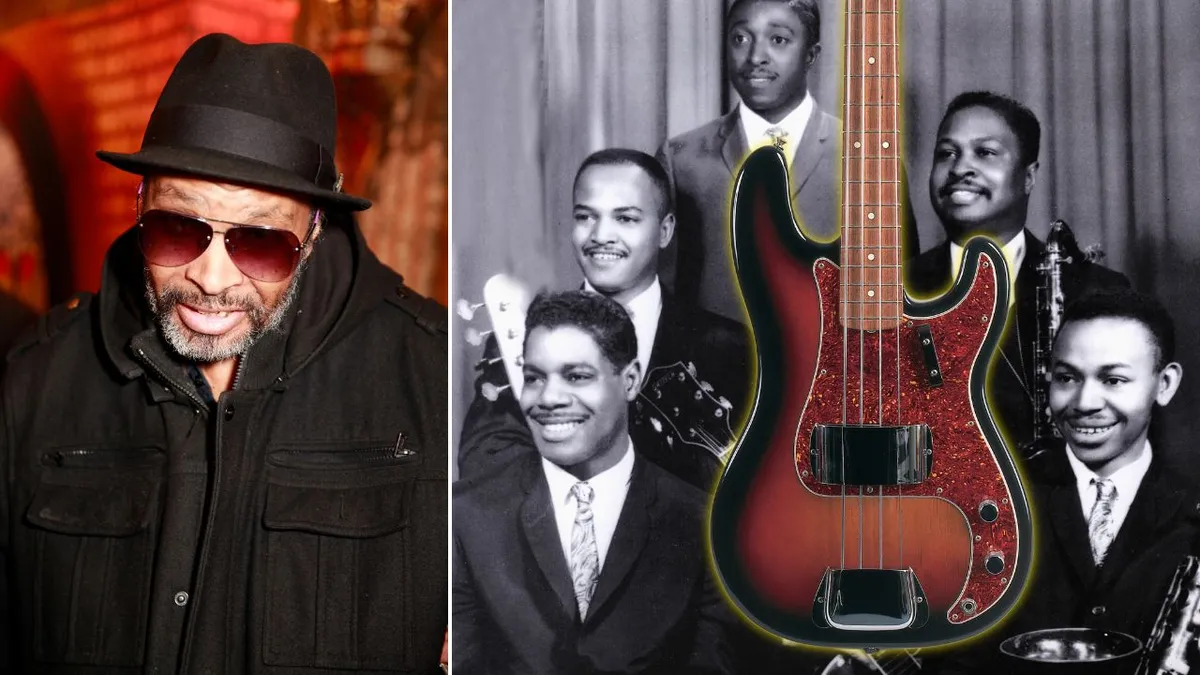
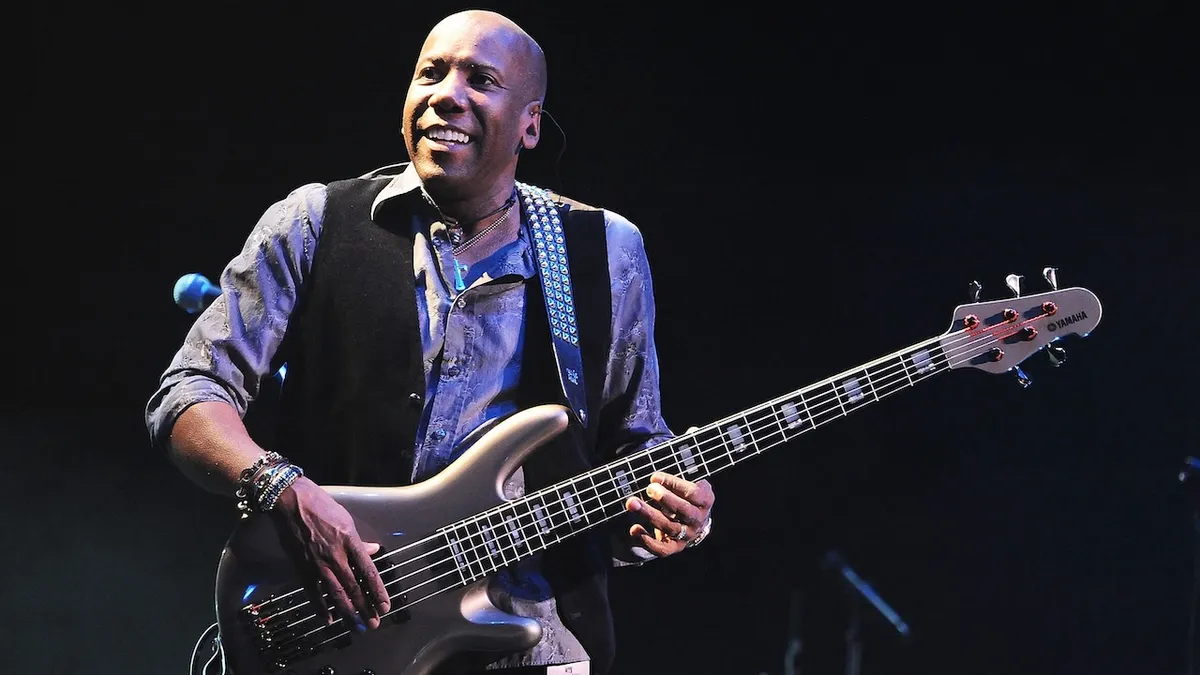
Nathan Watts scored his biggest bass hits on his ’74 Fender Precision Bass and ’79 MusicMan StingRay (which he still pulls out for recordings). He also plucked early Aria Pro and Yamaha 5-strings, a Fender Jazz, and a B.C. Rich. His present road rotation features Bossa 4- and 5-strings, a Coppola LG-5 Classic (www.allevacoppolo.com), and fretted and fretless Crewes 5-strings. His strings are GHS Boomers and Elixir Nanowebs (both .045, .065, .085, .105, .130). In the studio Nathan plugs into an Avalon U5 preamp/DI. Live, he stands in front of his Hartke rig, consisting of a 5500 head with 410XL and 115XL cabinets. Although Watts has used chorus and delay pedals, he currently prefers no effects.