Main Site Navigation

Your current location
BassPlayer.com >> This Month >> No Limits

Tool’s Justin Chancellor Pushes Rock Bass Into Wild New Frontiers

No Limits

July, 2007

How improbable is Justin Chancellor’s success? Consider this: Unlike most bassists who play before millions of fans per year, Justin enjoys practically unfettered creative input with Tool, both with his bass parts and the band’s compositions. And Tool’s heavy, technically challenging music could hardly be further from the formulaic. It’s filled with odd meters, difficult polyrhythms, and weird harmonies—not what you’d typically expect from most platinum-selling arena headliners.


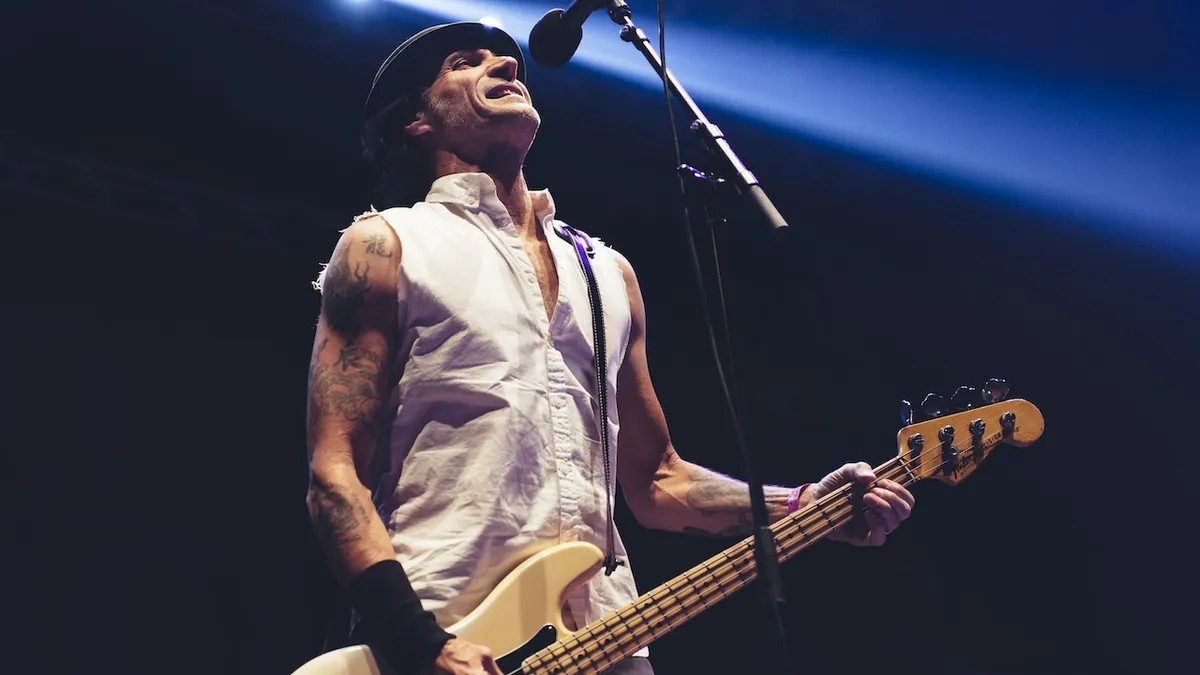
Tool released 10,000 Days in mid 2006 and sold 564,000 copies in the first week alone, debuting at No. 1 on the Billboard charts. A year later, the band continues to tour the Enormodome circuit, drawing a wide, loyal following that rightly puts the “fanatic” back in fan. And yet the average song on Tool’s new CD clocks in at well over six minutes; the main grooves of the first two tracks are in 5/4 and 9/8; and the song forms are long enough that charted rehearsal letters would run nearly the whole alphabet. Alongside mystical frontman Maynard James Keenan (also of A Perfect Circle), guitarist and sound painter Adam Jones, and the blistering Danny Carey on drums, Justin is at the center of a perfect musical and cultural storm.

A right honourable Englishman by birth, Chancellor joined Tool in 1995 after opening up for them while a member of his original band, Peach. Since then, each successive Tool release—1996’s Ænima, 2001’s Lateralus, and 2006’s 10,000 Days—has seen a major development not just in compositional complexity and depth, but also in Justin’s bass lines, sonic mixtures, and especially effects. On 10,000 Days, his tone palette ranges from grinding distorted riffs to slightly overdriven high-register delays to chorused chords and arpeggios. As Chancellor approached the recording of Tool’s first new album in five years, he left nothing unexplored.

Why did it take Tool five years to release the new CD?
We were on the road almost two years, and by the end of that we wanted to give each other some space. Maynard wanted to do another album with A Perfect Circle, and everybody else was interested in pursuing other musical things. So we took a year off from each other. After that, it wasn’t hard for us to get to the point where we all wanted to get back together and make music again.

That must have impacted the creative process positively.
Yeah. I think it’s important to interact with other people and explore different ideas. Then when you come back together, you’ve got things to offer each other, different ideas to bounce around. It is a really positive thing to do.

Of all the things on 10,000 Days that represent where you were as a bassist when you recorded it, what stands out?
I’d like to think I tried some things I had never tried before. I was a little less afraid to experiment—using my fingers, not necessarily relying on the techniques I know I can do proficiently. So I’m proud of it because I tried to go for some territory that I hadn’t been in before.

Did you make any major compositional contributions that survived intact all the way to the final recording?
Not really. Any idea we bring in pretty much gets ripped apart and changed to something completely different. That’s the fun thing about this band—the other guys really push you by exploring your ideas and tearing them apart. Before you know it, you’ve come up with something that hadn’t existed before.
A song that I like compositionally—but again, it’s from all of us—is “Jambi.” It mixes together everybody’s individual styles into a really cohesive song. It’s a good example of solid ideas getting transformed into all kinds of different areas.

In “Jambi,” there’s a riff with a strong delay on it. How did you come up with that?
I had a riff that I guess you could call the chorus, which is in 9. We did a lot of messing around with that riff, trying it every which way. Adam was like, “What are you doing there?” I started playing it up high, and he said, “Try some delay effects on that.”

It almost ends up sounding like a David Gilmour part.
It’s a bit Pink Floyd, for sure. But it’s in 9; it has a weird push and pull to it. The later riff was actually the original riff, and from messing around we came up with the higher-register stuff that leads into it. That was a little more suggestive of the [chorus] riff, as opposed to actually pounding out the riff immediately.

Later in that song, while you are all doing that highly syncopated thing in 9, the bass drum hits every three inside the nine, even though you’re subdividing it completely differently. How do you mentally approach that?
We’re just holding onto that original riff. Danny’s cutting up the 9 into fractions of 3, so he’s basically the one who’s pulling away from us, while we’re holding on for dear life [laughs].

On “Vicarious,” there’s a difficult syncopated riff with a total of 14 beats. How do you count the chorus?
Just with a straight beat through it, you know? To me, it’s like eight beats to the bar, basically. I play stuff that my foot will tap through the 5/4 of the verse, and it’ll keep tapping the same beat straight into the chorus. It’s almost like a grid reference that just taps the whole way through.

So when you’re in something like that, it’s not necessarily that you’re counting actual odd beats—you’re pulsing through it regardless of the time signature.
Exactly. It’s a groove—there’s a fundamental groove, a pulse, a beat going on, and then everything else is just pulling and jerking around it. A little more thought goes into it in a song like “Rosetta Stoned.” We do sometimes sit down with a marker and a blackboard and actually figure stuff out: “Well, we want to start here and end here using these two riffs, so what’s x to the power of 2 over y?” You work everything out mathematically—how two things can start at one point and meet again, being completely different time signatures. But that’s still sitting on top of a pulse.
Within however many beats you decide there are from point A to point B, you can do anything. If you start cycling that total phrase, it’ll have this groove—and in a way, it always ends up being kind of a 4/4 thing. You can tap your foot to it, basically, unless it’s the more prog-rock stuff, which gets a little more jerky and dramatic.
The other thing is that we all count things differently. It’s really interesting. For example, in “The Pot,” we had a lot of trouble with the first riff I brought in [underneath the first verse]. To me, the downbeat was on the first note—but for some peculiar reason, to Danny the downbeat was half a beat before that. I couldn’t figure out why he was hearing it that way, so we had to try it both ways, basically. It took a long time to get on the same page.

Though “The Pot” is the only tune mostly in 4/4, there are different syncopations going on: Sometimes you’re with the guitar, and sometimes you’re doing your own syncopation while everybody’s doing something else. How did you go about constructing that?
It’s kind of like making a new cake; you’ve got ingredients, and you start trying them together. Some things go together and some things don’t. Obviously riffs in 4 go together, as long as you can get your head around the fact that they’re not all hitting at the same places. For some parts, when we’re starting out, we might have Danny hit just the bass drum, which lets us see how two different riffs interact. Often it’s just a total mess, so you look at it and go, Wait—if I move just a bit this way, it’ll create this accent where we both hit at the same point. Then you start to have the “strong points” within the bar. In parts of the bar things are pulling away, and then it all sucks together in this one moment. That’s very much the way those two riffs in “The Pot” work.

About seven minutes into “Rosetta Stoned,” there’s a complex syncopated groove over a tabla-drum part. I counted 15 beats from the beginning to the end. What are you counting in there?
That was interesting, because the pulse beat in that case got added late. When we started writing the song, there was stuff in 5, and in 6. Danny started playing 5 with his feet with like a double-hit, and 6 over top of that. Basically, I play the 5/16 pattern on the root note, then a descending scale that matches Danny’s snare from the 6 beat. So it’s like [sings both parts at once; see Ex. 2 in the Tool Time lesson]. That’s the 6 moving across the 5 beat, cycling around until it gets back to the same point. After we’d been doing that for a while, Danny decided it would be interesting to add a pulse—I think it’s a sample—with his foot. So then there’s sort of a 4, a straight pulse, which doesn’t really exist anywhere else in the song. I spent a lot of time sitting in traffic coming back from rehearsal with my hands on the steering wheel, trying to play that 5 with my right hand and the 6 with my left—and trying to figure out how Danny was doing it before I was able to play it on the bass.

Can you explain the up-octave stuff that starts and ends the song “Right in Two”?
It’s basically just the setting on the DigiTech Bass Whammy Pedal—a 5th and a 6th, I think. And it’s three harmonics. It’s actually a bitch to play that part, because I’m using both feet. On the first note the tremolo’s on and the Whammy Pedal’s in the down position, and on the second note the tremolo comes off and the Whammy goes to the up position, to the 6th. When I was writing the part I was sitting down on a stool.

So while you’re standing up, you’re back on both heels?
Exactly, and almost pigeon-toed as well. That’s how I’ve been playing it for the last year. I’m not sure if I’ve got it sussed yet—I didn’t want to bring out the rock stool, or have a guy come out that I can lean on [laughs]. That’s a real difficult one; I’m still working on pulling it off. It’s definitely trickier if I’m a little hung over [laughs].

There’s so much room for you to fill up space. Is that the result of a group effort?
It absolutely is. We create space for each other. The songs are allowed to breathe, and we allow each of us to express ourselves, but only in a way that benefits the song as a whole. Everyone has their moment. It’s about a dynamic of the band: letting one kind of color rise up, and then letting another one take over. It’s not making color by overmixing everything; it’s about subtracting—taking things away and making it sparse, and then building from the ground up. A greater depth seems to come out of treating things that way.

You’ve said before that sometimes, mistakes turn into cool things. Can you think of a “mistake” that became something cool on 10,000 Days?
When we record our albums, we tend to be 99 percent prepared. We don’t do a lot of improvised stuff in the studio, and that’s another reason we take a long time writing records. But there are a few moments—like in “The Pot,” there’s a “whale’s call” sound I did with the Whammy Pedal that was completely ad-libbed. I was going through the section a few times with a bunch of pedals on and feedback squealing, randomly hammering my fingers around all over the place, and then finding something that worked. That wasn’t figured out in any way.

At the top of “Lost Keys (Blame Hofmann),” is that held note a bass?
Yes, it is. That’s a good example of a mistake. Sometimes I come into practice and I just start making a lot of noise. I might just turn on my distortion pedals and feed back, and just listen to the sound it makes, and move around the room without even having my hands on my bass, just kind of feeling the atmosphere and sound waves of the room. On that particular day, I think I just hit that note, and it was a combination of the pedals that were on. More than one—I think I had the chorus on, as well as two distortions—three, actually, because there’s one that’s always on a little. I was standing in the right spot, and it just started singing. There was a little bit of delay, too, so that as I’m bending the note, one area of the pitch muddies into the next giving it a real dreamy, wishy-washy sound.

What’s the distortion that’s always on?
The TurboRAT. When I play live, one cab has some distortion, and the other one’s very clean. The SansAmp is one of my overdriven distortions, the other is the Colorsound Tonebender Fuzz. I have to have that on now when we do the song live, and I have to be standing in exactly the right spot to get that effect. When I put on the tremolo and I pull up to some different notes, I have to adjust my body position for the feedback not to completely squeal out of control. It was pretty horrible a few times when we started off the tour. We even started gigs with the feedback a couple of times—I’d come out, turn my volume up, and literally nothing would happen [laughs]. I miscalculated where I was standing! Kind of embarrassing. But we’ve figured it out.
A few days after we discovered that sound, I was lazily trying to duplicate it with just some normal feedback, and Adam was adamant: “No, no, you gotta get that sound back. You gotta figure out how to always have that one particular combination of pedals.” So we worked hard on being able to reproduce it every time.

Does Tool ever record with a click track?
I think we might have used a click on “Intension,” because we added the drums afterward. For the most part, we play live all together to get a solid drum track and we’ll just play to that.

How do you like your headphone mix?
For tracking I like to hear the band, but I need to hear a lot of drums. There’s so much rhythmical stuff going on with the guitar, it’s important to have that, too. I pretty much like to hear everything, but I would say it’s drum-heavy. Drum and bass heavy—when you’ve got headphones on, you still want to be able to feel the low end.

Do you still practice?
Not really. A little before a tour, I’ll make sure my playing becomes more regular, just to build up strength. Mostly, practice is about writing new stuff. For this last stretch of the tour, we’ve decided to play older songs we hadn’t played for a while, so we spent some time remembering how to play them! But I find it tedious just sitting in a room playing my bass on my own unless I’m actually creating something. I have a little home studio where I’ll sit and write some drum beats, and then if I’m feeling creative, I’ll write some stuff to that. I can spend hours doing that. But in terms of endurance and arm strength, I’d rather get that from doing other things.

Why do you play 4-string basses only?
Mate, always 4-string for me. I’ll give 5-string a go when I’ve completely exhausted the four strings. I played guitar when I was a kid. When I started playing bass I realized it was enough for me—it’s almost like the six strings were too much to think about. Somehow my brain just works in this narrower margin. As soon as I pick up a 5 I’m completely disoriented. I’ll probably get into it at some point, but not for a while. I’m still busy.

Do you have any advice for young bassists?
Write your own stuff. Honestly, I never really wanted to play other people’s music, except when I was a kid. It’s not the easiest thing to write music, especially with a group of people, so it’s a little more safe and fun to cover other people’s songs. But in terms of playing your own instrument, just experiment and come up with something original. There are no rules, either; you can do whatever you want, and it’s worthy—and it’s exciting when you come up with something original. To me, that’s what’s inspiring: creating something new and original-sounding.

You’ve been in Tool for 11 years now. What motivates you to be a musician?
I just love music. It’s something that doesn’t go away. Aside from playing in front of thousands of people and sharing that moment, you’re on the edge, you’re trying to play well, you’re trying to express yourself emotionally. That’s an awesome experience, and the draw to do that is always there, because it’s very fulfilling. But also, I listen to music all the time; I’m a huge music lover, and to be able to create it as well is a great privilege. I don’t think I’ll ever stop wanting to make sounds, explore melodies, rhythms … it’s just an enjoyable way to express yourself.

Tool Tools

Like Tool’s compositions, Justin Chancellor’s bass sound is a carefully constructed and complex beast. It’s telling that his studio rig and live rig are essentially identical: His effects remain in place, his rigs are miked, and his signal path is his signal path, period.

Justin’s Wal 4-string, which has a mahogany body, bird’s-eye-maple top, maple neck, and Indian rosewood fingerboard, remains his choice for just about everything. “I can’t beat that bass,” he says. In fact, he had Wal make another one just like it in the event of an emergency. (The backup bass “doesn’t sound anything like it,” he laughs.) But Justin ended up using the cleaner, less-midrangy sound of the second bass for the finger-plucked buildup of “Wings for Marie.” He also used a greenburst Wal with a different body shape for the harmonics in the intro and outro of “Right in Two.” For many years Justin has stuck with Ernie Ball Hybrid Slinky strings (.045, .065, .085, .110) and Clayton 1mm picks.

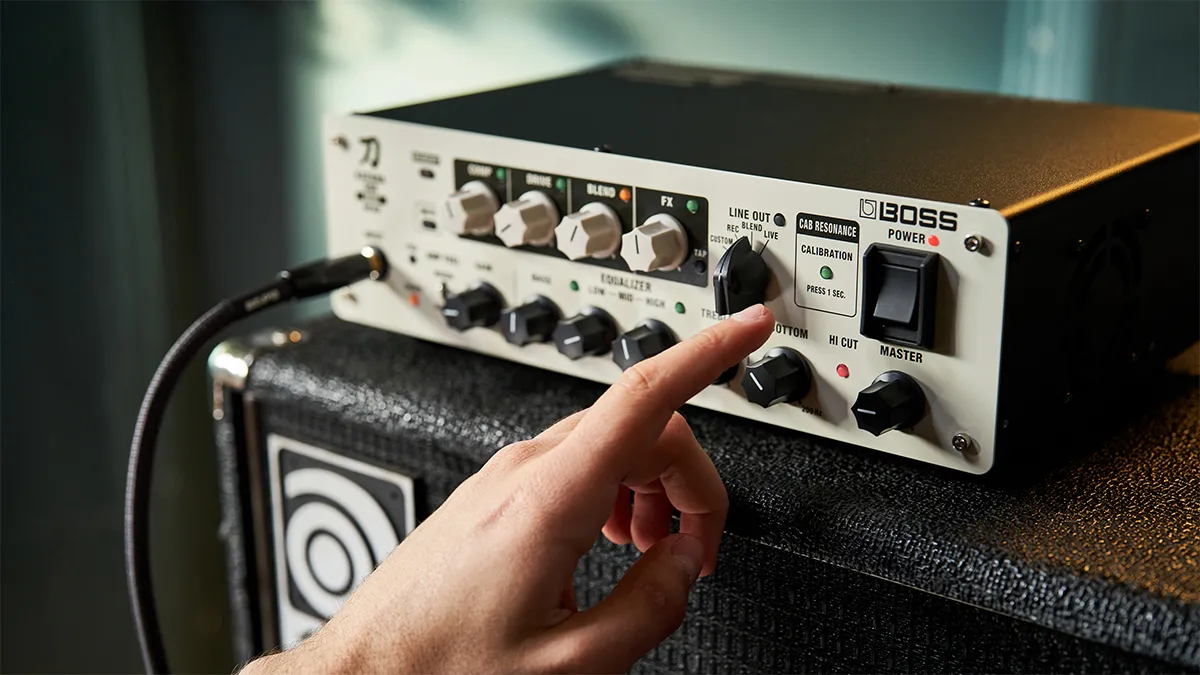
Still, Chancellor has made some changes to his setup since 2001’s Lateralus. He’s still using Mesa Engineering cabs, but he switched the dirty cab from an 8x10 to a RoadReady 4x12. Most significant is the switch to Gallien-Krueger 2001RB heads. “The Gallien-Krueger’s got really good punch, and it holds the note together well when you hit it hard. But the Mesa speakers were the best as far as I was concerned.”

Justin runs three channels all the time. The first comes straight off the xlr output of his Wal bass into a Demeter VTBP-201-DBL preamp (currently available as the Demeter VTBP-201-S), which serves as the clean direct signal and never touches anything else in the massive signal path. In addition to being a favorite of the soundman for filling out tone in the PA, Justin says it “saved my ass a couple of times” when a cable went bad or an amp went down.

His pedalboard is a thing to behold. New additions include two Guyatone pedals, a Flip VT-X Vintage Tremolo (used in “Right in Two”) at the front, and an Ultron AutoWah toward the back. Other newcomers include vintage pedals like a Colorsound Tonebender Fuzz (used in the crunchy middle part of “Jambi”) and the fOXX Fuzz-Wah Volume pedal (modified; the volume pot has been removed). That, plus everything else you see here, leads to the splitter and on to rig channels 2 and 3.

Channel 2 is the “clean” rig; Justin’s signal goes out of the splitter and straight into one of the two G-K 2001RB heads and into the Mesa 8x10. The third channel is “dirty”; the signal passes through a ProCo TurboRAT distortion (“That’s my textured sound that I have on the whole time”) and one last EQ before going to the other G-K head and a Mesa 4x12 cab. The overall rig is a blend of these two miked cabs, adjusted for desired levels of clean and dirty, with the clean direct running in the background at all times. Enough for ya?


Images
External Weblinks

Bass Player is part of the Music Player Network.


This is the end of the page [ Back to start of the page ]