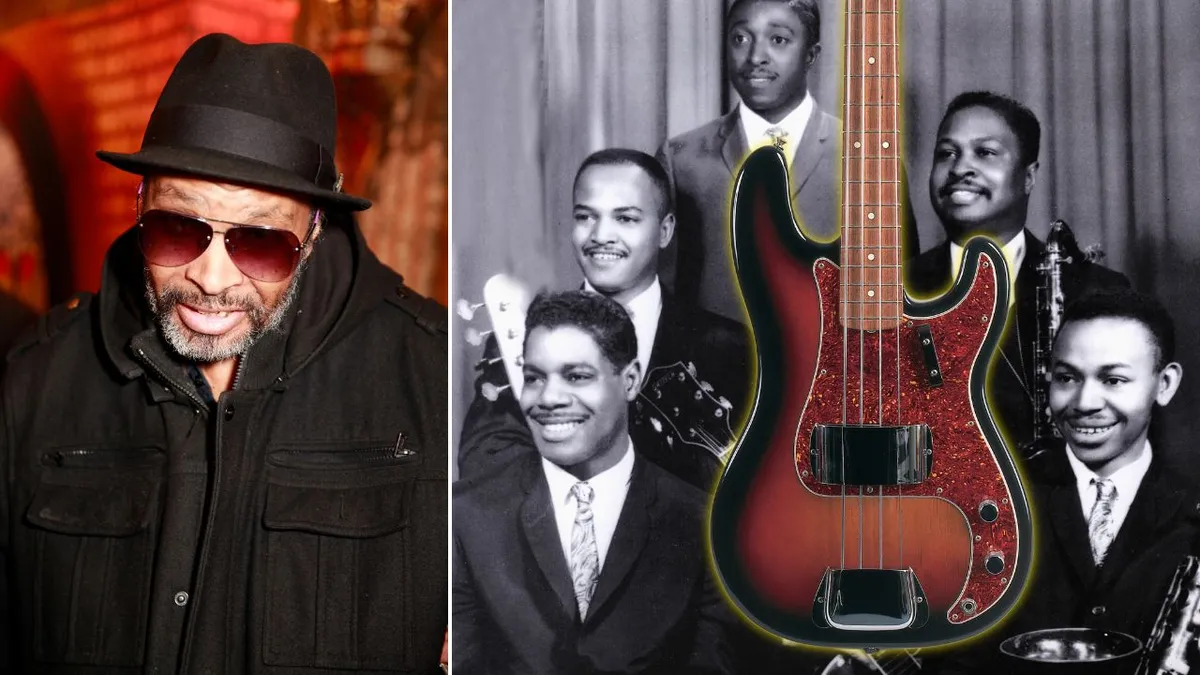
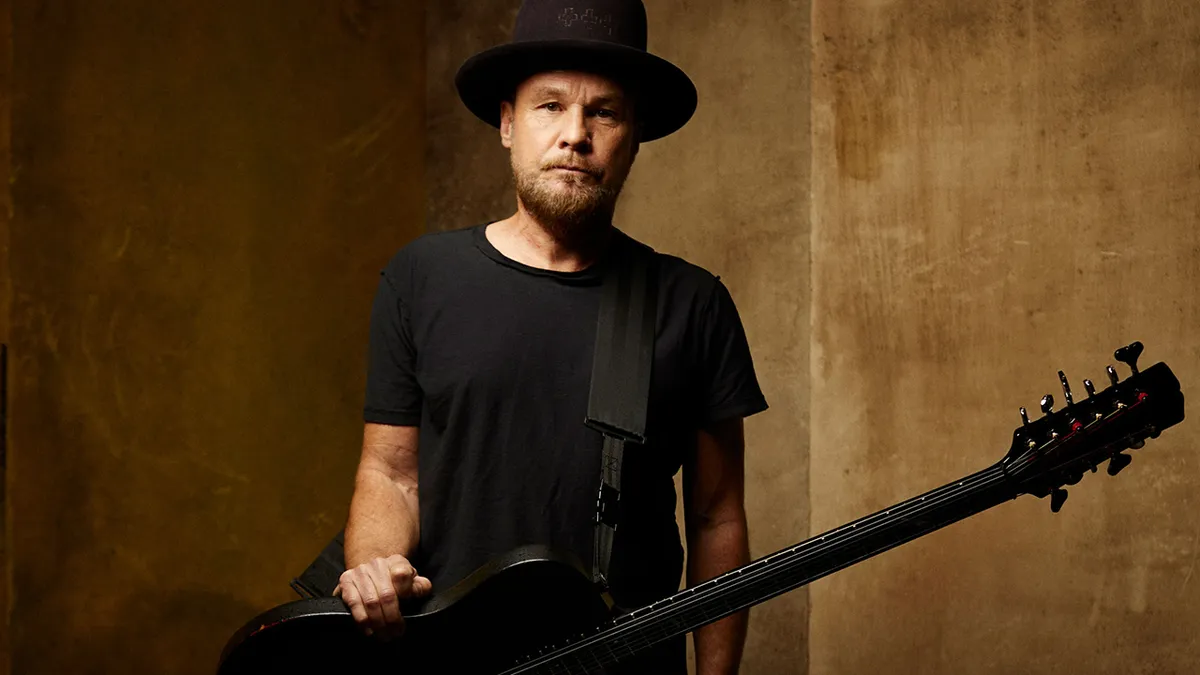
Artists ranging from Patsy Cline and Tammy Wynette to Elvis Presley and Bob Dylan have depended on Moore’s weighty upright tone and authoritative grooves, making him perhaps the most recorded musician on any instrument—as well as an inspiration to ensuing generations of session bassists.
“The simplicity and directness of Bob Moore’s playing influences me every time I do a country session,” reported Nashville studio ace Dave Pomeroy in June ’98. Says drummer Buddy Harman, reflecting on his years of sessions with Moore: “Bob had such a good groove. He was always right on top of the beat, and he played good lines. We just felt it right together.”
Born in Nashville in 1932, Moore couldn’t afford an instrument as a youngster, but he learned to play guitar in junior high, courtesy of two brothers he was friends with. When he spied a bass in the school band room, something clicked. “I asked if I could use it, and the guy said, ‘Go ahead,’” Moore recalls. “The three of us would carry it home and then walk it back to the school.” Hanging out at the Opry House stage door, Bob would shine the cowboy boots of Ernest Tubb’s bass player, Jack Drake, while pumping him for information about tuning, technique, and other bass topics.
Calling themselves the Eagle Rangers, Moore and the two brothers plied their Sons Of The Pioneers–style harmonies in the Nashville area, but Bob’s career began in earnest around age 14 when he signed on with the Jamup & Honey tent show. “It was country music,” says Moore, whose first non-borrowed bass was a gut-strung Kay Swingmaster. “All summer long we did one-nighters in Oklahoma, and I worked along with other young musicians and comedians.”
At age 17 Moore was sharing a boarding-house room with future guitar ace Hank Garland, jamming with young guitarslingers Grady Martin and Jabo Arrington, and doing road dates with Little Jimmy Dickens. Tours with country stars such as Cowboy Copas and Flatt & Scruggs followed before Moore began a busy two years juggling work with Red Foley in Missouri and Marty Robbins in Nashville. During that time pianist/producer Owen Bradley was laying the groundwork for his long Nashville reign, and Moore became the hitmaker’s first-call bassist. “Owen always told everybody I was his left hand, and that’s the greatest compliment I’ve ever had,” Moore says. “He helped me and gave me advice—he was that way with all of his guys.”
Moore’s ensuing decades of sessions include tracks with country legends like Patsy Cline, Ernest Tubb, George Jones, and Loretta Lynn, and pop and rock royalty such as Frank Sinatra, Bobby Darin, Roy Orbison, Bob Dylan, and Simon & Garfunkel. Bob’s work with rockabilly greats such as Ronnie Hawkins, Johnny Horton, and Johnny Burnette brought him a spot in the Rockabilly Hall of Fame (Moore replaced Dorsey Burnette in several sessions with the Rock & Roll Trio), and he logged hundreds of studio dates and live shows with the King, Elvis Presley. Moore’s onstage resumé also includes tours with Crystal Gayle and Jerry Lee Lewis and performances at the inaugurations of Presidents Kennedy and Reagan.
Beyond the country/pop world, Moore played a major role in Nashville’s longtime jazz scene, from gigs and recordings with his own big band to the legendary late-night jam sessions in Printer’s Alley. Moore—who counts Ray Brown, Oscar Pettiford, and Charles Mingus among his influences—was also part of the group scheduled to perform at the riot-marred 1960 Newport Jazz Festival. Away from the bass, Moore influenced Nashville’s music-business topography in his stint as a partner in Monument Records.
Now the patriarch of Nashville’s A-list bassists, Moore considers himself retired, but he still spends significant time behind his Italian and German uprights. “I’m doing probably 50 sessions a year instead of the six or eight hundred I used to do,” says Moore, whom the Country Music Hall of Fame recently saluted in its “Nashville Cats” series. “I also do a lot of traveling. I just got back from Hamburg, and I’ve got to go back to Denmark and Sweden for an Elvis fan club event. For my whole life I’ve been one of the most fortunate people on earth, to make good money and play good music, too. And travel—it’s like a paid vacation.”
How many recordings do you figure you’ve done?
About 18,000. Now, that’s not songs—that’s record sessions. I was doing 20 sessions a week for a long, long time, and you figure about three songs per session; that’s 50,000-some songs. I used to work a lot with gospel quartets, and those guys would have a piano and their piano player on the bus when they toured, so when they came in to do a session they could knock out six songs and be out of there. We did a whole bunch of that.
But then there were sessions like Simon & Garfunkel. They would come argue for two or three hours about one little note, and the next thing you know the whole day is gone and you haven’t got one song. Of course, we were getting paid for our time, but it’s more fun to accomplish something. However, look at how many records they sold.
What was your first recording session?
When I was 16 I went to Cincinnati and worked at King Records with a real good Western swing band—some top musicians were on it. I was in glory. I was getting to make some money and play music.
When you first started recording you were doing transcriptions—tell us about those.
It was a real big disc—bigger than a 12" LP—and the music was put directly on there by a needle, just like the old-timey records. There would be just 15 minutes on them, and companies would do a series of transcriptions, like 250. The transcriptions were done in radio studios. There was no written music, no headphones—you just stood there and played like you did in a regular radio show. If a mistake was made during the recording you couldn’t go back and fix it—you’d have to start the show again. And if the mistake was bad enough, they’d put on another disc and you’d have to start at the top.
Did you usually play through without mistakes?
No doubt I made some, but I don’t remember any of them. After a while, you get a feel for the band you’re playing in and a feel for the songs. When I was working with Red Foley I knew every song he sang. We would go in and just do the songs he knew, and of course I knew them, too. The whole band did.
I did a series of transcriptions with him in Springfield, Missouri, when I was doing the Ozark Jubilee TV show there, and I was also doing transcriptions in Nashville with Marty Robbins. I’d leave Nashville on Wednesday and drive to Springfield. On Thursday and Friday I’d do transcriptions with Red Foley there, and on Saturday I would do Ozark Jubilee. I would drive back to Nashville on Sunday, and on Monday and Tuesday I would do transcriptions for Marty Robbins. I did that for close to two years, commuting back and forth 480 miles every trip.
After one of the Nashville sessions, Owen Bradley said he wanted to talk to me. He offered me a job in his big band, and he said that within six months Decca was going to open a Nashville office and he was going to be the head of it, and at that point I could go to work in the studio with him. That’s exactly what happened. One of our very first records was “Gone” with Ferlin Husky—it went straight to No. 1, and after that we did “Crazy” with Patsy Cline, and that went to No. 1.
Bradley had a golden touch with many artists. What made his recordings so successful?
Owen said there’s not but one judge for the music we make, and that is the public—they are going to judge whether it’s good or not. As we got to be better and faster musicians, playing jazz and playing big band music, we still had to keep our heads in the studio and keep our music where people could understand it. Not everybody likes jazz. Not everybody likes big band music. We tried to play for the record-buying public.
Owen knew what he wanted, but he also knew that the musicians he worked with were creative. He not only allowed us to be creative, he wanted us to be. He encouraged us on every song. Like “Crazy”—the demo we got from Willie Nelson was a waltz and had a whole different tempo. So, we rearranged the song in the studio—all head arrangements; there weren’t any notes written.
When your session career got rolling, you kept different basses at various studios. Was that a matter of getting the best sound for each studio?
At one time I had five basses at five different studios, and one that I carried around to play in the big band or use if I wasn’t working in one of the five studios. I actually took each bass to each studio to find the right sound for each. I still have my two really old, really good basses. One is an Italian—hundreds of years old—and the other is a 180-year-old German roundback. I now have metal strings on the Italian bass because every now and then I play some jazz.
You started playing electric bass in the ’60s.
I more or less played it like I would play my standup, note-wise. I never liked electric, and I still don’t. It just don’t have the guts in the bottom. I’ve heard some awful good players and I’ve heard some awful good sounds, but it’s a different instrument from a gut-string bass. But different people wanted me to try it now and then, so I played it. I still have two—a Gibson Victory and a Fender Jazz. The Fender is the one I played on sessions; I didn’t get the Victory bass until about 1981. I used regular flatwound strings.
You did a lot of sessions where a “tic-tac” bass doubled your line.
That was actually a baritone guitar. It didn’t get much of a “note” sound; it got more of a tic. But it had enough of a note sound that it would clash if it was not the right note. I played what I would normally play—the piano’s left hand and I would work together, and the tic-tac would come in and try to play exactly what we were playing. Over the years as multi-tracking and earphones came in, we got the number system going—I worked probably 20 years before the number system started. Everybody would write out their numbers, and that made it easier for everybody to play together. But tic-tac would limit my freedom to play exactly what I wanted.
At one point you started playing jazz in addition to your country sessions. How did that come about?
When Owen Bradley asked me to join his big band. I had progressed in my playing to where I was able to handle that—not only handle it, but the band started jumpin’ when I got there because they hadn’t had a good bass player. I liked the drummer, Doug Kirkland—the two of us became good friends—and we made that band hop. I did that for 17 years.
I was not a sight-reader, but when I got in that big dance band, in two or three months I was readin’ the flies off the paper.
You had a big band of your own that did some recording.
I did some, and I produced some big band tunes. I got a lot of the horn-section things going around Nashville. Bill Porter and I had been in first grade together, and all of a sudden he showed up as an engineer at RCA, and we rekindled our friendship. He would open the studio on Sundays and I would call horn players and young arrangers. We would go in there and experiment with music and the engineering—miking techniques and all that. It was good for Bill and for the musicians. Word got around, and we finally got so many people coming over we had to shut it down. They’d jam the studio—it got to be too much.
What other jazz did you do?
I worked at the Carousel in Printer’s Alley. We’d play jazz there all the time, five nights a week probably, just hanging out. I worked there later with Chet Atkins. Also, Hank Garland and I were in a group called the Spotlighters, and we did radio shows on WSM—me and Hank, and Billy Burks on vibes and Doug Kirkland on drums. Anita Kerr played piano some.
You teamed with drummer Buddy Harman on many, many sessions.
Buddy and I came up as young guys in the business together, and we knew every move each other would make—it was no effort to work with Buddy. Some drummers you have to kind of pull along—if you’re a bass player you know what I mean. It’s not just the tempo; it’s anticipation. If you’re coming up to a certain place and it needs a little upbeat on it, sometimes a drummer will work it with you, and sometimes you have to force them to do it. So you play notes leading up to it [sings syncopated walk-up], and those anticipated notes will set into what he does, and the next time around he’ll play it with you.
I think Buddy was the king of Nashville and [drummer] Hal Blaine was the king of Hollywood. I did a lot of soundtracks out West. I did all of Elvis’s soundtracks, and when Harman didn’t go, Hal Blaine worked.
What was it like doing an Elvis session?
I loved it; it was great. They’d hire us for a week—fly us out there—and we’d go in and do our job in two days, and the rest of the time we’d go out to Elvis’s house and fool around. It was great fun. There was always something going on—a bunch of guys hanging out, teasing each other all the time. I got to be friends with Elvis; he called me “the King.” He’d tell the guys, “You’d better leave the King alone—he’ll getcha.”
Was Elvis’s entourage around during the sessions?
They were always there. They were his high school buddies, and Elvis put them on salary—so they were paid friends. They’d stand around in the control room when we’d listen back to a song, and they would whistle and carry on like they knew what they were doing. It was encouragement for Elvis, but Elvis was very aware musically. He was very intelligent, and he worked hard all his life. He also was a very polite person—he was raised that way—and always kind to everybody.
Do you have any advice for building a session career?
You need to have a good instrument, and you need to know your instrument. You also need the experience of working with different instruments so you know what’s a good instrument and what’s a good setup.
Never be late, always keep your head up, and pay attention. If they want you to offer suggestions, be ready to offer what you think. If they don’t, keep your mouth shut. But let them know that you’re there to make a good record for them.