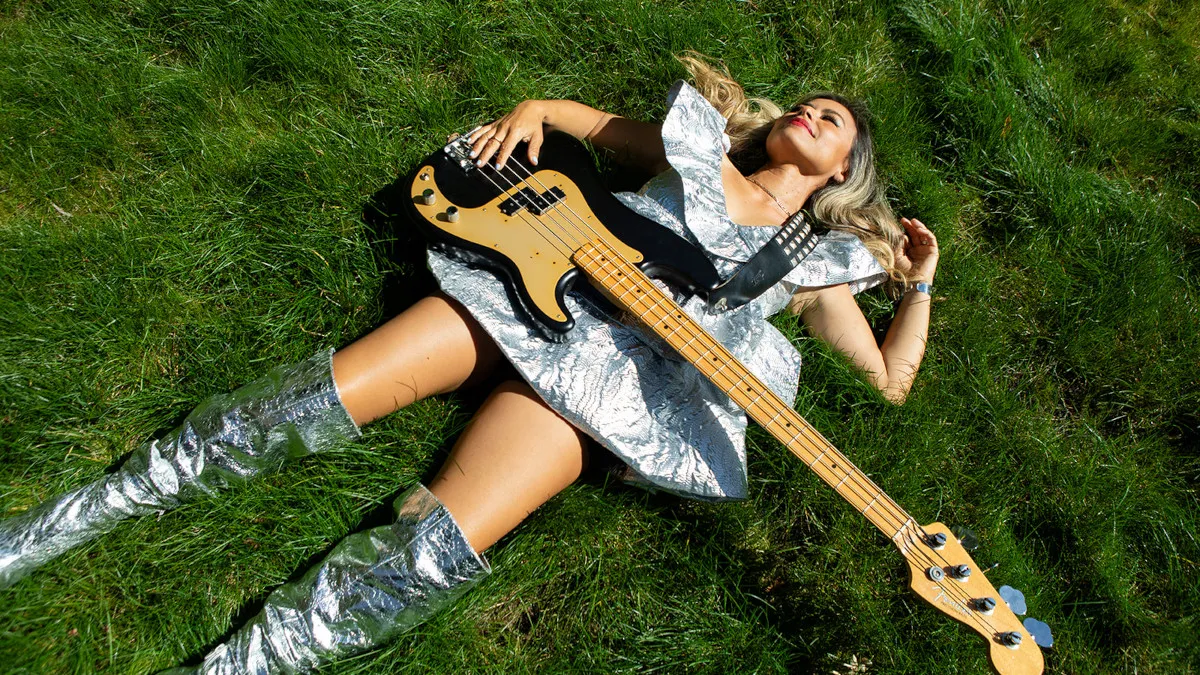
Think Fender Jazz Bass, and what comes to mind? Jaco
Pastorius’s fretless canvas? Larry
Graham or Marcus Miller’s thumb thunder?
John Paul Jones or Geddy Lee’s progressive
punch? While Leo Fender’s
Precision Bass stands as an iconic symbol
of the first mass-produced electric bass
guitar, his Jazz Bass, an arguably perfected
upgrade introduced nine years later, in
1960, is better defined by the musicians
who manned it. In truth, much about the
instrument has a sense of irony, including
the fact that the P-Bass’s perennially
younger, sleeker, sexier sibling has turned
50 this year. Richard Smith, Fender historian,
author, and curator of the Leo Fender
Gallery at the Fullerton Museum, observes,
“What’s interesting is how an instrument
named for and targeted toward jazz
musicians instead became the choice of
rock & rollers, and made its mark very
quickly. Timing-wise, the electric bass was
making the huge transition from ’50s-style
music to ’60s-style music, so the Jazz Bass
not only helped define this new music, it
was defined by the music itself.”
Bob Willocks, Fender’s Manager of
Consumer Relations, concurs: “To me, the
Jazz Bass is the instrument that changed
the whole bass world. The Precision Bass
was the defining instrument in the transition
from double bass to electric bass. But
so many players found their voices on the
Jazz Bass; a great deal of music was developed
on it that was unique to the player
playing it.” He adds, “The J-Bass has this
sort of transparent nature in the way it
was constructed. It’s primitive, as basic as
you can get on an instrument. It doesn’t
force its sound on you, so a player can find
his own way on it.” Super-hot L.A. session
bassist Alex Al, who navigates the current
old-school/modern mindset daily via his
’75 J-Bass, validates this theory: “With its
simple design and layout, the J-Bass allows
my personality to shine through in each
style of music I play. At times, people can’t
tell if I’m using a 5-string, a fretless, a P-Bass,
or even a keyboard bass, and it’s all the
Jazz. Best of all, they can still tell it’s me
playing.”
In tribute to the mighty J, we reached
out to a cross section of players for their
impressions, as well as tracked down the
instrument’s technological
evolution over the past halfdecade.
Among the more
compelling testaments to
the J-Bass’s endurance are
how many other builders
have copied it, and that an
estimated 90 percent of
bassists own or have owned
a version of the instrument.
As the B-52s’ Tracy Wormworth notes,
“Playing a Jazz Bass is like going home.
Every player leaves home to ‘see the world’
and try other instruments—but when you
pick up a J-Bass again that comforting feeling
comes over you, like, Yeah, I’m home.”
As if proving Tracy’s point, Oteil Burbridge,
who started on a J-Bass and has come full
circle playing one almost exclusively with
the Allman Brothers, affirms, “The Fender
Jazz is bass.”
1960s: Pre-Teen Machine
The Fender Jazz Bass was conceived in
1959 as a deluxe-model bass to go with
the Jazzmaster guitar line introduced two
years earlier. After considering the name
“Deluxe Model,” it was renamed Jazz Bass
to appeal to jazz bassists; unexpectedly,
though understandably, converted upright
players preferred the wider neck of the
P-Bass. In addition to being narrower at
the nut (1w" to the P-Bass’s 1e") and having
a rounder neck shape, the 34"-scale
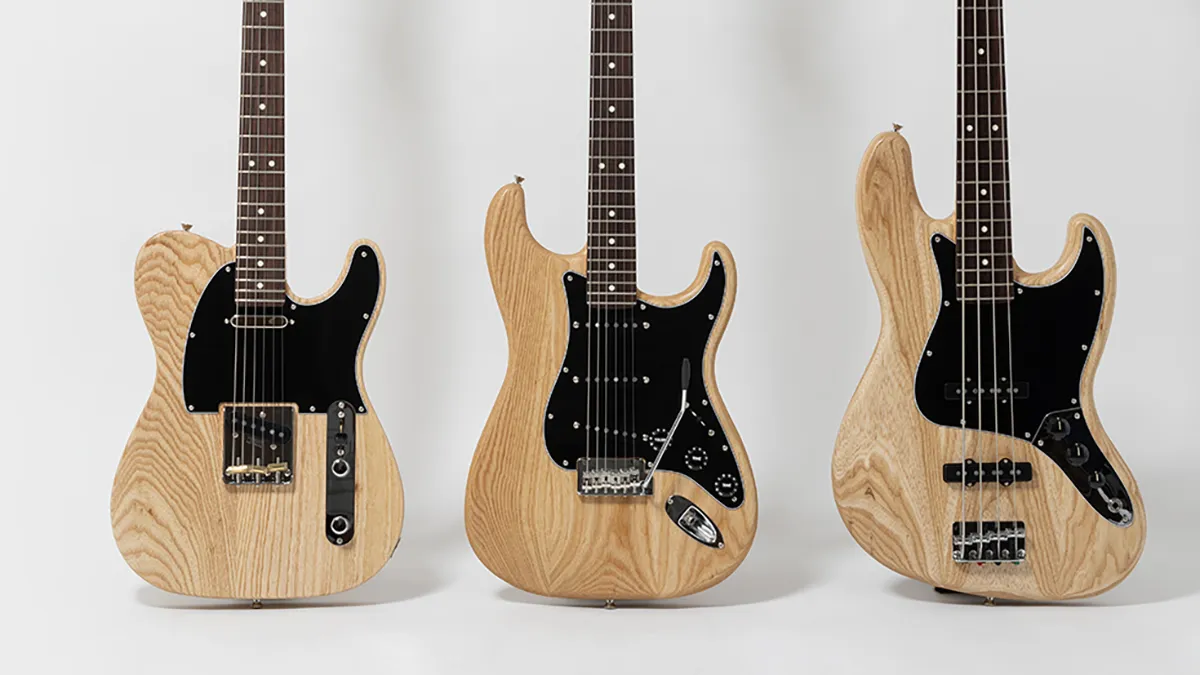
bass featured an “offset waist-contoured
body” that was sleeker though heavier and
longer than the P-Bass, and two separate
single-coil eight-polepiece pickups that
hum-cancelled with both on full. The phase
cancellation of certain frequencies in this
setting provided the instrument’s signature
mid-scooped, punchy sound. From top to
bottom, the original J-Bass sported a fourbolt/
21-fret maple neck and headstock (with a strap button), clover-shaped tuning
keys, bone nut, rosewood fingerboard,
Fender flatwound strings, clay dot position
markers, an alder (or on occasion, ash)
body, white or tortoise-shell laminated plastic
pickguard, G-string-side finger rest (for
pick-playing or thumb-plucking), two
stacked pots with volume and tone control
for each pickup, chrome bridge and pickup
covers (the former adorned with a large
“F”), top-loaded bridge with adjustable string
mutes, and a bottom strap button. In addition
to sunburst or blond, there were 14
custom color options, which included a
matching headstock.
Richard Smith postulates, “There were
two factors going on at the dawn of the
J-Bass: Leo Fender wanted to improve the
notion of what the electric bass was, and
Don Randall in marketing wanted something
new to sell, as he always did. There
really wasn’t much to compete against
except the Danelectro Bass in Nashville—
which led Fender to make their 5- and
6-string basses—and the late-’50s Rickenbacker
bass, which really didn’t get popular
until Paul McCartney used one with the
Beatles. Leo was also very concerned about
the P-Bass blowing up speakers in his amps,
as a result of the percussive spike you get
when plugging in the magnetic Alnico pickups.
For him, it was about the evolution of
guitars and amps, so he’d go back and forth
between them all, making refinements. In
the case of the J-Bass, for which he likely he felt he needed to introduce something
new, improve on the P-Bass, and appeal to
a wider audience.”
Session legend Jerry Jemmott was part
of that audience. “I never wanted to depart
from my jazz roots, so the name alone was
a source of inspiration to me. The body and
the neck of my first J-Bass were so comfortable
and easy-playing it felt like the Grand
Touring Coupe of basses. And the character
of the sound—a raw, punchy, tight, cutting
tone—was great for the syncopation,
ghost-notes, and dynamics I was playing. In
the hands of others, the flexibility of the
J-Bass gave voice to the electric bass guitar’s
potential in all styles and roles, helping
to forge the unique history of our
instrument.”
1970s: Sound Of A Revolution
With Larry Graham, John Paul Jones,
Aston “Family Man” Barrett, Berry Oakley,
and Anthony Jackson among the select
group forming their distinct styles on J-Basses,
and with Jaco on the horizon, the ’70s was
the breakout era for the instrument musically.
Sonically, the most noteworthy change
in the J-Bass design was the movement of
the bridge pickup closer to the bridge by a
quarter-inch, in 1972, leading to a noticeable
change in tone. This would affect the
sound of future J-Bass stars, and became a
factor for bass builders deciding on pickup
placement. The decade also saw the gradual
acceptance of the J-Bass in the P-Bassdominated
New York City studio realm, led largely by Neil Jason, who still plucks his
beloved L-series ’65 J-Bass. “When I arrived
on the scene,” he relates, “there was a lot of
big low end going on, but nobody was really
putting a point on their sound. Coming in
with a J-Bass, I got some weird looks early
on, and I was asked if I had a P-Bass, but I
knew I could favor the neck pickup and
play up near the neck to get that tone, while
both pickups full on or the back pickup
favored gave me that bite. As for the L-series,
I don’t know what it is about them, but every
one I’ve ever tried is amazing. Fender used
an L before serial numbers from 1963 to
1965, though no one has a definitive answer
why. I really like the old-style bridge on it,
which has the string grooves, because precut
saddles are sometimes not exactly right;
the ability to pull the string over that one
millimeter can make a huge difference in
the feel. When you have an instrument you
love, it makes you play a lot better.”
Jason’s Gotham session peer, Will Lee,
who switched to J-Basses in 1975 after
losing his cherished P-Bass in an apartment
fire, adds, “The two-pickup configuration
of the J-Bass is the most practical
design for bassists. Its sonic versatility
enables players to seamlessly glide to and
from different styles of music, while affording
the choice between sounding fat and
round or thin and nasally. Also, for most
players, the thinner neck by the nut translates
into better articulation in those rapidfire-
note-playing situations.”
1980s: Get Back
Perhaps the most significant development
to the J-Bass line in the ’80s, according to
Willocks, was Fender’s vintage reissue basses,
starting with the ’57 P-Bass and ’62 J-Bass,
in 1982. Now called the American Vintage
series, with ’62 and ’75 J-Basses, the instruments
remain very popular. Neil Stubenhaus,
who grew up with J-Basses on the East
Coast before making his mark in the L.A.
studios just as the decade began, offers,
“When I first moved from a P-Bass to a
J-Bass in the late-’60s I was hooked. Like
the P, it was light, perfectly balanced, and
comfortable; the smaller neck was easier to
play and felt more natural, plus the sound
was rounder, smoother, and seemed richer
and more balanced. By the time I had paid
attention to specific basses on recordings,
it was clear that P- and J-Basses dominated
the studio world for a reason: clarity in the
track (I personally chose to combine the
two with a P/J configuration). The way the
bass sits in a track is due to a combination
of many factors, including mix, EQ, and the
density of all the other instruments. A J-Bass
always held the best odds of being heard
clearly and having the definition and punch
one craves in almost any rock, jazz, or R&B
setting, regardless of those factors. One’s
sound is a most personal matter, and many
great players have found magnificent voices
via alternatively styled electric basses. But
it’s hard to argue the dominance of the brilliant
J-Bass design and its utter simplicity,
from inception to all current versions.”
Darryl Jones, who began his impressive
career with Miles Davis, Sting, and the
Rolling Stones in the mid-’80s, observes,
“Many of the great attributes of the J-Bass
are still being revealed to me after playing
them for nearly 30 years. For instance, Bigger
Bang, the last album I recorded with
the Stones, was all done on one ’66 J-Bass.
I used several front and back pickup combinations
to get many different sounds.
Most bassists know that by totally turning
down the bridge pickup you get a tone
similar to the P-Bass, and with the bridge
pickup only you get the classic Jaco sound.
What I hadn’t realized is all the tonal variations
that exist in between these two settings.
During the development of my
signature A Bass, which is based on a
pre-CBS Jazz, I discovered that the original
passive electronics of the early J-Basses
allow them to be heard in a way that basses
with active electronics sometimes cannot
be heard—particularly in very large venues.
I have nothing against active basses, but
there’s an immediacy of sound present with
passive instruments. I call it a ‘bark’—just
another aspect that Leo got so right.”
Tal Wilkenfeld, whose J-Basses are a
’74 alder/rosewood and a ’74 ash/maple,
adds some prudent perspective on vintage
basses. “For a musician, it’s not wise to buy
solely by the year of the bass or its condition.
There are great old J-Basses and notso-
great ones. Often the mint ones turn out
to be duds, and that’s why nobody played
them much; the best ones have the wear
on them. When I got my J-Basses, I first
listened to them acoustically and the wood
sounded amazing; then I plugged them in
and made further evaluations from there.”
1990s: Activate
While the J-Bass was a time-tested original,
it was not impervious to the advancements
in bass guitar design emerging in the
’90s. Willocks credits the introduction of
active electronics and graphite reinforcement
rods for neck stability as the decade’s
key improvements. By 2001, the latter was
perfected into a single Posiflex rod—a hollow
graphite tube with a maple dowel inside
allowing for maximum trussrod adjustments
and flexibility. Marcus Miller, who is credited
with putting the active J-Bass sound
on the map, shares his thoughts. “The J-Bass really made my style. It developed around
my ’77 Jazz, which I chose over a P-Bass,
figuring two pickups had to be better than
one. Everyone said get a pre-CBS Fender,
but I didn’t want a used bass; I wanted a
shiny new one with the smell of a new case!
The run of my basses, 1975 to 1978, had
the bridge pickup moved back and they
were criticized for the three-bolt neck, having
too much finish, and being heavy. But
it turned out to be a very versatile bass, and
when I got into the session scene it was all
about versatility. The active idea came from
Roger Sadowsky, who was maintaining my
bass. He recommended and installed a preamp
to give me some control of my sound
in the fast pace of the studio. When I listen
back now, I really hear the difference
in tone—growly before the preamp and
more round after. Best of all, it wasn’t an
overly electronic, active sound; it was still
the tone of the J-Bass, with a little bit of
steroids. There are even some records I did
before the preamp where the engineer got
close to that sound by boosting the lows
and the extreme highs.”
He continues, “When I road-retired my
’77 and went looking for a J-Bass from the
same era, I learned all the subtle differences
that contribute to tone. Like, was the
tree the wood came from closer to the river
or further back? Because the closer trees
absorb more water, thus the more porous
and lighter the wood becomes, and you get
a bass with a more open sound. Overall,
to me the J-Bass fits nicely smack between
the upright and the guitar, whereas a lot of
newer basses are slanted toward a guitar
sound and feel. It’s harder for me to play
some of the more modern soloistic stuff on
my J-Bass when compared to the flatter
necks and setups on more recent basses,
but the sound justifies the extra work I have
to do. And groove-wise, when you have to
support the band, there’s one frequency
down there waiting for you that’s not taken
by the guitars and keyboards; the J-Bass
fills that space perfectly.”
Like Miller, Victor Bailey is a jazzrooted
J-Bassist who launched his solo
career at the start of the decade. He recalls,
“When I was coming up, everyone in R&B
was playing a J-Bass because of Larry
Graham, and then Jaco came out and I
was even more attracted to the sound. I
bought one and soon realized it was the
one bass that sounded good no matter
what style or technique I played. There’s
a purity to it; you’re really hearing the
sound of the body, the wood, and that
makes it very personal. Anything I’ve ever
conceived or wanted to attempt comes
out freely on my J-Bass; I can get the sound
of me. I also love the versatility of the
instrument—I use every combination of
pickup shading. It’s the bass I’ve used
throughout my session and sideman
career. Leo and his team really thought it
through, from the pickup placement to
the headstock shape and tuning keys on one side to the horn and cutaway design,
so you can reach the upper notes and have
balance. The J-Bass is like the piano—it
doesn’t need to be redesigned.”
Another J-Bass purist in the decade was
Geddy Lee, who settled on his ’72 J-Bass
after seeking the more aggressive sound of
a passive bass for the recording of Rush’s
Counterparts in 1992. Geddy addressed his
current lineup of J-Basses and their tonal
details in BP’s August ’07 issue.
2000s: Design Expansion
With nine Fender lines featuring J-Basses,
plus various artist models, the first decade
of the new century was all about variations
on a theme. Willocks notes the 24-fret J-Bass,
available in the mid ’00s, was an interesting
design challenge. “Having 24 frets
changes everything; the position of the
bridge and pickups, and where the neck
comes into the body—for slappers that
meant having a different fundamental when
playing at the base of the neck.” The number
of frets is also a factor on Steve Bailey’s
signature Jazz Bass VI, the first new J-Bass
designed from the ground up. Says Steve,
“I’ve always loved the Jazz; all of my 6-strings
have been modeled after it. I feel like I’ve
been playing Fender 6’s my whole career;
it just didn’t have the Fender name until
now.” The other prominent feature of Bailey’s
34"-scale 6, built by Fender’s Michael
Frank Braun (who also built Marcus Miller’s
signature 5), is its aysmmetrical neck, which
is thinner on the G-string side and thicker
on the B-string side. Although Bailey
brought this element in from his other 6’s,
Fender used the concept on Roscoe Beck’s
signature Fender 5 some years back. Adds
Steve, “The J-Bass in any version is a sexy
instrument, much like beautiful women—
there are so many varieties.”
The Mars Volta’s Juan Alderete has long
been a fan of J-Basses and their nuances.
“The J-Bass was what my heroes, Jaco and
John Paul Jones, played, so I set out to follow
their lead. Initially, I was drawn to the
deep bass response of both pickups on, but
once I realized Jaco favored the rear pickup,
it changed my whole approach to music.
Harmonics, string scratching, and how feedback
sounded all came to light for me.
Effects react differently to the rear pickup,
too. Sonically, the J-Bass sits solidly with
the bass drum. Overall, bass became meaner
and more profound in the band when the
J-Bass came on the scene.”
So what does the future hold for the
Jazz Bass? Predicts Willocks, “There are
certain basic principles that won’t ever
change and other aspects that will. We have
vintage platforms that are extremely popular,
and other platforms we use for evolution,
like the American Standard and
Deluxe series, and artist models. All of these
will keep growing as long as we have great,
creative ideas coming in.”
A DOZEN GREAT JAZZ BASS MINDS, 11 GREAT J-BASS LINES
Although jazz-monikered, the J-Bass steadily made its presence felt in all styles of music, led
by an array of forward-thinking thumpers featured in the following examples.
Ex. 1 recalls the main riff of Jimi Hendrix’s “Little Miss Lover” [Axis: Bold As Love, 1967]. Noel
Redding and Hendrix were tuned down to Eb for the recording; remember Hendrix is doubling
you, so keep it firmly in the pocket. Rock’s next J-Bass powerhouse was Led Zeppelin’s John Paul
Jones. Revisit BP’s Feb. ’08 cover story for in-depth excerpts from “Good Times, Bad Times” and
“Black Dog.” Ex. 2 contains the main riff of Sly Stone’s “Sing a Simple Song” [Stand!, 1969].
Emulate Larry Graham’s stone-solid rendering, and then dig his contrasting looseness in the bridge.Joe Osborn’s trademark slides and melodic,
upper-register parts are in full display on the Carpenters’
“For All We Know” [Carpenters, 1971].
For the four bars of the verse, shown here in
Ex. 3, think legato and lyrical. Jerry Jemmott made
Tommy Cogbill’s “Memphis Soul Stew” one-bar
ostinato (shown here in Ex. 4’s first measure) his
own, on Aretha Franklin’s 1971 Live album. Check
out the King Curtis YouTube clip of the song to
hear Jerry’s taut feel and one of his occasional
variations, captured in the second measure.
Perhaps Jaco Pastorius’s most enduring melodic
reading, Ex. 5 features four bars of the first theme
of Weather Report’s “A Remark You Made” [Heavy
Weather, 1977]. Despite his Bass of Doom having
no frets, note how Jaco rolls up to some of
the notes, using his index, middle, and 3rd fingers
for consecutive hammer-ons. Don’t worry about
executing beat three of bar 3—the Db and Ab 5th
would be overdubbed, or arpeggiated from the
top note down, as Jaco did live.
Ex. 6 contains four verse measures from Bob
Marley’s “Could You Be Loved” [Tuff Gong, 1980].
As seen here, Aston “Family Man” Barrett is a
master of mixing melodies with more rhythmically
dense phrases in his Rasta rumble; keep
the bounce in your rendering. For his watermark
work on Chaka Khan’s 1980 disc, What Cha’
Gonna Do for Me?, Anthony Jackson tuned his
J-Bass down two whole-steps (thus the odd tab
markings here). Ex. 7 is from the outro (at 3:37)
of “Night Moods,” where Jackson makes the
most of his fill space with tasty note choices
from the Fmaj7#11 chord. Anthony had to play
with a very light touch, given the string tension; try to match his eveness throughout the phrase
and the separation between his notes. Ex. 8
shows Tommy Shannon’s driving bass line on
Stevie Ray Vaughan’s “Crossfire” [In Step, 1989].
Like Hendrix and Redding, Vaughan and Shannon
were always tuned down to Eb; pace yourself
and give the rests their full value.
For sheer range on a J-Bass, look no further
than Victor Bailey’s “Kid Logic” main melody
[Bottom’s Up, 1989], shown in Ex. 9. As you get
the fingerings together, listen and try to acclimate
to how hard Victor is swinging. Turning
to a bonafide bass anthem from the ’90s, Ex.
10 contains the opening four bars of Marcus
Miller’s “Panther” [The Sun Don’t Lie, 1993]. The
section is rubato, with an E minor tonality; try
to match Miller’s phrasing and breathing. Finally,
Ex. 11 is Geddy Lee’s raucous opening bass line
on “Malignant Narcissm” [Snakes & Arrows,
2007]. Keep the open A string ringing, and mind
where the downbeat is and isn’t pushed.
TIMELINE
For an expanded
Jazz Bass timeline,
including
pivotal moments in
the careers of
prominent J-Bass
players, go to
bassplayer.com
1959
Conception of an
upgraded companion
bass to the
Precision Bass, originally
called “Deluxe
Model” and quickly
renamed Jazz Bass;
prototype design
has soapbar
pickups and
3-knob configuration
1960
First production JBass
built in March;
appears on the July
pricelist at $279.50
for a sunburst model,
$293.47 in blond or a
custom color
1962
Stack knobs (introduced
in 1960)
replaced by original
3-knob design
1963
Round, laminated
fingerboards replace
slab fingerboards;
rubber mute glued
to the inside of the
bridge cover
replaces individual
string mutes
1964
White vinyl pickguards
replace tortoiseshell
pickguards;
faux pearl dot markers
replace
clay dots
1965
First version of CBSowned
Fender Jazz
Bass includes bound
rosewood fingerboard
and pearloid
dot markers
1966
Medium jumbo frets
replace smaller frets;
oval (or paddle) tuning
keys replace
clover keys, and no
longer turn backwards;
maple fingerboard
introduced,
with block inlays
(black on maple,
pearloid on rosewood);
bone nuts
phased out for hightech
plastic nuts
1969
Larger, bolder logo
decal replaces traditional
logo; headstock
strap button
removed and placed
on upper
body
horn
1972
Bridge pickup
moved about a
quarter-inch closer
to the bridge, introducing
noticeable
tonal change
1974-75
Pearloid blocks on
all necks, white
binding and block
inlay for maple fingerboards;
3-bolt
“Micro-Tilt
Adjustable” neck
(mid-1975); “Bullet”
trussrod adjuster at
headstock end
1976
Headstock logo
redesigned; serial
number moved from
neck plate to headstock
logo
1977
Control knobs
changed to black
plastic, with numbers
1981
J-Bass Standard
introduced, with bullet
trussrod and
white pickup covers
1982
Vintage ’62 J-Bass
reissue offered;
Japanese-made
products introduced,
including the lowercost
Squier line,
which features a
Jazz Bass
1983
J-Bass Standard
second version
includes control
plate and jack all
on the pickguard,
and returns to a
four-bolt neck
with dot
markers
1988
American
Standard J-Bass
introduced, with
larger body
shape, curved
neck plate set
into chambered
pocket, 22-fret
neck, vintagestyle
top-load
bridge, two separate
volume controls,
and passive
TBX tone circuit
1989
J-Bass Plus
introduced: first
J-Bass with
active electronics;
also features
downsized body,
Lace Sensor
pickups, Schaller
Elite fine-tuner
bridge, and
alder body
option
1990
First Jazz
5-string introduced:
the J-Bass
Plus V, with Pao
Ferro or
Rosewood fingerboard
and
all five tuning
keys on
one side; the
American
Standard 5
follows in
1995
1995
U.S.A. J-Bass Deluxe series introduced,
with 22 frets, 3-band/18-
volt active EQ on some models;
initially available with John Suhr
single-pole pickups, changed to
Bill Turner dual-coil Ceramic
Noiseless pickups, and then to
Bill Lawrence Samarium Cobalt
series pickups in 2004; in 1998
the line is renamed American
Deluxe J-Bass; Strings-Thru-
Body bridges are also introduced
as an option on Standard and
Deluxe Jazz models
1991
Custom
Shop creates
Jaco Tribute
’62 J-Bass,
100 made;
Mexicanmade
version
introduced,
some with
basswood
or poplar
bodies
2001
Custom Classic
line from the
Fender Custom
Shop introduced,
including 4- and
5-string J-Basses
with ash bodies,
C-shaped necks,
and 3-band/18-
volt preamps
2002
Jazz 5-strings
get 4+1 tuning
key configurations,
two
Hipshot string
trees, asymmetrical
neck
plate, and
contoured
neck heel
2005
Korean-made
J-Bass 24 introduced,
with
alder body, 24
frets, and
Basslines pickups;
a 5-string
version is added
in 2008, but
both are discontinued
in 2009
2003
American Series
J-Basses get S-1
Switching
Systems,
allowing
pickups to
be operated in standard,
parallel, or series; moderately
priced Highway
One Jazz Bass introduced,
with Leo Quann
Badass Bridge and, in
2006, a Greasebucket
tone circuit
2008
American Series
replaced by American
Standard series (different
from the 1994
American Standard
line); features include
rolled-edge neck,
high-mass vintage
bridge, Hipshot lightweight
tuning keys,
and the removal of
the S-1 Switching
System
2009
Steve Bailey
Signature
J-Bass VI
introduced,
Fender’s first
contrabassstyle
6-string
[see
main
story]
2010
50th Aniversary
Limited Edition
J-Bass introduced
[see
review, page
50]
BASS OF DOOM UPDATE
It remains the most famous Fender
Jazz Bass of all, Jaco Pastorius’s
sunburst fretless ’62 “Bass of
Doom” (serial # 57308), heard on
his solo albums and recordings with
Weather Report and Joni Mitchell.
Soon after buying it in the early ’70s,
Jaco reportedly removed the frets
with a butter knife and filled in the
slots and dinks with plastic wood
and several brushed-on coats of boat
epoxy. Jaco started on a ’66 J-Bass,
bought new, and went on to own
and play dozens of J-Basses, mostly
early ’60s models—including his main
fretted, a sunburst ’60 J-Bass
he used on tour with Joni
Mitchell. But it’s the “Bass
of Doom” that remains the
holy grail, especially after
it was recovered a few years
back [see BP, April ’08].
The fate of the infamous
4-string continues to be
in the hands of the federal
courts, with the possibility
of a trial that could begin
this spring or summer. The case involves the
instrument’s current owners—who purchased
the bass legally, from a private citizen—and the
Pastorius family, which contends the bass was
stolen from and not sold by Jaco in New York
City, circa 1986, and therefore not subject to sale.