Main Site Navigation

Your current location
BassPlayer.com >> This Month >> Tiran Porter On Rollin' With The Doobie Brothers

Tiran Porter On Rollin' With The Doobie Brothers

For most of us, life on tour sounds like a never-ending party. Between 1971 and 1980, Tiran Porter had a true dream gig: in the powertrain of classic rock supergroup the Doobie Brothers. In his tenure with the band, which saw relentless touring and prolific recording, the Doobie Brother learned a lesson that’s stuck with him until today: You’ve gotta work to play.

Porter began his career in the mid ’60s as a working bass player on the Los Angeles scene, moving north to San Jose around 1970. Playing with guitarist Patrick Simmons, Porter met Doobie Brothers singer/guitarist Tom Johnston, drummer John Hartman, and bassist Dave Shogren when the three played as a power trio—until, that is, the three Doobies approached Simmons about joining the fledgling band. With Shogren already in place, Porter was left out of the loop, but when Shogren quit the band after the band’s first album and tour fell flat, Tiran got the call to come sit in. “We just jammed around for a bit,” Porter recalls. “Then they said, ‘Hmm, we think this will work. Go get the rest of your stuff.’ I moved into the Doobie house on 12th Street in San Jose, and that was that.” For the next nine years, Tiran and the Doobies toured ceaselessly and recorded eight studio albums.

The Doobie Brothers’ country-tinged rock boogie plugged it into the same circuit as West Coast acts like the Eagles and the Grateful Dead, and the band soon established a loyal fan base, its free-wheeling outlaw image drafting fans from the rough-and-tumble biker set. On hits like “Long Train Runnin’,” “Jesus Is Just Alright,” “Rockin’ Down the Highway,” “China Grove,” “Black Water,” and “Listen to the Music”, Porter personified roots-rock style, his straightahead approach and extra-wide tone giving the Doobie machine its groove traction.

Michael McDonald’s arrival for 1976’s Takin’ It to the Streets marked a stylistic shift for the band, as McDonald’s angelic voice and glossy keyboards smoothed the band’s rougher edges on hits such as “What a Fool Believes” and “Minute by Minute.”


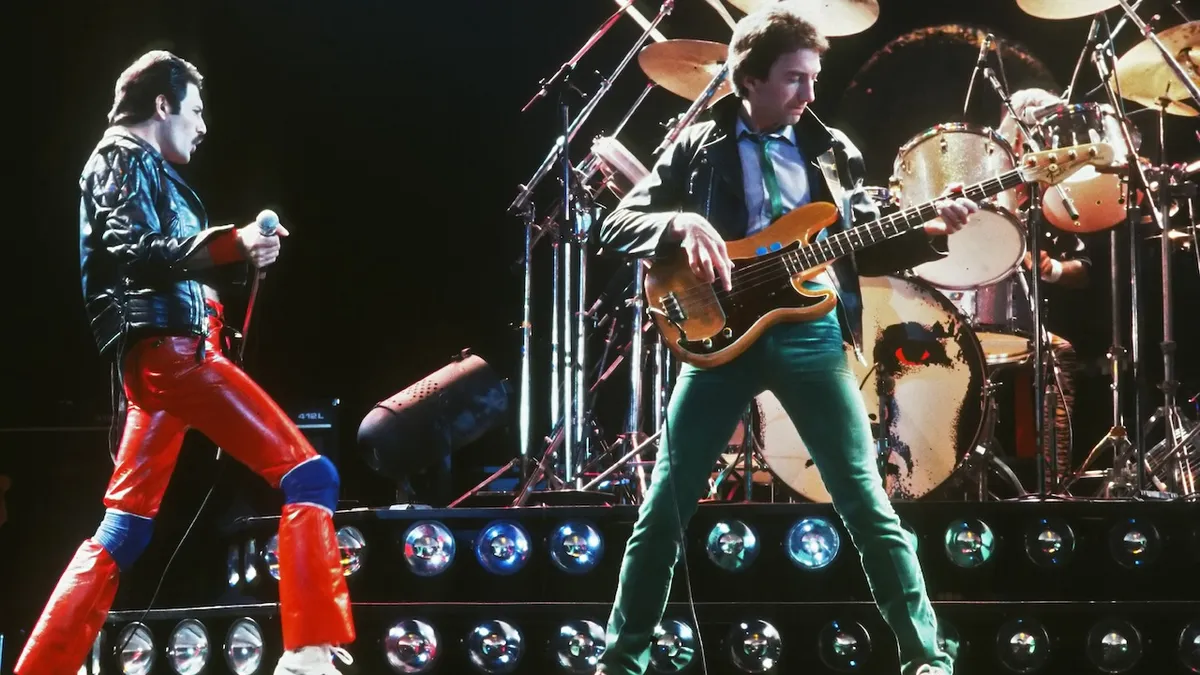
Judging from photos, you rarely played the same bass for long with the Doobie Brothers.
That was by design—I took a different bass on every tour. I always liked getting different sounds, and once I realized we were going to be on the road for a long time, I thought it would be a good way of dating photos later on!

For my first gigs with the Doobies, I played a ’66 Fender P-Bass. That was my first good electric bass. I’d started out on a Teisco that was horrible. I had always admired Jack Bruce’s bass tone with Cream, so I wanted to get a Gibson EB-3. Since EB-3s are short-scale, I got an EB-3L, which has a 34w" scale. Like a fool, I traded in my ’66 P-Bass at Tom Rouse Music City in San Francisco. A couple of gigs later—when I realized my mistake—I went back to get the bass back, but it was already gone.

I used an Alembic on a few tours, but it was too heavy. Then I played a Rickenbacker 4001 for a while before getting another P-Bass—a ’67 or ’68 with a translucent black finish. There were a lot of different bass tones on the Doobie albums. I remember renting a hollowbody Rickenbacker for a couple of tracks on The Captain and Me and What Were Once Vices Are Now Habits.

How did the Doobie Brothers come to have two drummers?
It was just John Hartman on drums for the first ten or 15 gigs. Then we did a gig at San Jose State University where Mike Hossack sat in. It was so cool that we went, Hey, what about two drummers? The Allman Brothers are doing it, and so is James Brown—why not us?

How did that work?
They would link up, and they’d take turns playing fills. But mostly it was both of them just keeping straight time. It could be tough, because Mike tended to play behind the beat and John tended to play on top of it, which is where I like to lay. So things got a little elastic from time to time. But it felt a hell of a lot more powerful with two drummers—it gave us a way larger backbeat.

When we first started touring, both drummers played on the floor. I loved that, because everything hooked up, sound-wise. When they started playing on risers, it decoupled us from one another. When they were on the floor, I could feel every tom hit and every kick coming through the floor with the bass. It made things really gel.

What was your live rig?
Tom was using a Marshall stack, and Pat was using an Ampeg V-4, so they were loud. The only bass amp that was loud enough to match was the Acoustic 360. I used two of those. Because those cabinets have a folded horn, the bass frequency doesn’t break until about 15 feet in front of the cabinet. So I would put them back between the drummers, and I’d stand about six feet in front of them. I started off standing to the side of the drums, but I wanted to hear a good stereo mix of both drummers, so I lobbied to stand in the middle.

Have you always played with a pick?
I mostly played with a pick; I’d started out as a guitarist, and Paul McCartney was my bass model. I’d pick right between the bridge and the pickup, sometimes using my palm to mute the strings. But I’d play with my fingers on occasion, like on ballads. When I quit the Doobies in 1980, I started playing exclusively with my fingers. I haven’t played bass with a pick since.

Why did you end up leaving the band?
I started having problems with being on the road all the time. We were constantly on the road, and I didn’t have a life. Right in the middle of recording One Step Closer, our management put us on the road, yet again. That’s when I balked and said, “We need a break. If you can’t give me a break, I’m leaving.” And so I did, in 1980.

You came back for a reunion in 1987.
Yeah, they dragged me back in. It started with a full-band reunion of 13 members. We toured the West Coast with everybody who’d ever been in the band, with the exception of Dave Shogren; it would have been counter-productive to have two bass players. It was four drummers, four guitar players, two keyboard players, a percussionist, and moi. It was the most fun I ever had in that band—it was awesome!

Do you have any advice on how to navigate the business side of music?
If you make some money, invest it. The first thing I did with the first big Doobie Brothers check was buy a car and a house. And I’m still living in that house, 33 years later.

I came from bands that wrote their own material, but since we never really recorded that much, we didn’t get into publishing. I feel the guys from the Doobies should have explained a few things to me when I joined the band. I contributed many melody lines, licks, and bass lines to the first couple of albums, but they never told me anything about publishing, so I didn’t know to demand my cut.

What’s something you wish you had gotten credit for?
For “Jesus is Just Alright,” Mike Hossack had the idea of slowing the middle section down—there is no middle section on the original Byrds recording. I came up with the “Jesus is my friend, Jesus is my friend” line and that melody. I couldn’t sing it, so I gave it to Patrick to sing. Well, he seems to have forgotten that I came up with that, so I never got credit. Robert Randolph’s band covered that song, and Eric Clapton sang my lyrics. I wish I had insisted on a writing credit.

You play a great fill on “What a Fool Believes,” from Minute by Minute
That’s my only contribution to that song, because Michael wrote the bass line. I was trying to create a melodic bridge between sections.

One of your most angular and unusual lines comes from the verse of “Takin’ It to the Streets.”
There’s a definite reason for that: Michael’s playing 16th-notes with his left hand, pedaling on G. It didn’t sound right for me to match that, so I made up a line that plays against what he was doing.

Your attack sounds almost like slap bass.
That came from really digging in with a pick on a P-Bass.

Your meticulous articulation on the pre-chorus really establishes the song’s groove.
I’m not a very flashy player, and I never have been. I try to pay attention to both the melody and the rhythm, so I let some notes ring out, and I play some staccato—like a bass drum.

On later albums like Livin’ on the Fault Line, I think I overplayed. We had started writing songs in the studio with just chord changes and drum parts, and no idea of the melodic and lyrical content. Then we’d go away on tour while they’d add the lyrics and melody. I didn’t have a chance to go back in and modify my bass line to fit. It drove me nuts.

These days you seem to stay busy playing with the Santa Cruz White Album Ensemble, performing entire Beatles albums live.
The White Album Ensemble has done everything from Rubber Soul through Abbey Road. We’ve even paired up with the Santa Cruz Symphony for performances of symphonic Beatles music. It’s been great. I’m playing all of the Beatles material on fretless; I’ve been playing fretless exclusively since 1992, and I’ve gone back to using flatwounds—D’Addario Chromes. Roundwounds just don’t have the thud I like. I have a number of “Frankenstein” fretless basses—I can’t seem to find production-model basses that meet my standards. I prefer ebony fingerboards, and I like particular pickup configurations. One is a Fender-style bass with three pickups: a Gibson pickup at the neck, a Precision pickup, and then a Jazz pickup at the bridge.

I played a fretless Rickenbacker for a few shows, but I wasn’t quite getting the punch I wanted. So I put together four active Fender-style “Frankensteins.” The first has two MusicMan pickups, one has two Jazz pickups, another has a PJ configuration, and another has a single MusicMan pickup. They’ve got different body woods—they’re mostly mahogany, but the PJ bass is korina, with a maple fingerboard. Plus, I play an NS Double Bass for acoustic shows.

My speakers of choice are Euphonic Audio—mostly 10" speakers. I’m using Carvin power amps, and several different preamps—Fender, Ampeg, Trace Elliot, and Ashdown. I run a different preamp to either side of the power amp, so I get a really complex waveform. It sounds like God!

Aside from the White Album Ensemble, who else do you play with?
I’ve played with Stormin’ Norman & the Cyclones for 20 years, and I play out with Jerry Miller from Moby Grape.

Of your time with the Doobie Brothers, what gives you the most pride?
For one, I was the only black person in a white rock band to be up singing—not just back in the rhythm section. It was something I was working toward since seeing the Love—one of the first integrated rock bands—back in the ’60s. I thought, Now here are black people playing the kind of music I like!

Over the years, you’ve certainly carved out a place for yourself.
I happened to watch a James Cagney movie the other week—The Time of Your Life—and a particular William Saroyan line stood out to me as a musician: “It takes an awful lot of rehearsal for a man to get to be himself.”

Porter's Props

Bass Player is always happy to receive reader feedback—especially if it comes from a dude like Tiran Porter. “You guys should do more articles about band bass players,” says Tiran, who has been reading the magazine since day one. “Not just the heavy hitters, but guys who really defined the sound of their bands.” Before sitting down for his own interview, Tiran prepared this list of players he’d like to see in the magazine. Send us your own list at bassplayer@musicplayer.com.

Bob Mosley with Moby Grape. “Great player, great singer.”
Greg Reeves with Crosby, Stills, Nash & Young. “He did only one album with them, but there are two songs on the Woodstock album that he plays with Crosby and Young.”
Carl Radle with Eric Clapton. “He was also with Gary Lewis & the Playboys, Leon Russell, Joe Cocker, and Bonnie & Delaney. The guy was amazing.”
Steve Winwood with Traffic. “He played everything on the early Traffic albums.”
Paul Samwell-Smith with the Yardbirds.
Kenny Edwards with Linda Ronstadt. “He was also in a band called Brindle, some of the best songwriters you’ll ever hear.”
Tommy Caldwell with the Marshall Tucker Band. “He’s also a great singer.”
Bruce Palmer with Buffalo Springfield.
James Dewar with Robin Trower. “Somebody told me that he died a few years ago, but I never saw anything on his death.”
Lamar Williams and Berry Oakley with the Allman Brothers.
John Doe with X.
Leon Wilkinson with Lynyrd Skynyrd.
Joe Puerta with Ambrosia. “Incredible.”
Doug Stegmeyer with Billy Joel.
Jimmy Bond. “He’s an incredible acoustic bassist from L.A.”
Royston Langdon with Spacehog. “He was also the lead singer—very McCartney-esque.”
Aimee Mann with ’Til Tuesday. “She wrote all the songs and played bass. She was great.”
Keith Wilkenson with Squeeze. “A great fretless player and singer.”
Dave Shallock with the Sons Of Champlin. “If you’re not familiar with the band, you need to educate yourself. Great psychedelic soul with a horn section that wouldn’t quit, and bass work that’s world-class.”
Niels-Henning Ørsted Pedersen and Scott LaFaro with Bill Evans.

Album File

All Doobie Brothers records on Warner Bros., except where noted.

1972 Toulouse Street
1973 The Captain and Me
1974 What Were Once Vices Are Now Habits
1975 Stampede
1976 Takin’ It to the Streets
1977 Livin’ on the Fault Line
1978 Minute by Minute
1980 One Step Closer
1989 Cycles [Capitol]
1991 Brotherhood [Capitol]


External Weblinks

Bass Player is part of the Music Player Network.


This is the end of the page [ Back to start of the page ]
 
-->