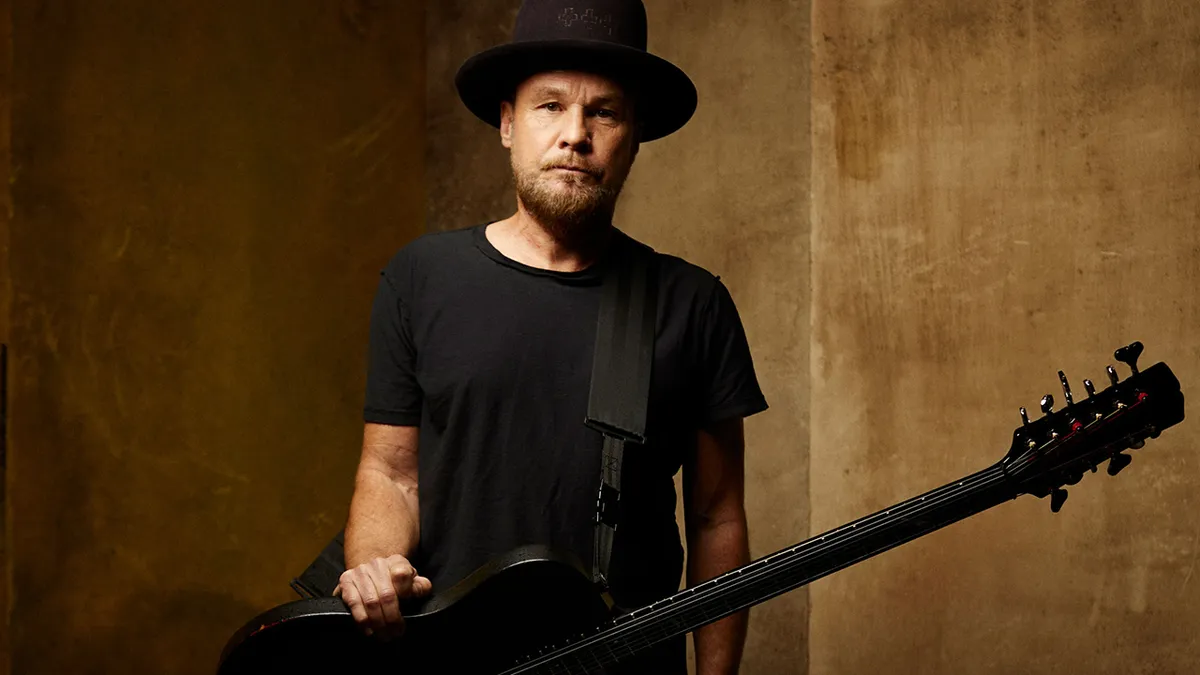
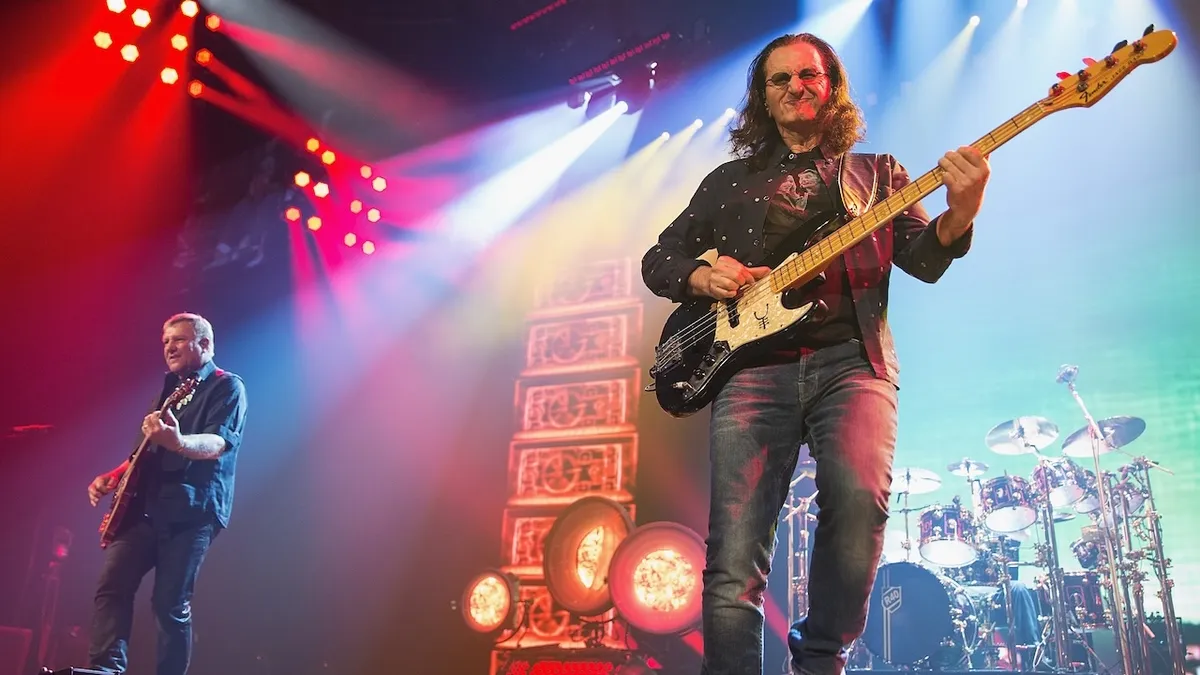
Gordon has juggled multiple projects
throughout this decade. His documentary
film Rising Low honored
founding Gov’t Mule bassist Allen
Woody and covered that band’s Deep
End tribute project, which featured a
slew of bass legends including John
Entwistle and Chris Squire. Gordon’s
short stint in the Rhythm Devils paired
him with Grateful Dead drummers
Bill Kreutzmann and Mickey Hart.
Significant Gordon studio recordings
included two delightful duet CDs
with acoustic guitar fingerstylist Leo
Kottke, and Gordon’s solid, songoriented
solo effort, The Green
Sparrow [see November ’08].
Soon after he got his own group
together, Phish came calling again. The
band rehearsed over the winter, and
emerged to do a few shows during the
first weekend of March at the Hampton
Coliseum in Virginia. In conjunction
with this year’s reunion and tour
announcements, Phish released the
Clifford Ball DVD set, which consists
of concert footage from 1996. We
connected with Gordon just after the
Hampton shows, and just before Phish
headed into the studio with producer
Steve Lillywhite [U2, Peter Gabriel] to
begin brewing a batch of fresh material.
How did it feel when you first got back
in the fold with Phish?
I’ve spent the past few years focusing
on my solo career, so it was a major switch.
I was a bit worried going in, but I got
inspired as soon as we started playing
together again. Interplay was the first factor;
there’s just no substitute for 25 years
of experience. We started with “Back on
the Train.” It was weird how the rented
bass rig started sounding so much better
to my ears once everybody dialed into the
subconscious chemistry, and began filling
various holes in the groove. One of Trey’s
new songs also motivated me; the only
bizarre aspect was one extra beat in its
repeating pattern. Sometimes a slight
tweak is more groundbreaking than ten
minutes of craziness. Of course, Phish
does plenty of that as well. We wound up
practicing for 36 days in order to work
out new material—which we’re mainly saving
for the record.
What was the biggest challenge
about digging back into the catalog?
Well, people who aren’t in the know
about Phish don’t realize the role of the
composed material. We call it the “woked,”
because it’s worked out—our road manager
accidentally dropped the “r” when
he wrote down the list a long time ago.
We played that material less and less over
the years, but we assigned ourselves the
task of learning the 20 most difficult songs
for this tour. About half of them are written
out on paper, and the other half are
not. Songs such as “Foam” and “Split
Open and Melt” are intense; I have to
memorize each song like a story because
there are no consistent time or key signatures.
The rhythms are easier to remember
than the melodies. The instrumental
section of “Split Open and Melt” is a good
example of how I have to bounce around.
As soon as something appears to be
regular—such as a whole-tone scale—there
are some chromatic notes added in that
make it irregular. I have to find places on
the fingerboard where I can execute most
easily. I utilize open strings in order to
bounce between chromatic runs without
switching positions.
Explain that a bit further—what’s your
base position?
It’s the 6th position. I play a 5-string
bass, so my index finger is on the F of the
lowest string. I walk up chromatically to
G#, and that’s when it gets interesting. I
skip to the open A, and then I hit A# at
the 6th fret of the E string. Then I walk
up chromatically to C# before jumping to
the open D string, and so on. By maintaining
my position at the 6th fret, I’m
able to call up any of the 12 notes in
strange combinations. I learned how to
do that in order to accommodate Trey’s
writing style back in the early years.
Do you still play the same way?
I’ve been trying to use open strings less
because they sound so different from fretted
notes, and require different muting. On
the other hand, I’m not going to go relearn
“Split Open and Melt” because it’s so much
work to recall it using the muscle memory
I already have. That’s a little frustrating,
because I think I could make the line groove
better if I altered the fingering. Even if I put
in the rehearsal time, I’m not sure which
fingering would stick once I got onstage, so
I pretty much have to revert.
“Fluffhead” was the most challenging
song to relearn because there are so many
sections—it’s just relentless. The intricate
material can be a bear, but it can also be
encouraging. It forces me to play differently,
and acts as a launching pad for the improvised
material. Believe me—after playing ten
minutes of memorized music, you’re really
ready to jam.
What goes though your mind when
you’re in the middle of a great jam?
When you really get into the Zen of it,
magical experiences start to happen where
the whole groove starts lifting off the ground
like a flying saucer. I’m attached via my
bass, and the interplay causes elevation. I
focus on giving each note maximum space
and depth. I don’t look at the fingerboard,
but I imagine it while I’m playing. I don’t
really plan what I’m going to do next. That
happens subconsciously as I react to the
other players. I might put one note a little
behind the beat, or play the same wholenote
five times in a row to raise an eyebrow.
If I notice the guitar is accenting the “and”
of two, I may jump on it as well. If I decide
to grab a b6th with my pinkie, and someone
else joins me—the ship rises even higher.
Each moment presents its possibilities. If
you stick to the album version of a song, or
play what’s expected, then you rob the
moment of the beautiful things that happen
when the music plays itself. Frequency,
groove, dynamics—all the elements of
music—are tools you can use to stay on that
flying saucer.
How did the Hampton shows go?
We might have been trying to prove
something on the first night. We started with
“Fluffhead” and played a lot of other orchestrated
material, so it was a little difficult to
get the groove going. I was surprised at how
much I loved the other two nights. They
were the highest-energy concerts I have
ever experienced—period.
You play a Languedoc bass on the
Clifford Ball DVD. When did you switch
to Modulus basses?
I switched in the late ’90s because I liked
the low-end clarity and the consistency of
the graphite neck. My first one was a standard
bolt-on Quantum 5 with single-coil
EMG pickups. I eventually switched to DC-
40 humbuckers because they sound more
even across the entire spectrum, and they
have a punch that blends well with the kick
drum. The story of how I wound up with
my neck-through Q5TBX bass is pretty
funny. I read a BASS PLAYER article on Phil
Lesh that mentioned how Modulus had
made him a custom bass, and that they were
working on one for me. So I called them
up and said, “Hey, where’s my bass?” They
took another year or two because it’s so
hard for them to construct a neck-through
instrument. They have to glue the graphite
onto the wood. It gets messy, and the oven
has to be really hot. They eventually finished
mine. The body is made of alder, and
the top is figured walnut. The scale length
is 34" inches rather than the typical 35".
I’ve been using it ever since.
Do you use your David King bass in Phish?
Not much, but I use it a lot for local
honky tonk gigs and sit-ins. The Dave King
is a short-scale, “headless/bodyless” 5-
string with Mørch pickups. It’s super
portable and has lots of handy features,
including an Aguilar preamp, an RMC
piezo bridge pickup, and a built-in tuner.
I bring it along a lot, but I actually find
the best sit-in strategy is to borrow gear
from whoever is on the gig. He or she
already has the bass and the rig dialed.
What is the advantage of the Meyer
Sound gear that you use?
The sound is clear, massive, and more
consistent than a standard bass rig. Phish
plays so many different kinds of venues that
I find it worth the trouble to tote around
and tweak. When you improvise as much
as we do, you need a safety net. You can’t
worry about your sound changing as the
night progresses, and that happens with
most rigs. The cabinet is tuned for the
speaker’s resonant frequency, but that can
rise as much as an octave as it heats up during
a gig. The active Meyer speakers I use
incorporate a “smart” system. It automatically
switches crossover points when the
speaker heats up, which allows it to cool
back down. Since the speaker is always at
peak efficiency, it never blows. Phil Lesh
turned me onto Meyer gear. It’s expensive,
but it works really well.
Lesh has influenced you in several ways.
What do you dig most about his playing?
I’m amazed that he can vary his playing
so much, and somehow avoid playing
root notes, downbeats, or regular patterns!
It’s like hearing Leo Kottke play acoustic
guitar: Afterwards, every other fingerpicker
sounds boring. Phil doesn’t even play along
with the band when they hit the signature
lick such as the one at the end of “Scarlet
Begonias” [see Transcription, April ’08], or
when they play a simple groove such as the
Bo Diddley beat. He weaves in and out.
You’d think that would make for a really
loose groove, but he’s able to make it sound
even more secure because of his flow and
sensibility. I purposely avoided learning any
of his bass lines during my formative years
because I wanted to find my own identity,
but I finally decided to study Phil’s original
parts when I did a benefit gig in 2007 with
several other members of the Dead. I realized
then just how irregular his bass playing
is. Mine is standard by comparison.
What’s the root of your strategy?
I’m not happy unless the bass and drums
create a solid bed of rhythms, and that
wasn’t the case in Phish for many years.
Fishman was following the guitar, so the kick
and the bass weren’t as aligned as they should
have been. That switched at some point during
the ’90s, and it was a really nice change.
The rhythmic bed has to include some
downbeats, of course, but I incorporate a
lot of upbeats to propel the rhythm in a
syncopated way. I’m constantly walking a
fine line between mixing it up and keeping
it steady. Playing bass is like playing chess
in that there are only so many combinations,
but there are also infinite possibilities. There’s
no reason it should be stale.
Can you cite an example of a simple
thing you might do to freshen up a line?
Here’s a note-based example I recently
used in a couple of solo tunes. It’s common
to play from the b3rd to the 3rd, and then
hit the root. You rarely hear that combination
in the other direction—from the 3rd to
the b3rd. The concept is so simple, but no
one does it! I’m always looking for that kind
of thing. Another idea is to throw a major
3rd into a minor song. The best way to be
unique is to surrender to your muse. You’ll
find unexpected things that keep music
interesting.
You render some interesting sounds
as well. How do you get the scraping,
spacey tone at the beginning of “Down
With Disease”?
I use three effects on that tune—a Lovetone
Meatball envelope filter, a Boss flanger,
and a Lexicon LXP-15. I leave the flanger on
throughout. The setting is very subtle—just
enough to provide some color and even out
the sound. It’s actually thickening the low
end. I turn the envelope filter on and off during
various parts of the song. The noise at the
very beginning that sounds like metal scraping
in a dungeon comes from a patch on the
Lexicon. My friend Edwin Hurwitz programmed
it for me. He’s a great bassist who
taught me my slapping technique when our
bands used to play together years ago.
Do you slap on that tune?
No, although I do slap and pop on several
tunes, such as “David Bowie” and
“AC/DC Bag.” For those, I curl the pick
between my last two fingers and my palm.
That allows me to go back and forth
between styles, but I play “Down With Disease”
using a pick the whole time. I attack
pretty hard, and I keep both palms ready
to do a lot of muting. I like a very percussive
sound. I don’t incorporate any fingers
when I’m picking.
Do you ever play pure fingerstyle?
I try not to, for the sake of consistency.
The shift from picking to slapping is enough.
My sound is dialed for those techniques,
and I’m afraid playing fingerstyle might
sound too dull. I don’t generally like the
sound of a fingered bass in a rock band context
when the venue is big. A muddy sound
is a letdown. Nor do I like a pick tone with
an aggressive amount of treble. I try to
achieve a happy medium—a round sound
with strong attack. I don’t know if I’ve found
it yet. The acoustics of the venue often determine
how well the gig goes for me.
The recorded version of “Down With
Disease” is four minutes long, but the live
Hampton version clocks in at nearly 23
minutes. Is there such a thing as overkill?
Not for me. If the experience is good, I
want it to last as long as possible. I would
rather play one song for a whole set—or even
the entire night—if it elevates me to a unique
place. I don’t want to have to come down
and go to the bathroom or something. On
the other hand, I appreciate tight arrangements
when it comes to recording. Phish’s
recordings became more focused over the
years, and I made a conscious effort to keep
The Green Sparrow as concise as possible.
How is the new Phish material coming
along?
All of us are contributing songs to the
new album, and I’m working on my next
solo album at the same time. It’s essential
for me to do both; I need to have my own
creative outlet where I’m the bandleader.
Trey is the principal songwriter and bandleader
in Phish, so most songs will wind up
going his direction. That’s fine. I embrace
the challenge of making his material feel
like my own, and I love to learn from great
arrangers and producers. Phish is working
with Steve Lillywhite again, and he’s definitely
used to the pop format. He did Billy
Breathes back in 1996 without ever seeing
us live. We crafted that record by working
in the studio for 12 hours a day with the
lights off. He came to the Hampton shows,
and that should make a big difference during
the recording process. Now he understands
how important it is for us to have
strong compositions and incorporate a fair
amount of improvised jams. We’re determined
to get the best balance of both.
CURRENTLY SPINNING
David Russell, Music of Barrios [Telarc, 1995]
“It’s a hauntingly beautiful classical guitar
album. I made a donation to public radio
in order to get a copy, and then I realized
I already had one.”
GEAR
Basses Modulus Quantum 5 TBX, David
King A Series “Headless/Bodyless” 5-string
Rig Eden WT808 used as a preamp feeding
into a Meyer Sound powered speaker
system, including two 750P 2x18 subwoofers,
two UPA1p 1x12 cabinets, and a
CP-10 parametric EQ
Effects Akai Deep Impact bass synth pedal,
Lovetone Meatball envelope filter, Klark
Teknik DN410 parametric EQ (“to make
the envelope filter sound perfect”), Boss
BF-2 Flanger, EBS OctaBass, Eventide
Eclipse multi-effect, Lexicon LXP-15, Custom
Audio Electronics 4x4 Audio Controller,
Custom Audio Electronics RS-10
MIDI Foot Controller
Studio Rig SWR WorkingPro 10, Ampeg B-15
“I’ve been getting big sounds out of small
speakers on my solo recordings, and I intend
to try the same strategy on the new Phish
record. I’m also going to bring an Avalon
direct box, Eden cabinets of various sizes,
and my touring rack. That should cover me.”
Accessories Dunlop 1.5mm triangular
graphite picks, Ken Smith Slick Round
(groundwound) strings
SELECTED DISCOGRAPHY
With Phish
(All currently on Elektra) Undermind
[2004], Round Room [2002], Farmhouse
[2000], Story of the Ghost [1998], Billy
Breathes [1996], A Live One [1995], Hoist
[1994], Rift [1993], A Picture of Nectar
[1992], Lawn Boy [1990], Junta [1989].
Solo albums
The Green Sparrow [Rounder, 2008],
Inside In [Ropeadope, 2003].
With the Rhythm Devils
Concert Experience (DVD)
[Star City, 2008].
With Leo Kottke
Sixty Six Steps [RCA Victor, 2005],
Clone [RCA Victor, 2002].
With Benevento/Russo Duo
Live at Bonnaroo 2005 [Independent,
2005].
SELECTED DIRECTORIAL VIDEOGRAPHY
Rising Low, [ATO, 2002];
Outside Out [Eclectic, 2000].