Will Lee Interviews Chuck Rainey: The "Godfather Of The Groove"

 
Chris Jisi ,Feb 01, 1997


Twenty-five years after arriving in New York from Miami, Will Lee has established one of the most remarkable careers in bass history. He has played on over 1,000 albums as a first-call studio musician, and for the past 15 years, he's appeared on David Letterman's nightly TV show. In addition, he balances parallel careers as a vocalist, producer, and solo artist. (His debut album, Oh!, has at last been released in the U.S. on Go Jazz.) He originally came to Gotham to play in the band Dreams--but Will didn't realize the bassist he was replacing was Chuck Rainey.

"If I had known, I never would have gotten on the plane," swears Will. "Chuck is my idol. Paul McCartney and James Jamerson were huge influences, but when I first heard Chuck, that was it for me. His touch, his sound, his feel--he had the whole package. He's the Godfather of the Groove."

Rainey, of course, spent the '60s as the first-call bassist in the Big Apple, earning legendary status by playing with everyone from Louis Armstrong to Aretha Franklin. Along with Jamerson at Motown, Chuck virtually defined the role of the electric bass in pop music. Ironically, his


dissatisfaction with Dreams not only opened the door for Lee but led Rainey to move to Los Angeles in 1972. There, he rapidly ascended to first-call status while compiling a resumé that rivaled his New York output. His gold-record-inducing lines graced albums by Steely Dan, Quincy Jones, the Jackson 5, and Rickie Lee Jones, and he appeared on numerous TV and film soundtracks. Finally, in 1982, Rainey left the frenzy of the L.A. music scene to raise a family in the quiet suburbs of Dallas.

Fifteen years later, Chuck's phone and fax machine continue to field a steady stream of calls for record dates, international tours, and clinics. One such recent call came from Will Lee, extending BASS PLAYER's invitation to fly the 56-year-old to New York to be interviewed by the man to whom he passed the torch. Chuck's busy week in Manhattan included a clinic at the Bass Collective (with Will as a guest), an album date with Cornell Dupree, and visits to various luthiers and old musician pals. Sandwiched in between were several interview sessions in Lee's SoHo home studio--a fitting setting for a studio lifer like Rainey. Only this time, when the tape rolled, Chuck spoke and his bass remained silent.

BP: Like Will, you've been able to sustain a studio career for decades. How do you stay in demand?

To start with, I'm a player, and I have been my whole life. I love to play and I need to play; the only music I don't like playing is music that isn't organized, and I encounter very little of that. I also realize what may be a good idea today isn't necessarily going to be happening a month or a year from now. I'm amazed how many of my peers still play the way they did 20 or 30 years ago; they act like it's the cutting edge, but it just sounds old-fashioned to me. I come more from the Miles Davis mentality: what's past is done, so let's move on to something new. For example, I wouldn't use an Ampeg B-15 [amp] now, and I don't play my Fender anymore, because things change.

My biggest problem, though, is getting people to perceive me that way. For at least seven of the last ten projects I've played on, I was brought in to recreate feels I played in the '60s and '70s, and that's a drag. I keep current with what's happening in popular music, and I feel I've continued to grow as a bass player. Even if a project involves old music, why not re-interpret it with some contemporary flavor? That's what made Cornell Dupree's Bop 'N' Blues album so enjoyable.

WL: You've said the only way to create something new today is to know what happened yesterday. With that in mind, let's trace your roots. Where were you raised, and what are your earliest musical memories?

I was born on June 17, 1940, in Cleveland, Ohio, and raised in nearby Youngstown. My mother and father were amateur musicians, so music was always in the house. My father was a Fats Waller/Art Tatum-style stride pianist, and my mom played piano and flute. In addition to hearing them, I heard the early jazz, Dixieland, and ragtime records they would play, by people like Louis Armstrong, Earl "Fatha" Hines, and Ma Rainey [no relation]. I also loved listening to our church choir.

WL: I know you played trumpet before you played bass, as I did. When did your love affair with bass begin?

Being a bass player was always in my spirit; it just took me a while to pick up on it. Initially, my sister and I took a few piano lessons, and then I played violin and viola in the 4th and 5th grades. I didn't like it, though, and all the kids made fun of me. Shortly after, my uncle gave me a bugle, and I started playing trumpet in the 6th grade. I had good teachers, a strict father who made sure I practiced, and a wonderful musical environment--so I ended up in all the local marching and drum-corps bands, both in and out of school. In two of those outside bands there was an adult tuba player named Joe McCrae; we all looked up to Mr. McCrae because he was a great player, had the perfect attitude, and would always help us with section rehearsals. His tuba was also the first bass-clef instrument I heard up close, and I loved his beautiful, warm tone. I realize now he had a big influence on me.

When I got to college, I joined the brass ensemble on baritone horn. I had also briefly played upright bass in high school, and I sang bass in a vocal group--so I was definitely zeroing in on my love for the lower register. Finally, while on duty in the military reserves, I learned to play guitar; when I returned home, I joined a band that had three guitarists and a drummer. To complement the other guitars, I found myself starting to play moving lines on the lower strings, just to keep the rhythm going. The more I did it, the more they liked it, and gradually I started lowering my E, A, and D strings.

WL: How did you acquire your first electric bass?

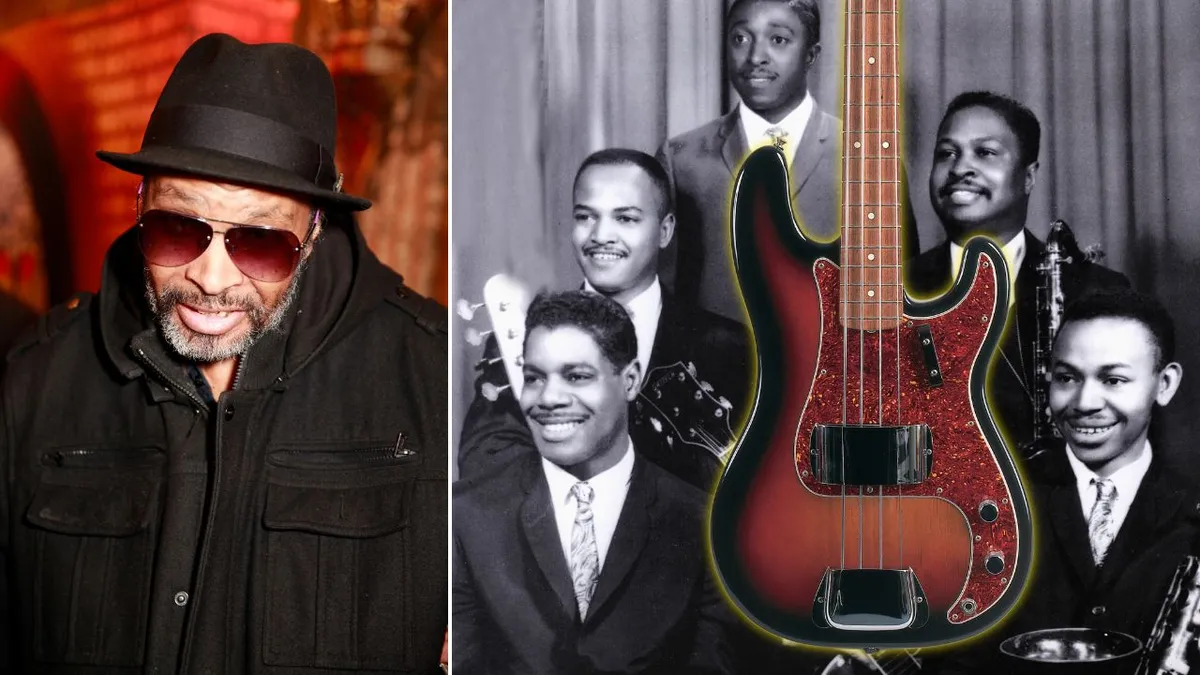
I had seen an electric at a Hank Ballard & the Midnighters dance, and a local gospel group had one--but it really didn't register until I saw a bass in the movie Rock, Rock, Rock. Shortly after that, my mother and I went over to a local music store that had a '57 P-Bass in the window. This was 1961, and the owner was elated because it had been hanging there for four years. I got the bass and a 50-watt Fender Bassman 2x12 amp, all for $375.

From that point, the sky opened up. I was the only guy in the area with a Fender bass, so I became very busy. Between the sound and the look, the bass gave a lot of attention to bands I played in; people would come by just to see it. And when acts from Detroit or Chicago came through town and needed someone to play it, everyone would steer them to me. That's how I landed my first major gig with [saxophonist] Big Jay McNeely. Someone told him about me, and I didn't have a phone, so he came and knocked on my door.

WL: Talk about opportunity knocking!

Up until that point, I had been using a pick--but I wasn't able to play some of the things I was hearing, so I threw it away and switched to plucking with my thumb. But I had trouble swinging with my thumb; I couldn't get the accents on my walking lines, and I couldn't play descending triplets--so I switched to my index finger.

WL: Who were your early bass influences?

I had heard a number of blues artists, like Elmore James and Muddy Waters, and they would always have a second guitar sort of playing a bass line. When Jimmy Smith's The Sermon [Blue Note] came out in 1958, I listened to it over and over because his organ bass lines were so clear and strong. I was also checking out great upright bassists, like Keter Betts, Ray Brown, and Percy Heath.

Everything changed when I heard Motown on the radio. In terms of me playing bass, Jamerson gave me the keys to get into the house. In those days, I had to play a lot of Top-40 music, which meant a lot of Motown--and every time I had to learn one of James's lines, it would kick me in the butt and open my eyes a little wider. That really motivated me to study and evaluate what could be done with the instrument. Even though later events contributed to my approach on the instrument, I would certainly describe myself as a Jamerson-type bassist. I have a lot of his motion and sound in my style.

WL: Did you ever get to know Jamerson?

I knew who he was as far back as 1959, because the Motown acts used to tour all around the Great Lakes area. We first met at a huge concert in Ohio in the early '60s; I was playing with Big Jay McNeely and he was with the Miracles. Someone in the previous band had borrowed my amp and blown the speakers--so I plugged in and just pretended to play. Afterwards, James came up and told me I should have plugged into his amp, which was right next to mine. I appreciated that, and since then I've done the same for other bassists.

We kept in touch over the years, although we didn't get to hang out regularly until we both lived in L.A. in the early '70s. When I'd go to his house, he'd always be cooking something and we would talk shop. In retrospect, when he left Detroit he might have been better off going to New York or Philly, where a lot of his crew of musicians and arrangers ended up. He never quite seemed to fit in with the L.A. crowd.

James was headstrong, but I admired him for it. He felt the upright was the real bass. I remember bringing him to B.I.T. for an electric bass clinic, and he promptly told the audience to forget the electric and learn the upright. I knew him too well to be offended, though! He also felt there would be no Fender bass if it weren't for him, and if you consider his accomplishments at Motown, he was probably right.

BP: How did you get to New York?

While I was playing with Big Jay, another saxophonist/bandleader named Sil Austin came through town looking for an electric bassist, and I was recommended. He was going to Canada and then New York, and that was all I needed to hear--anyone who was going to New York had me! Unfortunately, he lied about the stability of the band; when we got to New York in 1962, the band broke up, and I got stranded.

Sil's guitarist, Lester Young, lived uptown and let me move in with him. Lester played a lot of hotel gigs all over the city, and eventually I became his bassist. At that time [saxophonist] King Curtis was very prominent on the scene, and he was the kind of guy who knew all the musicians--especially the new ones in town. I used to go see his band and daydream about being the bassist. One night, I was playing a supper club with Lester, and Curtis walked past me and said, "Yeah--Chuck Rainey." Lester turned to me and said, "He wants you in his band." Sure enough, on the next break Curtis asked Lester about me, and they ended up switching bassists.

I can now state unequivocally that my stay with King Curtis was the greatest musical experience of my career. He was the ultimate leader and showman, and the baddest tenor player of them all. And his band was revered wherever we went. Although we played mostly Top 40, we also covered everything from the blues to Ornette Coleman, and we never had an off night.

WL: One of your more notable King Curtis gigs was a cross-country tour with the Beatles in 1965. What was that like?

Unbelievable! Curtis was hired to open the shows with a couple of songs and then back up about six artists; then there were two English bands, including the Hollies, and the Beatles would play the last hour. Initially we weren't familiar with the Beatles, so we had no idea of their magnitude until the first show in front of a packed house of screaming fans at Shea Stadium. From there it snowballed. We had a police escort all the way down to the Spectrum in Philadelphia. Then we started flying on special chartered jets, and wherever we landed there were thousands of people waiting. I remember the plane once screeching to a halt and everyone being thrown forward, because the crowd had broken down the fence and was attacking the plane! Anytime we would pass a part of the audience on our way to the stage, people would be scratching at us, pulling our hair, tearing off pieces of clothing--and we were just the opening band! It became routine to see hundreds of passed-out girls laid out in designated areas.

WL: Did you meet the lads?

For some reason, Paul and Ringo were very rude; they stayed on a separate floor in the hotels and in their own part of the plane, and they never talked to anybody. John and George, on the other hand, always hung out. They told jokes, played cards, and were always in our part of the plane or bringing champagne to our hotel rooms. I must say that as a band they were impeccable; we gained the utmost respect for them. They sang in perfect harmony, and the guitars, bass, and drums were right on.

BP: How did you get into the studio scene?

After the Beatles tour, King Curtis broke up the band for personal reasons. I got a road gig with Sam Cooke, and Eric Gale was the guitarist. Eric and I hit it off, and when we got back to New York he told me if I got a consistent phone number he would call me for studio dates. He was contracting a lot of sessions, and he often played guitar and bass to earn double scale--but he preferred to play just guitar with a live rhythm section instead of overdubbing it. Eric also felt there were too many older musicians in the studios; he and [drummer] Bernard Purdie were younger and played with more energy, and they wanted to bring in more younger players. At age 26, I fit the bill.

Eric started me on demos so the other musicians could get used to me; from there, I started doing actual record dates, including a lot of singles. I couldn't even tell you the first hit record I played on, because we were churning out so many singles. I came in at the end of the vocal-group era, with artists like the Four Seasons, the Ronnettes, and the Shirelles.

WL: You gave R&B, and groove playing in general, a fresh sound--and an approach on which I've humbly based my entire career. Would you say your style came together in New York?

Without a doubt. In New York, the drummers were playing with a 16th-note feel; that awakened a similar rhythmic sense in me, rooted in both my drum and bugle-corps background and my exposure to rag music early on. I hear all the stuff between the notes when I play--like the tuba's funky two-feel in a Dixieland brass band, or the high-tom parts in a drum corps. All those in-between rhythms and ghost notes provide the nuances that give a groove that swinging, push-pull feel. In Detroit, Benny Benjamin and Pistol Allen weren't playing as busily as the New York drummers--so I was able to clearly hear all of those rhythms coming from Jamerson.

I've always described myself as a busy player, but not "busy" as in playing a lot of notes. I'm rhythmically active--almost like a drummer playing bass.

BP: Is this also the period when you developed your back-and-forth plucking technique with your right index finger?

Yes--that evolved from doing long sessions at Atlantic Studios with Eric, Bernard, and [keyboardist] Paul Griffin. We would work to the point where my finger would get tired and stiffen up; I couldn't stop playing, so I started moving my finger back and forth on the strings to keep up. Eventually I got good at it, and a successful style developed.

It never occurred to me to use two fingers until the early '80s, when I worked that into my playing as well. Similarly, before I started slapping with my thumb the conventional way, I would pat the strings with my right-hand palm for the same effect. I should add that the '60s was also when I really got my reading together. The two things that kicked my butt the most were sight-reading high ledger-line passages, and Latin bass lines written in cut time.

WL: I hear you loud and clear there. I've always wanted to ask you about the chordal stuff you play in the upper register, like your classic tritone lick on Roberta Flack's "Reverend Lee" [Chapter Two, Atlantic].

I got that from a bassist named Mervin Brunson, who followed me in King Curtis's band and who later worked with Larry Coryell. I walked into Small's in Harlem one night while Don Gardner and DeeDee Ford were singing a ballad, and Mervin threw in a riff that ended with a high G and B against his open A string, for an Am9-type chord. That slayed me! I immediately split and went back to my room, grabbed my bass, and worked it out; from there, I started figuring out all the other chordal possibilities. The hardest part about using chords was learning when not to play them!

BP: Who were your favorite rhythm sections in New York?

One was led by Gary McFarland, with Donald McDonald on drums and Warren Bernhardt on piano; another was with drummers Gary Chester and Herb Lovelle, and guitarists Vinnie Bell and Al Caiola. I did the most sessions--literally thousands--with Bernard, Eric, Paul Griffin, and Carl Lynch on second guitar; that would sometimes be altered to include Jimmy Johnson on drums or Richard Tee on piano. My first-call subs were Jerry Jemmott and Gordon Edwards, who were great bassists in their own right, of course. As for my all-time favorite section, it would have to be the one with Bernard, Eric, and Paul Griffin or Richard Tee.

WL: That section became legendary as Aretha Franklin's recording and touring band. What stands out about that period?

Aretha's brilliant singing, as well as the band's ability to thoroughly kick ass every time we played. The tours in the early '70s were some of the most exciting times of my life. What I'll always remember are the opening moments of those shows: The house would be dark while the sound system blared the theme from 2001: A Space Odyssey. Then Aretha would walk out onstage in her gown and furs, and we would play the first few notes of "Rock Steady." The crowd would go insane, and I would feel the blood rushing to my head!

WL: On the first session I ever did with Bernard Purdie, I noticed he listened to the song and let the melody and lyrics dictate his drum part, as opposed to just bashing away. That forever changed the way I approached my role. Is that how the two of you came up with your grooves?

Absolutely--it was all based on the song and the artist. We would try to create a groove that would both complement and serve the melody and the lyric. I wouldn't just try to lock into Bernard's kick pattern; I'd listen to the rhythm of his whole kit, and I'd find something to play off. Fortunately, we had a special chemistry, so everything would fall into place pretty easily. Back in those days, an artist would sing the song as many times as was needed to get a take. Sometimes Bernard would ask for a certain section to be sung over and over until we all felt comfortable with our parts.

BP: Aside from your leaving Dreams, what led you to move to Los Angeles?

The first time I ever saw L.A. was at the end of the Beatles tour; I was captivated by the lifestyle, and I knew I'd live there someday. What set everything into motion in 1972 was a call Quincy Jones made to me and Eric Gale. We had just recorded Walking in Space with him, and he was putting together a 24-piece jazz band in L.A. I began by commuting to rehearsals, and each week I'd end up staying a little longer before returning to New York. Finally, in June 1972, I gave up my Manhattan apartment and moved to L.A. permanently.

I started doing sessions for Quincy, and because of that, a lot of producers and contractors began calling me. Motown called with work as well, since many of the artists and musicians knew me from back in the Great Lakes area, and they had two studios going around the clock. On top of that there was the weather, the beaches, the convenience of driving right to a session and parking my car, and--of course--the fact that I was getting double and triple scale.

WL: How did the L.A. session scene differ from New York's?

A lot of the bassists played with a pick, so they had a clicky, twangier sound. I switched to roundwound strings, and I even had a DeArmond pickup installed by the bridge of my P-Bass for a while to get more of that snappy tone. But it wasn't just the bass players; the whole sound coming off the board was much brighter than in New York. On the business side, there were a few ploys I didn't care for. If someone wanted you on a record date and another person on the project wanted a different bassist, sometimes that person would call and book you on a bogus session that took place at the same time. Then, when he got the player he wanted, he'd cancel you on the fake session, and you would end up with nothing. The other hassle I ran into was bassists--and I mean notable bassists--taking credit for something I had played on. I was sort of a maverick in town, because I worked as an independent contractor, and I refused to be pushed into any cliques. Overall, though, I have fond memories of my time in L.A. The only downside was that my chops suffered, because I wasn't working as much or enjoying the playing as much as I did in New York.

I had the honor of playing with many great drummers in L.A., such as Earl Palmer, Hal Blaine, and Johnny Guerin. Probably my favorite experiences were working with Jeff Porcaro or Bernard Purdie; the two of them were perfect. Some drummers were stiff and played in a way that demanded you follow them, but Jeff and Bernard were loose, and they played with nuance. They went with the flow and never forced you to play in a certain way. I got to work with both of them on the Steely Dan albums.

WL: How did you like working with [Steely Dan's] Walter Becker and Donald Fagen?

Overall, it was quite pleasurable. They had great budgets, which meant they paid well and always had great musicians and sound people involved. They never kept you more than six hours, and half the time you did nothing. On top of that, they're great writers, so the music was always interesting. As for the bass lines, Walter would either write parts or have ideas for most of the songs, but he and Donald always gave me plenty of creative freedom. An example would be "Peg" [on Aja]: Walter came up with the verse bass line, but the introduction and chorus parts were mine. Looking back on their albums, I liked the first two [Pretzel Logic and Katy Lied] the least; I enjoyed The Royal Scam and Gaucho, but my favorite was Aja.

BP: Why did you leave L.A. and settle in Dallas?

I entered a down period in my life, and when I landed on my feet again, I was in Dallas. It was an interesting path. Initially, I left L.A. in 1979 when my first marriage broke up; I went on a tour of Japan with [trumpeter] Terumasa Hino, which returned to New York. There, I put together my own band and played clubs--but it was the early '80s, and the session scene had slowed down considerably. Soon after, I got a call from [drummer] Spider Webb to do studio work for a production company in Boulder, Colorado; Spider was married to Carol Kaye, and they were both good friends of mine. Unfortunately, they had a falling out, and Carol split--so I moved out there to take her place. After a couple of years, the work dried up and I moved back to L.A. The studio scene was still slow, but I got on a tour with [saxophonist] Hank Crawford--and when we came to Dallas to play at a club for a few nights, everything changed. I saw a lot of people I knew from New York, as well as a good friend from Newark. I also ran into friends from my college days in Tennessee. On top of all that, I met my current wife, who had come to see a Hank Crawford show. I immediately moved to Dallas and got remarried.

BP: You've written six method books, made three instructional videos, and taught at numerous schools and clinics. What motivated you to enter the educational field?

First, realizing how important my education and training were to my career. Second, recognizing consistent weaknesses in other bassists' playing. And third--back when I started out--seeing a lot of inferior educational material for the electric bass. That said, I should add I'm not completely satisfied with my instructional videos, because I had little control over the finished products. I've enjoyed my teaching stints over the years, but I'm most proud of my method books. Most bassists lack a knowledge of harmony, so my books have dealt largely with theory, harmony, and scale studies. An exception is my latest book, published by Mel Bay, called Time Signatures.

BP: Many of your peers feel they weren't properly compensated for their contributions to early hit records. What's your take?

That's revisionist history. I've never listened back to any of the hits I played on and thought, I should have gotten a piece of that or been paid more, because I wasn't there under those circumstances. I'm a sideman--that's my role--and I'm usually paid very well for it. Generally, an artist hires you to get information and creativity from you, and then they pay you back by hiring you again and again. I also never look for a writing credit; if someone offers it, fine--but I'll always do my best. Now, I'm sure there are plenty of musicians with legitimate complaints about artists who went back on their word or who blatantly lied, and I completely support them. But there are musicians who don't seem to understand that all an artist wants is a bass player, not a bassist/producer/writer who walks into a date and starts asking too many questions that aren't related to the bass part.

My only gripe on the subject is that the publisher assumes the rights to my bass line, even though it's not on the original copyright of the song; as a result, I can't get permission to use my own lines in a book or instructional video without paying a fee. I didn't ask for part of the original writing credit, so at least let me have use of my own lines.

BP: Is there an intangible aspect to studio players that separates them from other great musicians, or were they just in the right place at the right time?

I think studio work is a highly specialized job; not everyone can do it. In addition to having your musicianship together, having a great feel, and being extremely versatile, you have to alter your concept of sound and get used to hearing the bass small. Then there's the whole non-musical side of it: being on time, having the proper decorum, and being able to relate to people. On the other hand, I'm certain there were bassists around who were just as qualified or even more qualified than I was, but for whatever reason they were unable to crack the scene.

Whatever the situation or level you're playing at, my feeling is you've got to be a strong player. Bass is a strong instrument; you can't allow yourself to play it weakly, with no authority. You've got to play with an attitude, because everybody's listening to the bass--and I dare anyone to challenge me on that. When you listen to a record, the melody and lyrics may be obvious, but what you really hear the most is the bass.

WL: Who are your favorite bassists?

There are so many I admire, from when I started right up to the many brilliant young players today. To name one would mean leaving out a dozen. But the three who stand out for me are Jamerson, Buster Williams--my all-time favorite upright bassist--and Paul Jackson. Paul is probably the baddest cat I've ever seen on the electric, and he sings as well as anyone out there. People associate him with the Headhunters, but that wasn't the true Paul; I heard him prior to that in his native Oakland. The bass players from there--Larry Graham and Rocco Prestia, to name a couple--have a special approach to music. Paul lives in Japan now, and I've seen him the last two times I've been on tours over there.

WL: You seem to have chosen a similar path for your own future.

That's correct. Working with longtime clients and meeting new artists and producers as a sideman is something I hope to do always, but I'm also working on my own project. I would describe it as a contemporary jazz-fusion instrumental record featuring the bass--although it's not an album of bass solos. I've got a lot of music in my head, and I think I have much to offer in the way of melodies. The reason I'm so dissatisfied with my past solo records is I was always pushed to finish them or had to compromise in some way. This time, I'll have complete autonomy on all decisions, from the musical content to the sound of my bass in the mix, because I've assembled my own studio. I also want to put together a band and go out on the road, the way artists like George Benson, Joe Sample, and Herbie Mann do. People have heard my bass for years--now I want them to hear my music.


Leave a Comment
Name:
Location:
Average Rating :
 

Alan Parsons Art and Science of Sound Recording Series

The New Golden Age Of Metal, The Complete Interviews

William Murderface Of Dethklok

Steve DiGiorgio, Extreme Metal Session Ace

Sharlee D’angelo of Arch Enemy


What's your take on modern metal?
 
Subscribe Live Bookmarks Advertise Contact Us Privacy Policy Terms & Conditions


Bass Player is a trademark of New Bay Media, LLC. All material published on www.bassplayer.com is copyrighted @2009 by New Bay Media, LLC. All rights reserved