The Great Bass Amps Of The 60s

 
David Hicks


Although the bass guitar was introduced in 1951, bass amplifiers lagged far behind. For a decade, bassists had to make do with guitar (or accordion) amps ill-suited to reproducing low-frequency sounds. Even the early Fender bass amps, including the ’59 Bassman 4x10, had open-back enclosures that produced little more than a muddy approximation of the instrument’s true sound. Finally, in the early 1960s, engineers began to turn their attention to the problem of amplifying this “new” instrument. Let’s take a look at some of the more memorable designs they came up with during that turbulent decade.

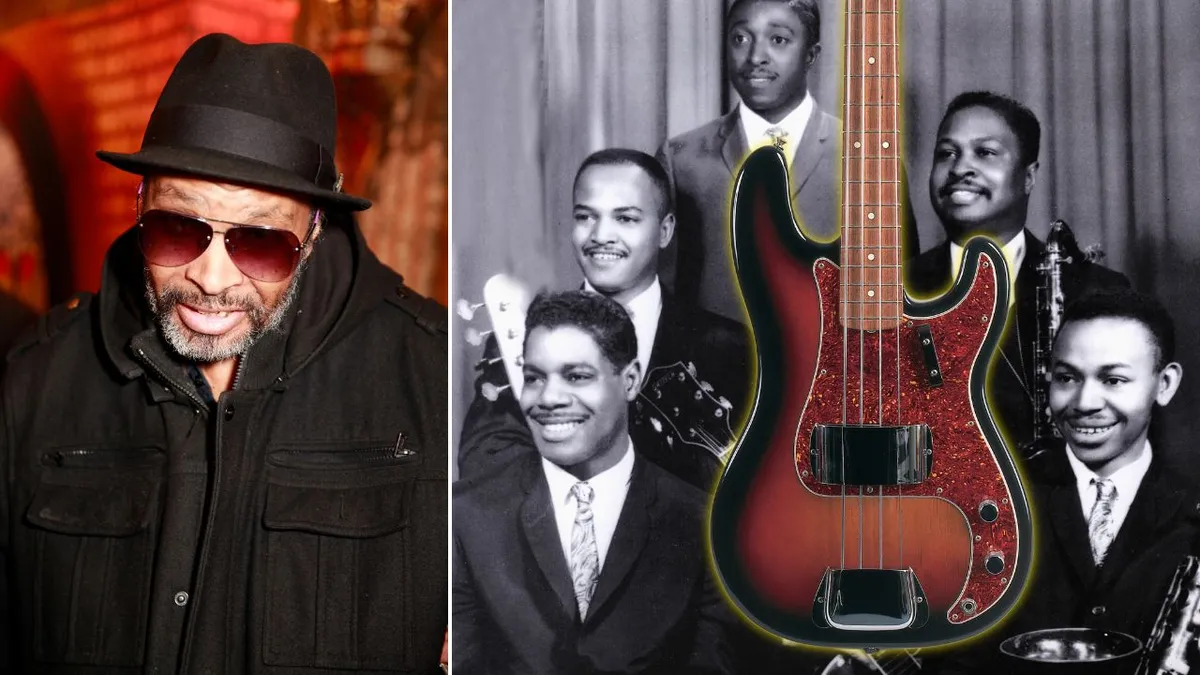
Some of the greatest bass lines ever recorded were played by Motown’s James Jamerson, who used a Fender Precision and the Ampeg B-15N Portaflex. The design of this great little amp placed a premium on compactness, and it featured an amp head that fit neatly inside the speaker cabinet for transport and then flipped up and over for use. The amplifier chassis was attached to a mounting board that locked securely in either position, and it had a carrying handle on one side. To minimize vibration and interaction between the amp and speaker, the chassis sat atop four rubber shock mounts. A rubber gasket around the top edge of the speaker box provided further isolation and sealed the speaker system. The B-15N also came with a detachable 4-wheel dolly that screwed onto the bottom of the enclosure.

The amplifier itself was a two-channel, all-tube unit. Channel one included two input jacks, labeled GUITAR and BASS, while channel two had one input marked INST; each channel had a volume control and passive treble and bass controls. The power-amp section could produce approximately 35 watts RMS into Ampeg’s custom-design 15" 8Ohm speaker. The sealed speaker system was well matched to the amplifier, and it provided respectable volume and smooth tone for recording or small clubs. Ampeg put a lot of thought into this amp, combining simple and reliable electronic design with an innovative enclosure. Although it’s a bit bulky by modern standards, the B-15N remains a model for efficient design and great sound.

Fender Bassman

As the mid-’60s neared, a phenomenon called the “British Invasion” occurred. Suddenly, everybody was learning to play guitar, bass, or drums, and combos were forming in every town across the nation. While many of the English groups were using strange gear made by Vox, most music stores in the U.S. featured amps manufactured in California by Fender. At this time, Leo and company had some 15 years of amp-building experience under their belts, and they were building what proved to be perhaps the most durable—and desirable—amplifiers ever made. In 1964, if you were serious about your music, your amp of choice was a “blackface” Fender Bassman (so called because of the black paint on its front panel).

This amp featured the relatively new (at the time) piggyback design, with separate amp head and speaker bottom, which provided flexibility as well as an illusion of size. (While some of the Fender piggyback amps had tilt-back legs and fasteners to attach the head, no self-respecting rock player of the era set his speaker bottom on its side!) The Bassman’s all-tube amplifier design included dual channels, one marked BASS and the other NORMAL—implying, one assumes, that playing bass was somehow abnormal. Each channel had volume, treble, and bass controls, as well as individual voicing and preamp designs for optimum sound with bass or guitar/microphone. And, as the popularity of electric music continued to expand, the 50-watt power section and pair of heavy-duty 12" speakers set the standard for bass. The tone was pretty good—all of a sudden, you could hear the bass guitar, without a lot of buzz or distortion. At the time, it was the ultimate in bass gear.

Vox Beatle and Super Beatle

During the late ’60s, almost every form of popular music was expanding rapidly. For musical-equipment manufacturers, this meant more sales, more research and development, more and better products. The extreme popularity of electric music made it inevitable that amplifiers would become more versatile, and the size of the audiences made it necessary that they become more powerful.

In Britain, Vox had introduced the AC100, later to be known as the “Beatle” after the Fab Four used them on their 1965 tour. It was a plain-jane, single-channel tube amp with 100 watts of power and a huge 4x12 (plus two high-frequency horns) speaker enclosure suspended on a chromed, roll-around stand. While the Beatle was designed as a guitar amp, Paul McCartney used the head with an earlier Vox T.60 bass cabinet (1x15 + 1x12) on the tour.

In the mid-’60s, the owners of Vox entered into a licensing agreement with Thomas Organ of California to design and distribute solid-state amplifiers worldwide. While many vintage enthusiasts vehemently dislike these amps, they helped to introduce modern transistor technology to the field. The top-of-the-line amp in the new line was also dubbed the “Beatle,” and the name was later changed to “Super Beatle” to distinguish it from the British tube model.

The “Super Beatle” had a three-channel preamp with effects built into the circuitry—a truly novel idea at the time. These crude signal processors included an active midrange boost (MRB), tremolo, fuzztone, REPEAT PERCUSSION (which made the sound “chatter” like a machine gun), and—for the bass guitar channel—a single control called TONE-X, which provided active filtering of the tone between a mushy deep bass and an edgy, high-frequency sound. The power amplifier section boasted a 240-watt (“peak power”) transistor amp with limiting circuitry intended to prevent transistor clipping at full power. The speaker cabinet was identical to the British 4x12, and (at least for a while) included the same speaker components.

Acoustic 360

In the late ’60s, as venues grew ever larger and technology continued to advance, bass amplifier design began to mature. To provide the high output required for proper bass reproduction, designers at a new company called Acoustic Control Corporation attacked the challenge from two directions.

First, to minimize the amplifier overload caused by high-volume playing, they designed a 200-watt RMS solid-state power amplifier. Although using high-power amplifiers for low frequency reproduction with low distortion became de rigeur in the mid-’70s, it was a bold design step at the time. Then, taking a page from high-fidelity speaker designers, Acoustic’s engineers produced a folded-horn speaker enclosure loaded with a massive 18" driver. Besides extending the useful frequency response of the amp, this design was more efficient than sealed-box systems. Again, while such enclosures had been used for years in large theatre sound systems, this was new for an instrument amp. The large (48" x 24" x 18") speaker cabinet featured e" plywood with sturdy tongue-and-groove construction, and it was equipped with dual handles and casters for “dolly-like” handling.

The 360’s power amp was located in the bottom of the speaker enclosure, and the head contained only the one-channel preamp, designed for bass use exclusively. Front-panel controls included a BRIGHT/NORMAL switch and knobs for volume, treble, bass, VARIAMP, fuzztone, and an electronic tuning fork. (Remember: There were no handheld tuners in those days.) The bass and treble controls were boost-only circuits, so full-off was flat, and the VARIAMP controls constituted what was, in effect, the first on-board parametric equalizer: the RANGE knob provided a choice of one of five single-octave frequency ranges, which could then be cut or boosted with the EFFECT control.

Since the projection of the folded-horn box made it noticeably louder at a distance than onstage, an output jack (with crossover) was included for an additional speaker system to extend and smooth the mid- and high-frequency capabilities. The Acoustic 360 featured better low-frequency response, less distortion, and greater efficiency than anything on the market at the time, and it was the first truly professional-quality bass amplifier.

Fender 400 PS

Not long after the introduction of the Acoustic 360, Fender decided to approach the market in a similar way but to use tube technology rather than transistors. In doing so, they came up with one of the most gargantuan amps ever built. At the time, however, bigger was assumed to be better, so the extreme size of the 400 PS didn’t seem as outrageous then as it does now.

This amp had a folded-horn speaker system, with a heavy-duty 18" speaker in a W-type cabinet very similar to Acoustic’s, including tilt-back handles and casters for (relatively) easy hauling. While the Fender speaker system was actually a little lighter than the Acoustic (120 pounds vs. 150 pounds), the head was another story. It was rated at an astounding 440 watts RMS, and the enormous transformers required to produce this much tube power made up a major part of its back-breaking weight: nearly 90 pounds. Like the 360, the 400’s speaker system suffered on the high end, so the power amp featured multiple output taps to power up to three speaker systems for improved sound.

While this huge rig was obviously designed for bass guitar, the preamp section provided controls for both bass and guitar, with features nearly identical to those offered on the Bassman and Twin Reverb. Channel one (BASS) had volume, bass, and treble controls, plus a DEEP switch, while channel two (NORMAL) added a midrange control, reverb depth, vibrato intensity and speed controls, and a BRIGHT switch. The design of the preamps was essentially identical to that of Fender’s earlier amplifiers. Although the passive EQ controls suffer when compared to modern active types, this amp nonetheless featured the clear sound reproduction made famous by Fender.

Ampeg SVT

The Acoustic 360 and Fender 400 amps pointed the way in designing a high-fidelity bass amplifier, but each had its problems. While the 360 featured high power, many players favored a tube sound (the debate still rages), and both amps missed the mark for good stage presence and attack. In 1969, someone finally came up with an amp/speaker combination that had it all.

By using multiple 10" speakers (eight per cabinet), Ampeg produced a closed-box speaker system with sufficient speaker-cone area and compliance to reproduce the lowest frequencies while maintaining the superior high-frequency response characteristic of smaller drivers. And, because it had special 32Ohm speakers connected in parallel, the cabinet had an operating impedance of 4Ohm. Two of these huge enclosures were included in an SVT system—with earth-shaking results.

Much like the Fender 400, Ampeg’s piggyback head featured dual channels and an abundance of tube power. The preamp section had different tube types in each channel for various combinations of gain and equalization. Channels 1 and 2 included controls for volume, treble, and bass, plus switches for ULTRA LOW (–, 0, +) and ULTRA HIGH (0 and +). Channel 1 also had a midrange selector switch (220Hz, 800Hz, 3000Hz) in tandem with the midrange control, constituting a parametric equalizer. And, because of its circuit design, the SVT power amp could produce a full 300 watts RMS into any designated single or multiple load. As with the Fender 400, tube design required the head to be large (11" x 23" x 14") and heavy (82 pounds).

Soon after the introduction of the SVT, its punchy response (especially when combined with roundwound strings) became one of the de facto standards for bass-guitar sound. The SVT’s combination of low distortion and tight, controlled sound reproduction was (and is) the delight of many bassists. It’s very much to the credit of its designers that many of these amps are still in use more than 20 years later. Only in the last few years, with the re-emergence of expensive, high-power tube amps and the introduction of improved speaker systems (notably the 4x10 designs that owe their origins to the SVT) have bass players had new systems that compare to the SVT. Truly it was the benchmark for bass amps!


Leave a Comment
Name:
Location:
Average Rating :
Dave Hughes Austin, Texas
Does anyone know what the real, usable frequency response of the Acoustic 360's 18" w-fold cabinet is was? I'm really interested in this information, and if anyone has any such data on that cabinet, I'd really appreciate an email at dlhughes001@juno.com Thanks! Dave
 

Andy Irvine’s Thunder Dome

Questions With Suzi Quatro

Timothy B. Schmit: Up & Down The Highway

Nashville Amp Expo, August 21-22. Demo gear without volume restrictions!

Godlyke Power-Grip Pedalboard Tape


What does your typical practice routine involve?
 
Subscribe Live Bookmarks Advertise Contact Us Privacy Policy Terms & Conditions


Bass Player is a trademark of New Bay Media, LLC. All material published on www.bassplayer.com is copyrighted @2009 by New Bay Media, LLC. All rights reserved